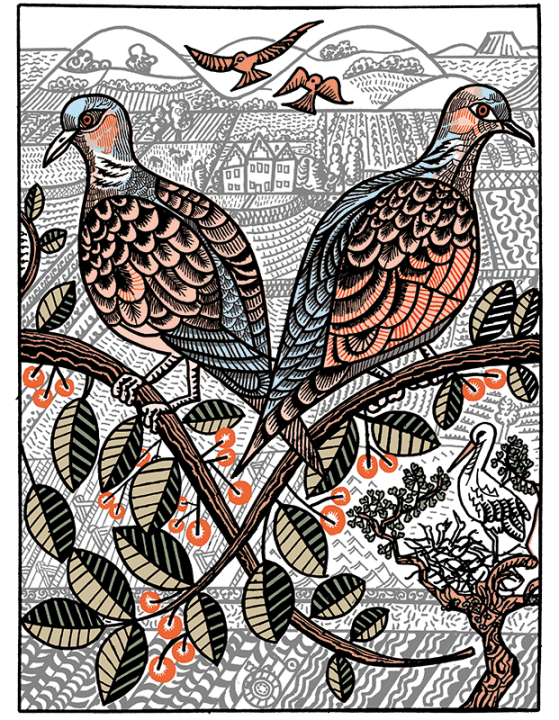

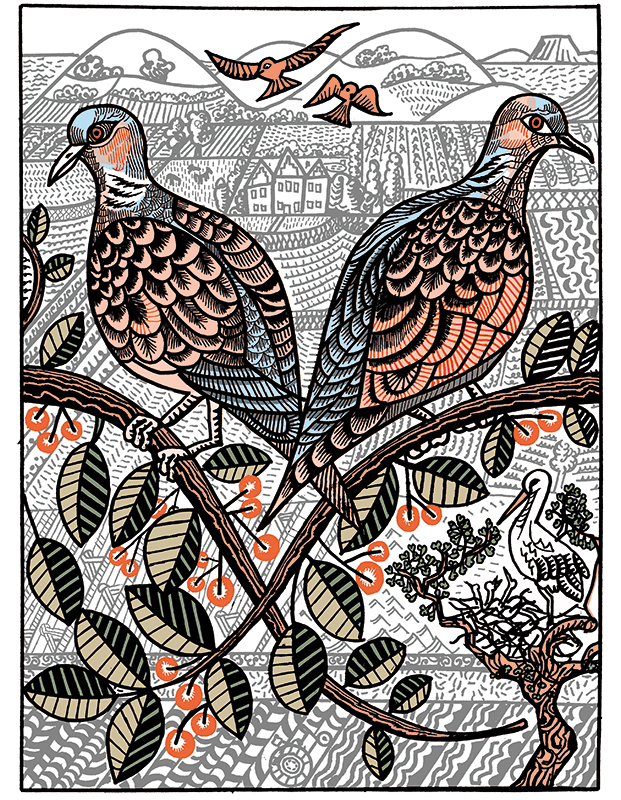
In the latest success story for reintroducing species to the British countryside, turtle doves, reared in captivity and released at three locations in Somerset and Devon last year, have returned to breed. Turtle doves have steeply declined in numbers, hanging on in the south and east of the country, but this scheme opens a new front in the battle to save the species as a British summer visitor.
In May 2025, 244 captive-bred turtle doves were set free across three sites. Like others of their species, they spent the winter in Africa but a handful found their way back to southwest England this summer.
Reintroductions like this are now all the rage among conservationists because it is a policy that can have spectacular results. Red kites, sea eagles, cranes and storks have returned to throng British skies after becoming extinct (or nearly so in the case of kites). Golden eagles have expanded their range in southern Scotland and black grouse in the North York Moors as a result of reintroductions from other parts of Britain.
Plus, of course, in the world of mammals, wild boar are rampaging through the Forest of Dean, beavers are being released all over the place, pine martens are being moved into new areas and there’s talk of lynx. Nor is the reintroduction craze confined to vertebrates. The large blue butterfly went extinct in Britain in 1979 but was brought back four years later and currently survives at 33 sites across the south of England.
Is reintroduction rewilding? No, I don’t think it is. That word means letting land go back to nature of its own accord, hands off. Yet the turtle dove scheme is badged as a rewilding effort and the white storks are a flagship species for Knepp Estate, the nation’s most famous rewilding project. At Knepp, the rebounding populations of nightingales and purple emperor butterflies are indeed examples of what hands-off rewilding can achieve, but the storks are surely an example of something else: human interference to undo the deleterious effects of previous human interference.
My point is not a semantic one. It is to argue that the best nature conservation, in a landscape vastly altered by human beings, requires active human intervention, not passive neglect. We know this from the most successful of all “managed wilding” projects, which is heather moorland, home to huge numbers of the British Isles’s only endemic bird species, the red grouse, alongside thriving endangered curlews, heaps of rare sphagnum mosses and plenty of other wildlife.
This is achieved by the very opposite of leaving the landscape alone: private landowners graze, burn and cut the vegetation to create a mosaic of habitats for the birds and mosses. Meanwhile, they relentlessly wage war on the unnatural numbers of crows, foxes and stoats that human activity has artificially encouraged – and which, if left uncontrolled, make it impossible for ground-nesting birds to breed.
In short, interference in the ecosystem is vital to achieve biodiversity and abundance. Or, as the California thinker Stewart Brand once put it: “We are as gods and might as well get good at it.” Reintroduction schemes prove the point.
Not all reintroductions are welcome. The sea eagle is a spectacular creature but putting them back in the Lake District, as is currently under discussion, would be a mistake. There is little natural prey for them so they would have to eat a lot of lambs, which to put it mildly does not thrill the local farmers, and they would probably prevent golden eagles colonizing the area. The champions of seabird colonies off west Wales and Northumberland similarly dread the return of sea eagles: one bird can panic a thousand guillemots into a stampede that takes all their eggs into the sea.
Likewise, when a few years ago some bearded weirdos tried to persuade Northumbrian sheep farmers that lynx would be cuddly additions to the local fauna, it went down badly. And wild boar are a menace to walkers, dogs and gardeners. I have often made the point that beavers are welcome on my farm but only if I am permitted to shoot them if they dam the one ditch that drains much of the low-lying land. So making them protected was a mistake. There’s no problem, say ecologists, since you can get a permit to kill a rogue beaver. How long would it take to get the permit? Probably four months. In that case forget it, I reply.
I once took a paleoecologist for a walk on my farm and he exclaimed: ‘This is crying out for a megafauna’
A heavily populated, intensively cultivated island is never going to get all its fauna back. Those who talk of wolf, bear, bison and moose in the British countryside are being unrealistic. I once took an Australian paleoecologist for a walk on my farm and as he looked at the verdant undergrowth he exclaimed: “This is crying out for a megafauna.” Mammoths are extinct, I pointed out. “Then get some elephants,” he replied.
It is time conservationists stopped being obsessed with large and predatory animals. The species I want to see brought back are smaller, less violent ones: black-tailed godwits, which now breed all over Iceland and would love parts of the Pennines; ruffs, which used to be very numerous here and could be again; red-backed shrikes, which were once common but now show up only sporadically; corncrakes, once everywhere but now found mostly on Scottish islands; wrynecks, which ceased breeding here some years ago. And maybe the burbot, a small freshwater fish related to cod that was last seen in England in 1969.
And then one day, great auks. These -penguin-sized, flightless fish-eating birds are globally extinct. But we have sequenced the genome from guts preserved in spirit in Copenhagen, and it will surely soon be possible to edit the genome of the closely related razorbill into that of the great auk and rear a chick in a laboratory. I would give my right arm to see them swimming off the Farne Islands before I die.



Comments