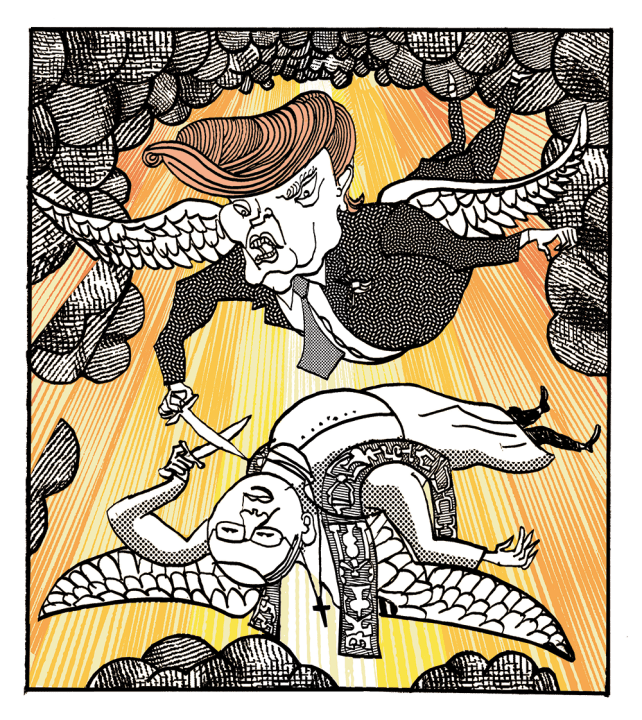


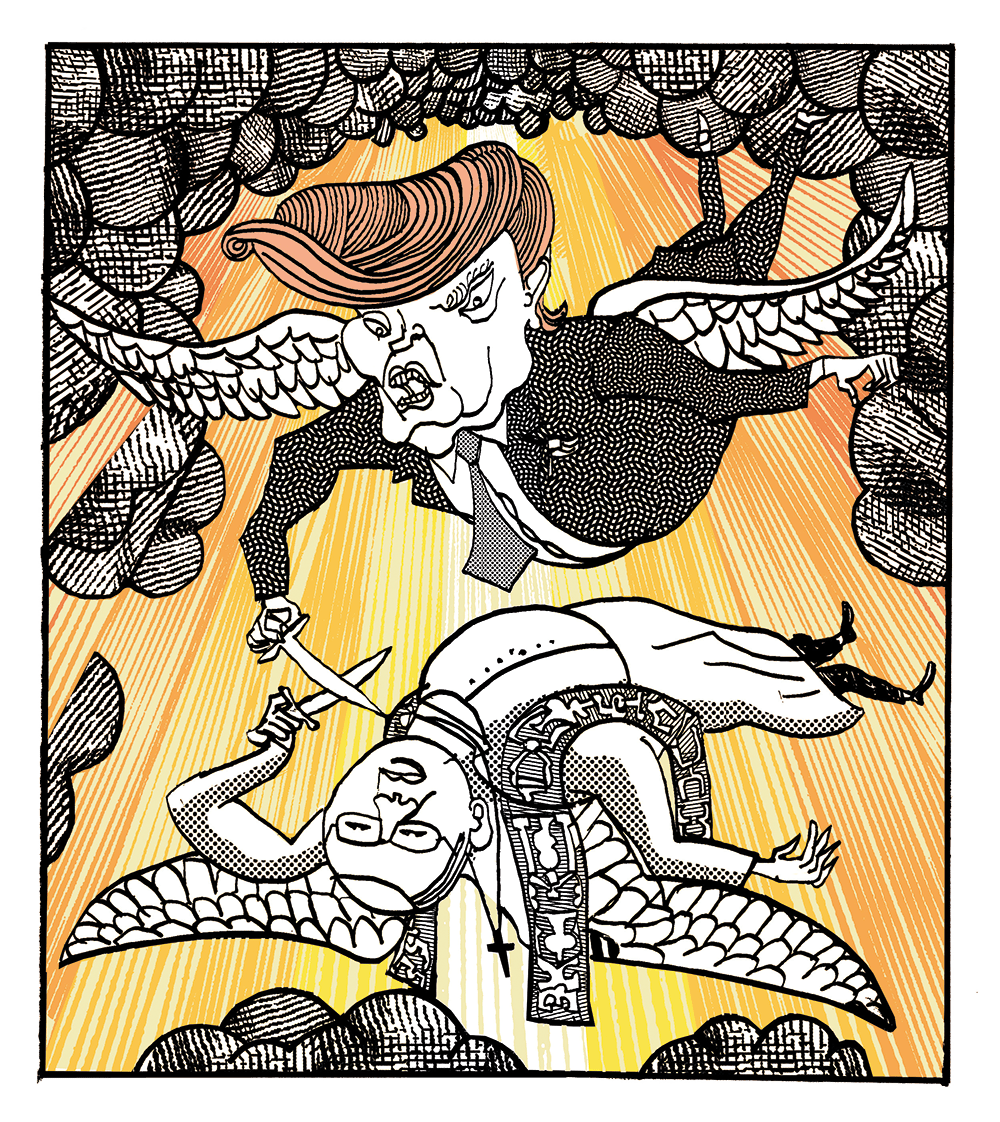
Donald Trump’s latest clash with the Catholic Church stunned even the most hardened veterans of culture-war Twitter. According to the President of the United States, the Chicago-born Pope Leo XIV, the conspicuously holy spiritual leader of 1.3 billion people, is ‘WEAK on crime and terrible on foreign policy’. He also claimed that ‘if I wasn’t in the White House, Leo wouldn’t be in the Vatican’.
For commentators accustomed to the fog of modern diplomatic platitudes, such trash-talk was the equivalent of a Holy Roman Emperor hurling insults at a medieval pontiff. In the year 963, for example, the Emperor Otto I accused Pope John XII of fornicating with his own niece, ‘making the sacred palace a whorehouse’ while he drunkenly murdered his enemies and consecrated a ten-year-old bishop.
Trump’s rhetoric may have been mild in comparison, but the fact remains that not once in the 250-year history of the United States has a Commander in Chief launched a personal attack on the Supreme Pontiff.
Catholics wield unprecedented influence in the administration of this most secular of presidents
Trump didn’t stop there. Less than an hour after eviscerating Leo, he posted an AI-generated image of himself dressed like Jesus, healing a sick person with his messianic touch, the Stars and Stripes billowing, onlookers gazing adoringly, American eagles and planes flying overhead. It was as if the President, not content with outraging Catholics by lashing out at the Vicar of Christ, was also determined to alienate Protestants with a blast of outright blasphemy.
All this just months away from midterm elections that no one expects to be a GOP landslide, in which the President’s party must cling on to Catholic voters, among whom the Pope enjoys an 84 per cent approval rating.
The uproar was predictably deafening. ‘Not even Hitler or Mussolini attacked the Pope so directly and publicly,’ said Massimo Faggioli, an Italian church historian and former professor at the Catholic Villanova University in Pennsylvania. That wasn’t surprising: Faggioli, once close to Pope Francis, is a seasoned Trump-hater. More significantly, the president of the US Catholic bishops, Archbishop Paul Coakley, said he was ‘disheartened that the President chose to write such disparaging words about the Holy Father’ – a carefully worded statement that failed to conceal his cold fury.
Meanwhile, conservative Catholics, already split by the Iran war into isolationist and interventionist camps, issued anguished denunciations. CatholicVote.org, the conservative nonprofit credited with delivering millions of votes for Trump in successive elections, declared that the image of Trump as Jesus ‘is blasphemous and we condemn it’. Its president, Kelsey Reinhardt, tweeted that: ‘President Trump’s post insulting Pope Leo crossed again a line of decorum that plays an important part in diplomacy and sets the temperature for interactions between the two. Calls for an apology are well founded.’ Trump refused to apologise, though he did delete the post with the image.
Yet what has become clear is that Trump’s outburst, while startling, was not out of the blue. In fact, the reaction from CatholicVote speaks volumes about the dramatic breakdown in relations between the Vatican and the White House. The organisation was co-founded by the Catholic political activist Brian Burch, its president until last year. He’s now the American ambassador to the Holy See. ‘He has been very nervous recently,’ says one insider. ‘This has put him in a really horrible position.’
It’s not just Burch, however. The events of the past week have reminded us that Catholics wield unprecedented influence in the administration of this most secular of presidents. Vice-President J.D. Vance is a passionate convert and Secretary of State Marco Rubio is a devout Mass-goer. But they are also rivals who attract support from different factions in the fractured world of conservative American Catholicism.
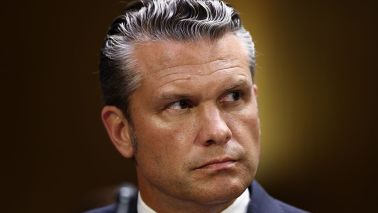
Last week an article in the Free Press by the Italian journalist Mattia Ferraresi broke the story of a heated closed-door meeting between Pentagon officials and the papal nuncio to the United States, Cardinal Christophe Pierre. Details were sparse, but US sources described ‘frank exchanges’ over American foreign policy and the Vatican’s perceived meddling. Democrats immediately spun it into conspiracy theories about the Pentagon threatening military action against the Holy See. No such threat was made, of course. But Vatican diplomats are telling colleagues in Rome that Pentagon officials lost their temper with Pierre.
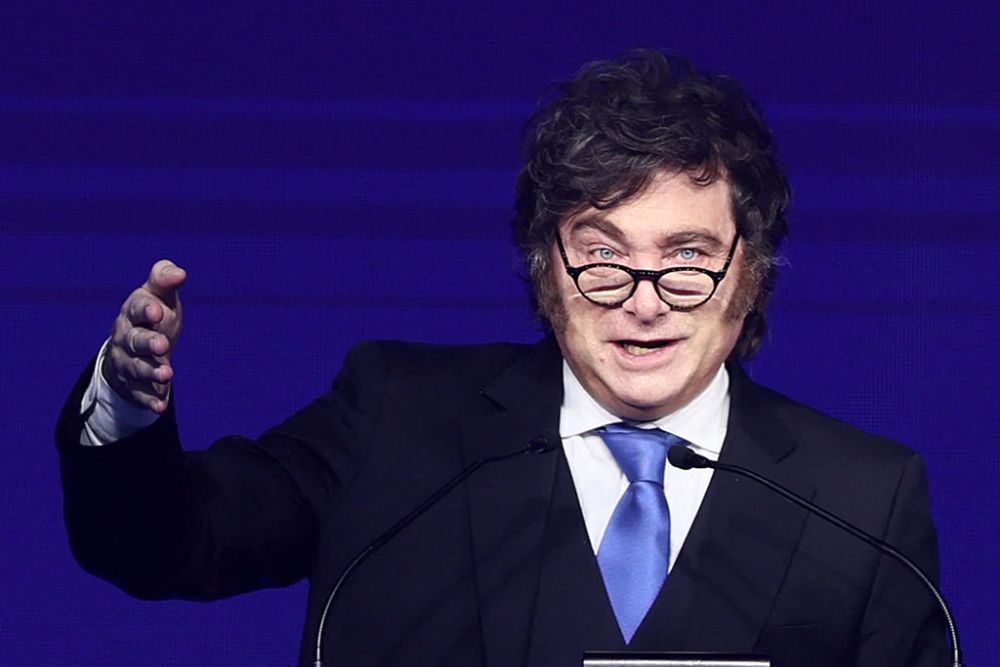
According to one source, relations between the White House and the Holy See have been deteriorating since Leo’s election last May and took a nosedive in December when the administration updated its National Security Strategy. This unveiled the so-called ‘Donroe Doctrine’ – a new, hard-edged emphasis on the Monroe Doctrine that asserts American political and economic supremacy over the entire western hemisphere.
This is where we shouldn’t dismiss President Trump’s belief that Pope Leo was elected in order to clip his wings. The Latin American cardinals knew that Robert Prevost, for decades a missionary and then a bishop in Peru, identified as much with South as North America. ‘The political and philosophical aggressiveness towards a part of the world very dear to the new Holy Father went down very badly,’ says a source.
Paradoxically, matters were hindered, not helped, by the sophisticated Catholic orthodoxy of J.D. Vance. The Vice President has talked extensively about the inspiration he draws from St Augustine. Leo is an authority on the saint and a former head of the Augustinian order. Vance appears to have believed that he was uniquely qualified to handle the new pontificate. If so, he was soon put right. Even before Leo was elected pope he had clashed with Vance on the subject of how Augustine’s teaching applied to Christian ethics. In February last year he retweeted from his (now defunct) private X account @drprevost an article with the headline: ‘JD Vance is wrong: Jesus doesn’t ask us to rank our love for others.’
Undeterred, when the Vice President visited the Pope in May he presented him with copies of Augustine’s City of God and On Christian Doctrine – a curious gesture, all things considered. And, according to one insider with contacts within both the White House and the Vatican, the meeting with Cardinal Pierre reflected Vance’s continuing ambition to handle relations with the Holy See. That is why it was held in the Pentagon, where he wields far more influence than in the Secretariat of State.
The leak of the disastrous ‘frank exchanges’ at that meeting, followed immediately by Trump’s anti-Leo tirade, must have been excruciating for the Vice President. Worse was to come. On Monday it was Vance, not Rubio, who was wheeled out to defend the President’s criticism of the Pope. ‘I certainly think it would be best for the Vatican to stick to matters of morality, to stick to matters of, you know, what’s going on in the Catholic Church and let the President of the United States stick to defending American public policy,’ he said.
On Tuesday Vance dug the hole even deeper. Drawn into a discussion about Leo’s admittedly hard-to-interpret statement that Jesus ‘is never on the side of those who once wielded the sword and today drop bombs’, he opined that: ‘It’s very, very important for the Pope to be careful when he talks about matters of theology.’
To grasp how agonising this must have been for the Vice President, we need to understand that he belongs to the so-called ‘post-liberal’ school of Catholic thought that treats papal authority with extreme reverence. Presumably, Trump decided that it was Vance who should sweat in front of the cameras. If so, he was really twisting the knife.
Making sense of this chaos is quite a challenge. If Trump’s strategy is mysterious, so is Leo’s, even if he does express himself with infinitely greater subtlety. Why has he said so little about Iran’s slaughter of tens of thousands of its own citizens? His opposition to the Iran war, and especially Trump’s horrifying threat to wipe out a whole civilisation, enjoys overwhelming support among the world’s Catholics. But before this conflict, at a time when Trump was playing the role of peacemaker, the Vatican appeared to interpret every action by the United States in the worst possible light, reawakening memories of Pope Francis’s crude anti-Americanism.
But here we risk falling into the trap of lumping together Francis and Leo. This Pope is more theologically orthodox than his predecessor, and brighter. On Tuesday the website Catholic Culture carried a perceptive article by Peter Wolfgang, a Catholic advocate for family values, under the headline ‘Memo to Trump and the non-Catholic Right: Leo isn’t Francis’.
Vance belongs to the ‘postliberal’ school of Catholic thought that treats papal authority with reverence
Wolfgang, an opponent of the Iran war, wrote that he understood some of Trump’s frustration with the Pope, and especially with his baffling decision to meet the Obama cheerleader David Axelrod – a move that is thought to have made Trump apoplectic. Combine that with intriguingly timed leaks about diplomatic spats between the Vatican and Washington, plus a big interview on CBS’s 60 Minutes (a show Trump watches) featuring three left-wing American cardinals criticising the war on Iran, and it’s not surprising that senior Republicans spy a Democratic ‘op’ to woo back Catholic voters ahead of the midterms.
Wolfgang’s main point, however, was that ‘attacking Leo is not like attacking Francis, because conservative Catholics actually like and respect Leo. What Trump and the right assumed would play like their long-running disputes with Pope Francis instead misfired. Leo’s moral emphasis on peace, service and Gospel teaching resonates with a broad range of Catholics, including many on the right… His moral authority cuts across traditional partisan lines, which is why attacks on him are a form of political malpractice’.
In other words, Leo is more formidable than Francis, whose juvenile sniping at the United States was easy for Trump to exploit. The American Pope is completely unruffled by middle-of-the-night outbursts from the West Wing. Cynics might say that, having surreptitiously poked the bear in the White House, he is enjoying the opportunity to exhibit his Christian serenity.
What is beyond doubt is that global enthusiasm for the Pope extends far beyond his own gigantic constituency. He may even win the Nobel Peace Prize. Just imagine the Truth Social post if that happens.
Damian Thompson and Freddy Gray discuss Trump’s row with the Pope on this special Holy Smoke – Americano podcast collaboration:



Comments