
A chess game can run you ragged in myriad ways, but in my experience the most exacting ingredient is neither the length of the game nor the strength of the opposition. Rather, it’s the sensation of walking a tightrope, knowing that even a minor misstep can make the difference between winning and losing.
I played one such game for England at the recent Olympiad in Samarkand. Mine was the last to finish in a hard-fought match against Georgia, and I was heartened by fighting back from the brink of defeat in the early middlegame. But with less than a minute on the clock, I was struggling to fathom the position below, where the d7-pawn is useful but firmly blockaded, while the h3-pawn looks nimble. My opponent played the move which both frightened and excited me. I had an ambitious counter-idea up my sleeve, but I could scarcely believe it would work.
Luke McShane (England)– Luca Paichadze (Georgia)
Fide Olympiad, Samarkand, September 2026
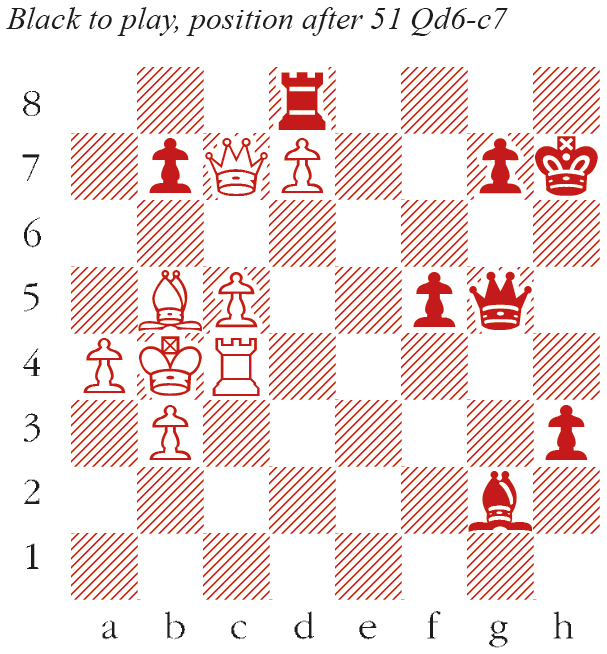
51…f4? Instead, 61…Qe7 is complicated but dynamically balanced. 52 Rxf4! 52 Qxf4 Qxf4 53 Rxf4 hopes for 53…h2 54 Rh4+, but after 53…g5! it will be the h-pawn which triumphs. h2 53 Bd3+ Kh8 54 Rf5! After 30 seconds’ thought, I couldn’t see anything else worth trying. Qh4+ Giving check, defending d8, and supporting the h-pawn. What more could you ask? In fact, the immediate 54…h1=Q was equally plausible, but after 55 Rxg5 Qh4+ 56 Bc4 Qxg5 57 Qh2+ Qh6 58 Qxg2 Rxd7 59 Qe4! Rd8 60 Qxb7 White should win in the long run, as the queenside pawns will roll forward. 55 Ka3 h1=Q Black is a whole queen up, but now comes the trick I had hoped for when I snatched the pawn on f4. 56 Rh5+! A shocking sacrifice while already a queen down, but 56…Qxh5 57 Qxd8 is mate, so Black has no choice. Kg8 57 Bc4+ Bd5 The alternatives are no better: 57…Kf8 58 Qd6+ Qe7 59 Rf5 mate, or 57…Qxc4 58 Qxd8+ Kf7 59 Qe8+ Kf6 60 d8=Q mate. 58 Bxd5+ Qxd5 59 Rxd5 Two pawns up, the rest is a formality. Qf6 60 Qxb7 Qa1+ 61 Kb4 Qe1+ 62 Kb5 Qe2+ 63 Kc6 Kf7 64 Qb5 Qf3 65 Qd3 Black resigns
Thus, a 2.5-1.5 victory to England in this match from the fifth round, which concluded a solid start to our campaign. The next phase was tougher, as we drew with France but lost narrowly against India (one of the strongest teams) as well as Uzbekistan’s second team, filled with a dangerous set of youngsters. But a strong finish of three match victories (against Peru, Belarus and Italy) propelled us up the standings, and tying for 8th place with four other teams was closely in line with our seeding (11th).
The women’s team also performed well, finishing in a group of 16 teams tied for 12th place, and comfortably above their seeding (20th) when taking into account the standard tiebreak method. The Nona Gaprindashvili Trophy, named in honour of the former women’s world champion, is awarded to the country with the highest combined placing across the Open and Women’s sections. India won it for the third time running, but England’s 11th place was an excellent result, and our best since at least 2000.
Notably, England’s women’s team were led by 11-year-old Bodhana Sivanandan on top board, whose superb individual performance in Samarkand (8 points from 11 games) means that she qualifies as the youngest Woman Grandmaster in history, and takes an important step towards the next big milestone: the International Master title.





Comments