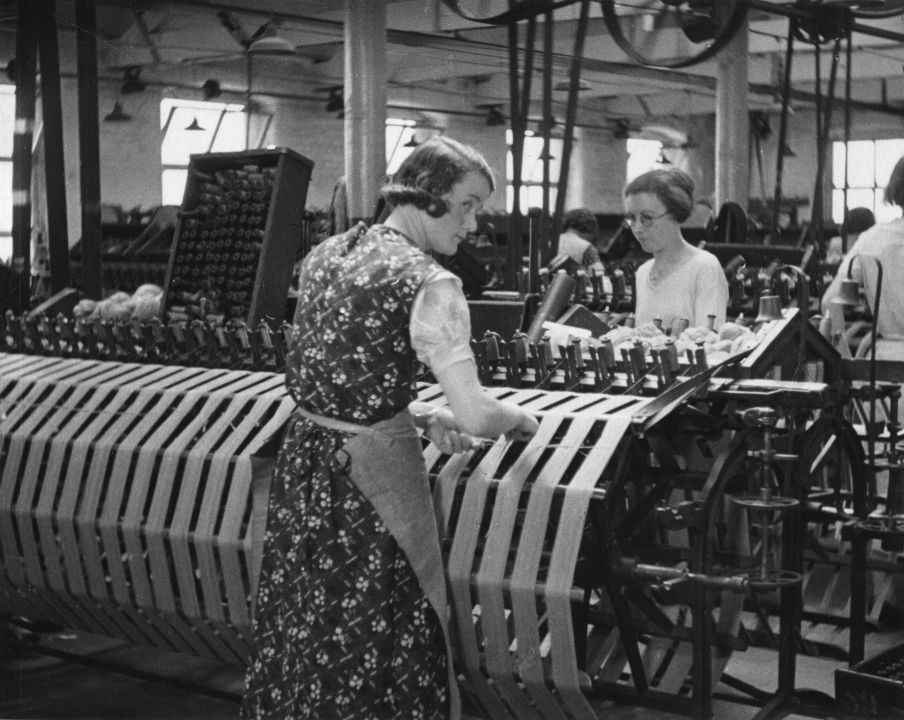
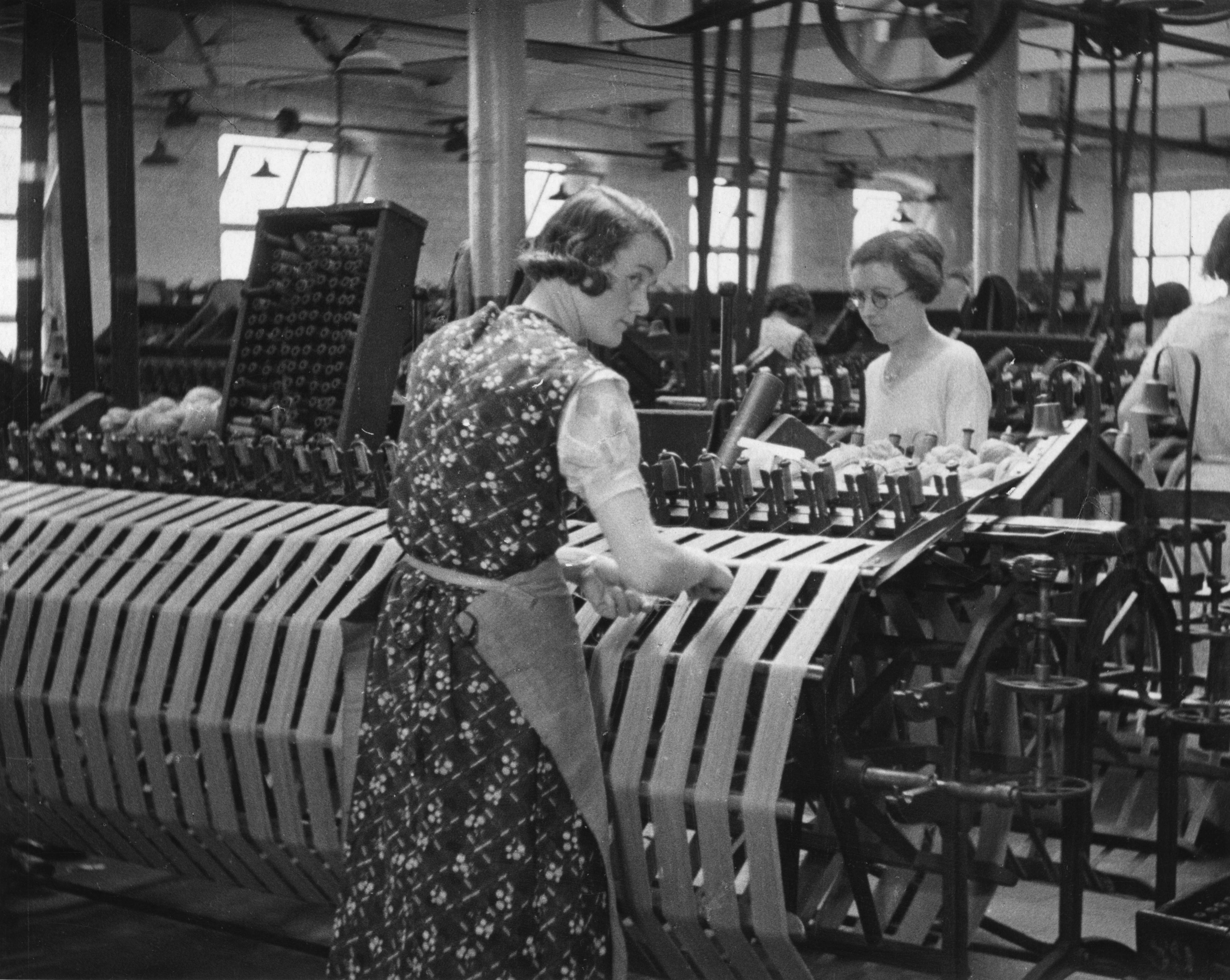
Her name, let us say, is Mary Ann McCready. She is eleven-years-old when she first walks through the gate at six in the morning. The hooter has already gone. Her mother walked her to the mill from a kitchen-house off the Grosvenor Road: a two-up, two-down with six children in one room and an outside privy shared with the next terrace. Mary Ann is a half-timer. She does school until noon, the mill until six. She is paid two shillings a week.
By 13 she is full-time. By 15 she is a spinner at the wet frames, which means she stands ten hours a day in a room kept at ninety degrees Fahrenheit, with the windows shut – barefoot on flooded boards, her apron soaked through, the air thick with a fine vegetable dust that settles on her tongue and in her lungs – and never leaves. The women call it pouce. The doctors, later, will call it ‘byssinosis’. The frames are so loud that the spinners learn to lip-read across the aisles, and so the women of her street will be famously deaf into old age, shouting at each other on the doorsteps on Sunday afternoons.
She marries at the age of 19. Like her mum, she has six children, two buried before they walk. She is back at the frames a fortnight after each birth. She coughs blood for the first time at 34-years-old. Her chest sounds, her sister says, like ‘wet paper tearing’. She dies at 41. She is buried in Milltown Cemetery in a grave she shares with three others. There is no stone.
It is, very obviously, a tragic story. But it is one that could have come from many decades and places during the Industrial Revolution. So why am I telling you the particular story of Mary Ann? Because I think you should buy what she made. Which is Ulster linen. And specifically, I think you should buy Ulster linen tea towels. Here’s why.
For most of my adult life, like most people, I dried my wine glasses on cotton tea towels. That is to say: I dried them on something that leaves lint, needs ironing, and starts degrading immediately. A cotton tea towel is at its best on the day of purchase. By month six, it is a rag. Year two, you chuck it out.
A linen tea towel, by contrast, does the opposite. Linen is one of the few things on earth – alongside some houses, most churches, a handful of travel writers – that gets better with age and use. A linen tea towel is at its worst on day one – slightly stiff and resistant – and improves every time you wash it. The fibres bloom, the drape softens, the absorbency deepens. After 50 washes it is more like silk. After 500 washes it is close to perfect: cool, soft and yielding and capable of polishing a whisky tumbler to invisibility in one pass. I have towels in active use that are older than I am.
Professional kitchens know this, indeed they have multiple linen tea towels so they can use them as often as possible. The French call this system torchon – it means a deep bench of linen cloths in rotation: two or three in use per evening, one over the shoulder, another on the bench, dirty ones into the wash. You need at least a dozen to do it properly. I have, at last count, 22.
By now you might be thinking: how on earth do I get them? Which brings me to eBay. The strange and glorious thing about Ulster linen tea towels – and I mean the proper ones, woven in Belfast or Lurgan or Lisburn, often from Irish-grown flax, and printed with pleasing imperial patriotism – think British birds, Gurkha symbols, maps of Cornwall, royal weddings — is that they are currently being sold, on eBay, for the price of a London pint. Eight quid. Ten quid. £12 for something exceptional. If you want an actual tea towel from the time of Mary Ann, you can get those too, for about £30. It will be 120 years old, and it will be brilliant.
It is not just a kitchen cloth. It is one of the last surviving artefacts of the largest linen civilisation in human history
The other reason you should buy them – wherever you find them – is what they represent. The most recent tea towels date from the 1990s, and they are the last gasp of what was, between roughly 1880 and 1920, the largest linen industry on earth. This is the time Belfast was linenopolis: a city of mills, bleach greens, weaving sheds and shipyards: exporting linen to every continent, and dressing the world’s tables, beds, altars and ballrooms.
At its peak, the Ulster linen trade made roughly a third of the world’s finest cloth. The great York Street Mill alone employed 5000 people. The whole industry employed 70,000 people, the majority of them women – the millies – and the trade was so dominant that the word linen and the word Irish were, for two generations of buyers from New York to Calcutta, effectively the same word.
It is all gone now. The mills are apartments. The looms were broken up for scrap in the 1980s and 1990s when cheap cotton and synthetics finally killed what flax dust, emigration and war had not. Ulster Weavers still exists as a brand, but most of what it sells now is cotton printed in Asia. The actual industry – Irish flax, retted in Irish water, scutched and hackled and spun and woven and printed in Irish towns – is essentially extinct.
Which is why that Ulster tea towel in your hand, if you buy one, really matters. It is not just a kitchen cloth. It is one of the last surviving artefacts of the largest linen civilisation in human history, and it was made by thousands of barefoot women, who stood in flooded rooms breathing pouce until their lungs gave out, so that the British Empire could dry its glasses – and you can have one for a few quid. And every time you wash it, it gets better, and every time you use it, you honour the toil of Mary Ann McCready, as she was not honoured in her life.




Comments