
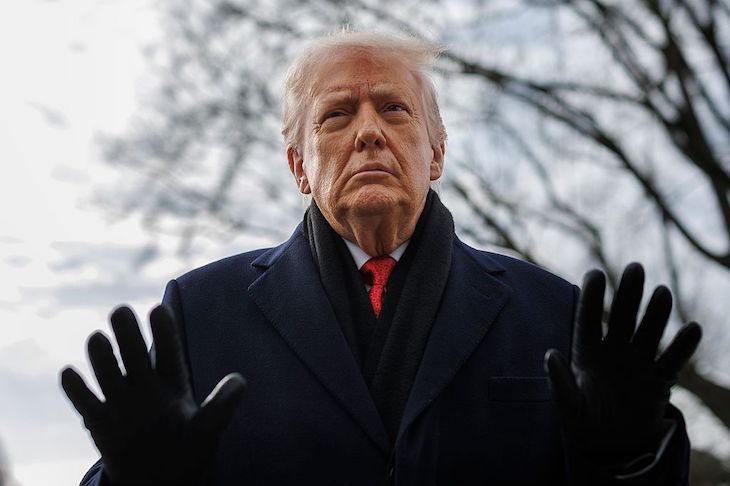
I am, as often, lost in admiration for my colleague Freddy Gray. Whenever Donald Trump does something that looks, on the face of it, like a toddler tantrum backed by the world’s largest nuclear arsenal, and announces said tantrum in an erratically capitalised screed on Truth Social – and when the world responds as one to this apparent tantrum with utter bewilderment – Freddy is there with one finger raised sagely. Let’s take a pause, he says. Let’s look at what this really means. And then he explains, in a wholly plausible and authoritative manner, that the president is actually doing something bold and well-calculated – albeit characteristically dramatic – to secure the long-term strategic interests of the United States. Trump knows exactly what he’s doing, Freddy says. The bewilderment is all part of the plan.
The president of the United States is not playing four-dimensional chess with long-term global politics but, rather, is a complete maniac
There he was again this weekend, unpacking the out-of-nowhere announcement that president Trump would be levying 10 per cent tariffs on any country that raised objections to the US acquiring the sovereign territory of an ally, and upping them to 25 per cent if they didn’t give him what he wanted by early summer. It was a humdinger. Sure, Trump wants Greenland, says Freddy – and that has to do with the Golden Dome missile defence project – but you need to look at the bigger picture. The timing, ahead of Trump’s meeting with European leaders at Davos, is ‘probably no coincidence’. What’s more, ‘it’s also about business’, and ‘the greater game is to do with the wider world’.
All this is level and ingenious and, I do not deny, points to some serious strategic realities; the pragmatic and transactional foreign policy agenda of this White House, a chilly realignment of the postwar world order into one of hard-power spheres of influence and so forth. We can make jokey reference to the Donroe Doctrine, nod sagely about the Arctic being the new Baltic, mutter about Greenland’s untapped mineral resources and steeple our fingers. And were the man in the White House Henry Kissinger, I might even be persuaded.
I would humbly offer the following counter-point: that this thing that walks like a duck, quacks like a duck, has feathers and would taste excellent with a piquant orange sauce is, in fact, a duck. The president of the United States is not playing four-dimensional chess with long-term global politics but, rather, is a complete maniac. That the way we should understand this, as all his actions, is that they proceed not from careful calculation but from a rampaging id at the service of a vast and fragile ego, a seething rage at ever being told no – and that the explanation jokingly offered that he’s obsessed with Greenland because it looks disproportionately big on a Mercator projection has a non-zero chance of being true.
This view, I’m pleased to say, these days appears to unite everyone from Daniel Hannan to Owen Jones, the leaders of every major European country (even Sir Keir Starmer has found the stones to pipe up), and – to take a dip into the BTL comments – the sensible majority of readers of this magazine. Weighing against the argument that all this stuff is carefully calculated is the fact that a) Trump’s Nato allies are perfectly prepared to let him build his wretched missile bases on Greenland if he wants to, and that b) raising arbitrary tariffs on Europe’s trade with America and destroying Nato is an economic suicide bomb and benefits exactly the putative enemies he claims to want Greenland in order to defend against.
Occam’s razor applies. A man who the evidence seems to suggest can’t read his own briefing papers, let alone a history book or a primer on global economics, is not one we can imagine having mastered the subtleties of the geopolitical situation. He’s very much a vibes man. Far from thinking three moves ahead, if my account of the situation is correct, our man is more likely to be wondering how many of the pieces on the chessboard he can fit into his mouth. To interpret his actions and pronouncements as if they correspond to a coherent worldview seems to me to be a category error, the cognitive equivalent of seeing faces in clouds or reading the future by means of goat entrails. I’m cast back to Dominic Cummings’s funny remark about coming into government: ‘You might think somewhere there must be a quiet calm centre like in a James Bond move where you open the door and there is where the ninjas are who actually know what they are doing. There are no ninjas. There is no door.’
I say this not simply to reiterate that Orange Man Bad, but because for the bewildered world leaders – and my goodness one feels for the Danish prime minister — knowing how to respond depends on seeing clearly what you’re responding to. Is it a question of strategy or of psychology? The so-called ‘Madman Theory’ of Richard Nixon’s Cold War policy depended on encouraging the enemy to think that there was a maniac in charge. No good, I dare venture, will come for any of us from having an actual maniac in charge. And unless some compelling evidence to the contrary is presented, it looks like that’s exactly where we are.

Comments