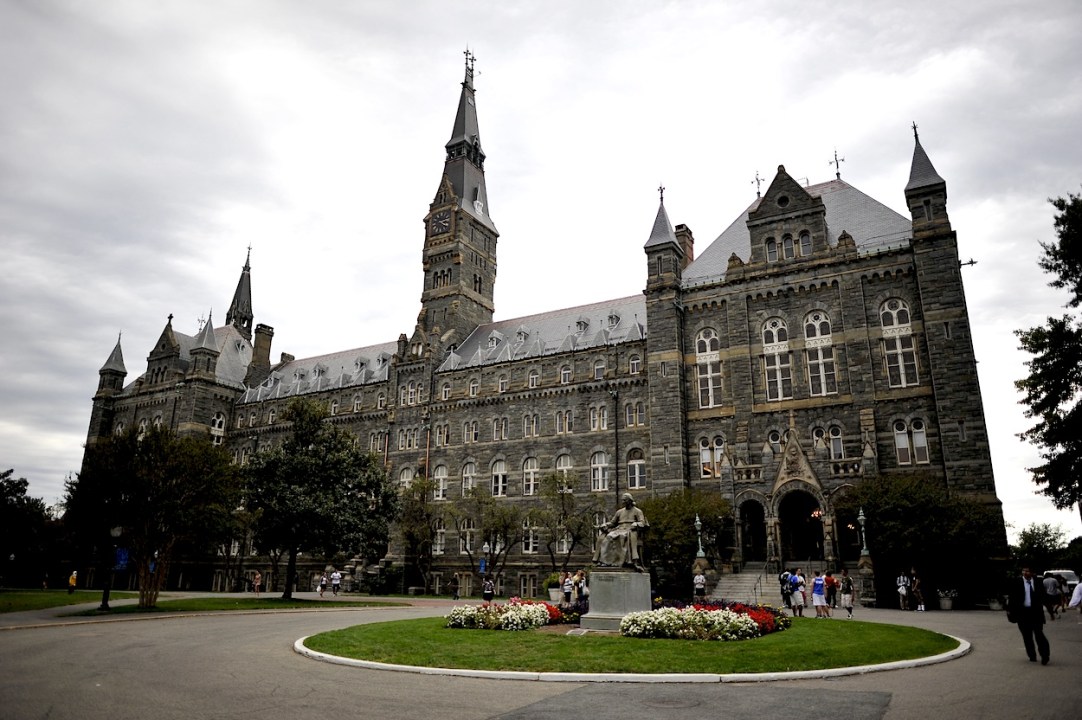
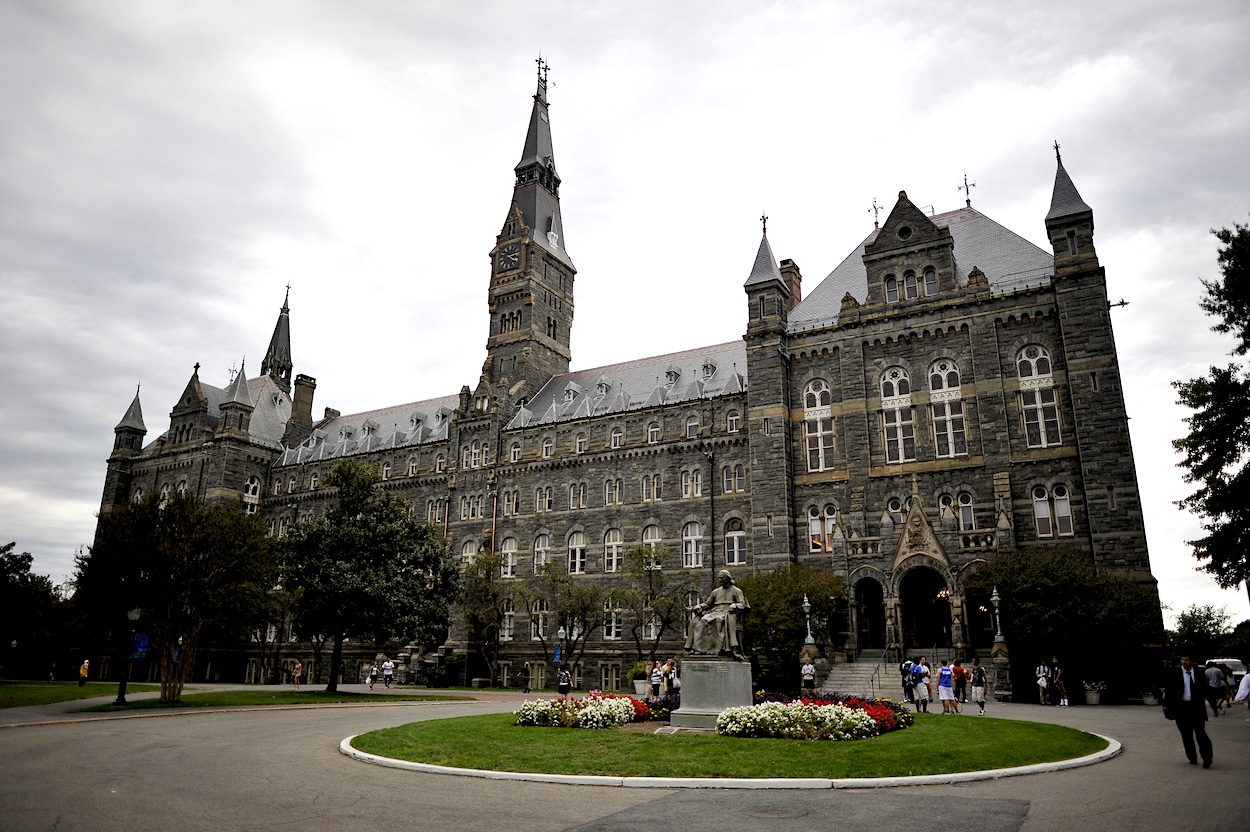
Many readers of The Spectator will never have heard of John Esposito, who died in Philadelphia on 15 July. Why should they? At various times he was a professor of religious, international, Middle Eastern and Islamic studies, first at the College of the Holy Cross in Massachusetts and then at Georgetown University in Washington DC, where he was also director of the Prince Alwaleed bin Talal Center for Muslim-Christian Understanding. As a side-hustle, he was editor-in-chief of – inter alia – The Oxford Encyclopedia of the Islamic World, The Oxford Dictionary of Islam and The Oxford History of Islam. Another packed, worthy and pro bono academic career, you might think, even if much of it was spent labouring for little thanks in the stony interfaith vineyard.
You might very well think that. But, as the ballad singer in Brecht’s Dreigroschenoper puts it:
Denn die einen sind im Dunkeln
Und die andern sind im Licht.
Und man siehet die im Lichte
Die im Dunkeln sieht man nicht.
You see the ones in the spotlight: those in the dark, you don’t. But those are the ones you really need to watch. Esposito, for all his academic diligence, was a wilier operator behind the scenes than in the spotlight. And he ensured he was amply thanked by those he helped.
He was a paradox: a devout Catholic whose passing Islamists and their sympathisers mourned. He had studied with the Palestinian scholar, Ismail al Faruqi, an Arab Hegelian, Islamic supremacist, anti-Jewish and anti-Christian polemicist and advocate of the Islamisation of Knowledge, a concept closely associated with the Muslim Brotherhood-adjacent International Institute of Islamic Thought (IIIT). On Esposito’s death, the Prime Minister of Malaysia, Anwar Ibrahim – himself an IIIT promoter; the co-founder of the AKP and former president of Turkey, Abdullah Gul; the executive director of the Council on American Islamic Relations (CAIR), Nihad Awad; and Jonathan Brown, a Muslim convert, protégé of Esposito and the Alwaleed bin Talal chair of Islamic Civilization at Georgetown, all expressed their admiration for his defence of Islam and Islamic activism.
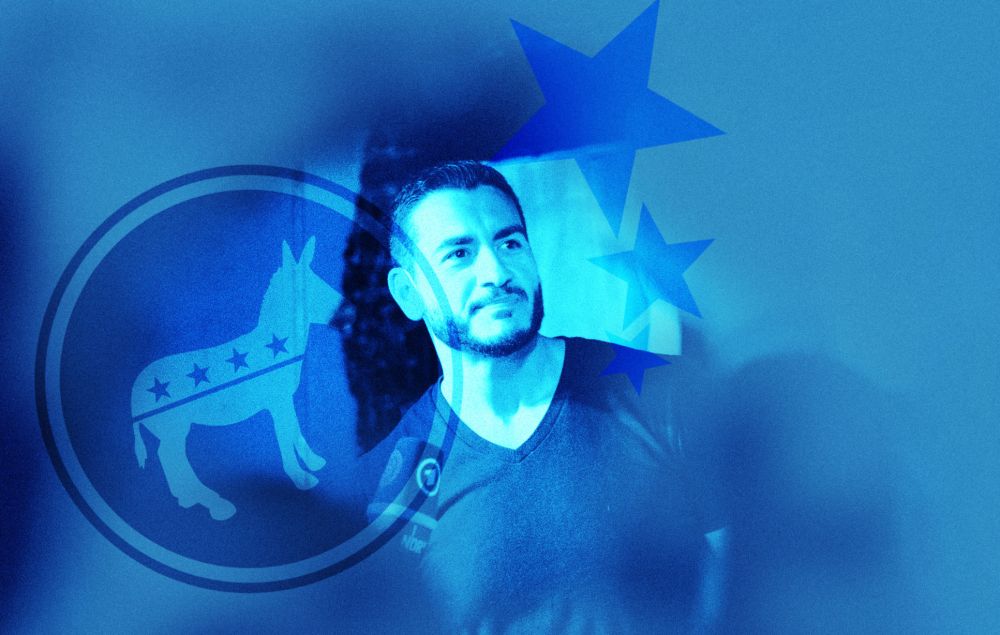
Ibrahim, Gul and Awad are all closely associated in different ways with the Muslim Brotherhood and its analogues. Brown – a serious scholar – ran into trouble in 2017 over remarks he made apparently excusing slavery in Islam and again in 2024 over remarks on Twitter which were taken as trivialising the grooming gangs scandal in the UK. In 2025, he was suspended by Georgetown for a period after calling on Iran ‘symbolically’ to attack a US base. His father-in-law, Sami al Arian, was deported from the US to Turkey in 2015 after a protracted investigation into his links with Palestinian Islamic Jihad (PIJ). And the governors of both Texas and Florida are currently seeking to ban CAIR from operating in their states by designating it as a foreign terrorist organisation. Strange company to keep, you might think, for a man whose ambition as a young man was to join the Franciscans – and who eventually taught at two Jesuit institutions.
But it wasn’t just a question of the people Esposito knew. It was also what he did. In 2007, the Holy Land Foundation for Relief and Development (HLF) was accused by the US authorities of supporting Islamist terrorism – specifically Hamas. The subsequent trials were the biggest and most searching examinations of Islamists not just in the US but anywhere outside the heartlands of Islam (where courts – ahem – accept a rather lower level of evidence).
Islamists and their allies have consistently contested the outcome. Others – including Esposito himself, who appeared as an expert witness for the defence – sought to obfuscate. The court discounted his testimony. After all, he had worked with or defended three entities which comprised the so-called Palestine Committee (PC), and which – it emerged at the trial – the Muslim Brotherhood had established in the US to help Hamas both politically and financially. He played down the significance of an internal PC document from 1991 (a version of which had also turned up after 9/11 in a search of the house in Italy of Ghaleb Himmat, a prominent Syrian MB member and close associate of his neighbour, the senior MB financier, the late Yusuf Nada) calling for a ‘civilizational jihad’ against ‘the miserable house’ of the West in order that Islam might triumph.
It was shown in court that two of Esposito’s friends, Awad and Omar Ahmed, another founder of CAIR, had attended a secret 1993 meeting to discuss ways of undermining the freshly minted Oslo Accords. A year later, Hamas launched a suicide bombing campaign in Israel, which contributed to the assassination in 1995 of Yitzhak Rabin, one of the architects of Oslo. The court documents also cited an entity called the United Association for Studies and Research (UASR), founded by Musa Abu Marzouq, a senior Hamas figure and chief fundraiser in the US, later deported to Jordan, and run by Ahmad Yousef, who became the chief Hamas spokesperson in Gaza (and whose son-in-law reportedly studies at Georgetown). Esposito co-sponsored a conference with them.
In a 2008 letter to the judge trying the case of al Arian – who only two years earlier had pleaded guilty to conspiring to provide goods and services to PIJ and serving on its board of directors – Esposito described him as ‘an extraordinarily bright, articulate scholar and intellectual-activist, a man of conscience with a strong commitment to peace and social justice’. That’s certainly one way of putting it. Those who have suffered from PIJ terrorism might take a different view.
Esposito founded the Center for Muslim-Christian Understanding at Georgetown in 1993. In 2005, after a gift of $20 million from the prominent Saudi Prince Alwaleed bin Talal, the Center, which still forms part of Georgetown’s School of Foreign Service, was renamed in his honour. Quite frankly, I never detected much understanding of or sympathy for Christianity in the Prince when I knew him in Saudi Arabia. And the Center too has displayed very little of either. But it showed the facility with which Esposito – and others like him who promote an accommodationist narrative – could raise money from rich people in the Islamic world in order to shape an apparently improving but in fact highly partisan public discourse in the West.
Even when the extent of the Hamas atrocities of 7 October 2023 became clear, and Hamas leaders gleefully publicised their millenarian ambitions, Esposito continued to argue – as he always had – that Islamist groups were legitimate political actors, used violence sparingly and with justification and could be accommodated within democratic systems.
The Muslim Brotherhood’s favourite jurist, the late Yusuf al Qaradawi, with whom Esposito also collaborated, had publicly said that Islamists did what they did not because they were poor or oppressed but because they believed the West was corrupt and the world rightfully theirs. Other Islamists have been equally frank. But Esposito never recanted. He dismissed al Qaeda as a minor nuisance. He served as a board member of Azzam Tamimi’s Institute of Islamic Political Thought – in company with Abdullah al Nafisi, a notorious Kuwaiti Islamist who in 2009 publicly proposed an anthrax attack on the US. Esposito defended Qaradawi and the London-based activist Tamimi – both of whom publicly justified suicide bombings – and praised Tariq Ramadan, the grandson of the MB’s founder, who has recently been convicted of rape in both Switzerland and France.
Policy Exchange – the think tank where I am a Senior Fellow – has consistently warned that activists will use a definition of Islamophobia to undermine free speech. When the allegations against Ramadan were first made public, his defenders in the western academy saw them as Islamophobic. That was a constant theme in Esposito’s career. In 2015 he helped transform the Bridge Initiative at Georgetown into a project dedicated to the study of Islamophobia. Thanks to a report issued in March this year by the House of Representatives Education Committee in Washington DC, we now know that in 2024, Qatar, which hosts a Georgetown campus and has supported Hamas for years, gave it $630,000. In return for this support, Qatar demanded the right to help determine both themes and speakers for conferences.
The Bridge Initiative has supported both Siraj Wahhaj, a Brooklyn Imam and unindicted alleged co-conspirator in the 1993 World Trade Center bombing, and Omar Suleiman, an American Islamic scholar who has claimed that homosexuality is a disease that destroys children. One of those who works there is Farid Hafez, an Austrian academic whose home was raided by the Austrian authorities in 2020 as part of the massive counter-terrorism investigation, Operation Luxor. No charges were brought.
He was part of a sophisticated and very well-funded influence operation
Hafez is a founder and co-editor of the highly partisan European Islamophobia Report (EIR), which pins a target on the backs of not just infidels but also liberal Muslims, such as the German writers and activists Ahmad Mansour, Seyran Ates and Saida Keller-Messahli (who have called on the European Commission to withdraw its own inexplicably generous funding of the EIR project. In the words of the House of Representatives Education Committee, the Bridge Initiative ‘purports to be a “multi-year research project on Islamophobia” but… in practice has sought to malign those who are opposed to political Islam’, and ‘defended groups instrumental to anti-Semitic terrorism, such as the Holy Land Foundation and Hamas’. Quite some bridge.
All that, I suppose, shows how you can build a career out of knowing the sort of people who like to fund the sort of things Esposito was willing to say, and persuading others that they ought to support them too – because it’s the sort of thing righteous progressives should do. In other words, he was part of a sophisticated and very well-funded influence operation. It’s hardly ad maiorem Dei gloriam – as the Jesuits who established Georgetown like to say. But if you play your cards right, you can still claim to be on the side of the angels, while Hamas, Hezbollah, PIJ and the rest of that crew go about their bloody business.
Esposito’s death – like any death – is, of course, a moment for reflection. As a fellow Catholic and product of both Maryvale and the Birmingham Oratory, I think of Cardinal Newman’s luminous epitaph, ex umbris et imaginibus in veritatem. I hope Esposito’s final journey has taken him too from the world of shadows and images towards the truth. Because when it comes to Islam, Islamists and Islamism – as with anything else – the truth really does matter.


Comments