
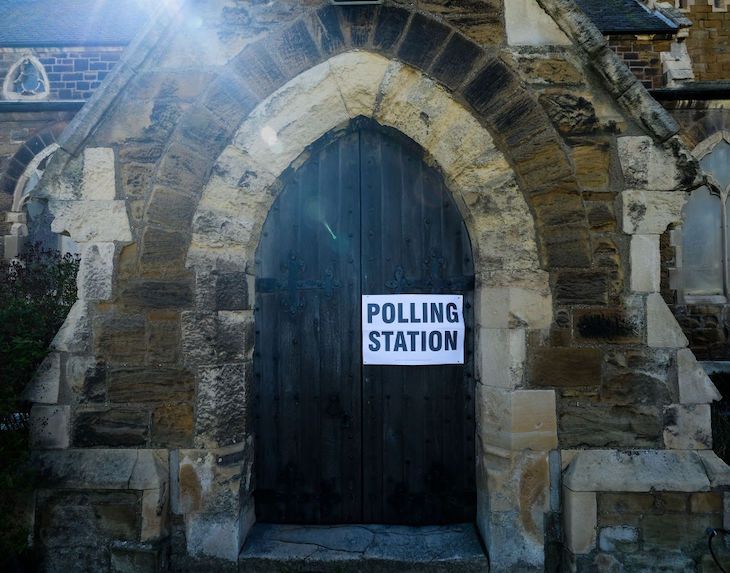
There is a big opportunity for one of the parties to show that it understands and values Britain’s Christian tradition.
You might reply that Reform has already seized that opportunity. If so, your grasp of Britain’s Christian tradition is shaky. In fact, it is Reform’s clumsy attempt at this that spurs my thoughts.
A party that rails against ‘liberalism’ and flirts with Christian nationalism is unlikely to have much understanding of Britain’s Christian tradition. What defines our religious story is the established Church, and the fact that it has developed a strong affinity with liberal values.
The Labour party has an awkward relationship with the national Church
Last year it became increasingly apparent that Reform was playing the Christian card. It appointed a theologian, James Orr, as its head of policy. It recruited Danny Kruger, who had been perhaps the most vocal conservative Christian on the Tory front bench. And it also had the allegiance of Tim Montgomerie, the most influential Tory Christian pundit and think-tanker before his move to Reform. Furthermore, Nigel Farage began to open up about his quiet Christian allegiance.
All these men identify as Anglicans. But Reform types don’t always like to sing the praises of the CofE. Farage has said bishops are ‘out of touch with their flocks’. Orr, who has since stepped down as Reform’s head of policy after a Channel 4 sting, has spoken out against the ‘Leftward, progressive turn’ of the Church’s leadership. Reform, it seems, lacks affection for our established church as it is today.
Many Tories have also, of course, expressed dismay at the national Church on political grounds: in the 1980s, some of them accused it of issuing a ‘Marxist’ report on poverty, and Mrs Thatcher thought Archbishop Runcie was unpatriotic over the Falklands. But since then things have been more nuanced. When David Cameron introduced same-sex marriage against the will of the bishops, the old narrative was disrupted. And Theresa May showed that a Tory could have a quiet, sensible and authentic Anglican allegiance.
In other words, the Tories have largely moved away from their old line on the Church of England, that it has been taken over by liberal lefties and fails to embody national pride. Reform has taken up this mantle.
The Labour party has an awkward relationship with the national Church. Even though the Church was a key backer of the welfare state, and stood up for broadly socialist values in the 1980s, Labour has been wary of it. Surely it is still Tory at heart, however progressively the bishops talk, Labour politicians seem to think. So Labour has preferred to draw on the dissenting traditions of its roots. At first, Tony Blair seemed a solid Anglican, of a Christian socialist bent – then he converted to Catholicism. The northern Catholicism of his wife presumably felt more authentic than the religion of public school and Oxbridge. And now northern Catholicism has returned to the fore, with Andy Burnham as Prime Minister. Wes Streeting is a rare Labour politician who is openly Anglican. The party in general seems nervy and evasive about religion and national identity.
Without making a meal of it, the Tories should gently position themselves as the party in tune with the CofE, and the wider culture of liberal Christianity.
It would help if Kemi Badenoch were Anglican, but she is the next best thing: a cultural Christian who says sensible things on the subject. Badenoch has been impressively sceptical about ‘post-liberalism’, which has seduced so many brainiacs on the right. She rightly distinguishes between the ‘left-wing liberalism’ of identity politics and the ‘classic liberalism of free markets, free speech, free enterprise, freedom of religion, the presumption of innocence, the rule of law and equality under it.’
The Tory leader has calmly stated the obvious: that Britain should be proud of its liberal tradition, and confident in its Christian-based values. Above all, she seems to grasp the fact that Britain’s identity is both Christian and liberal. If she can hold to this course, and if other senior Tories follow suit, I predict a rise in the party’s fortunes.






Comments