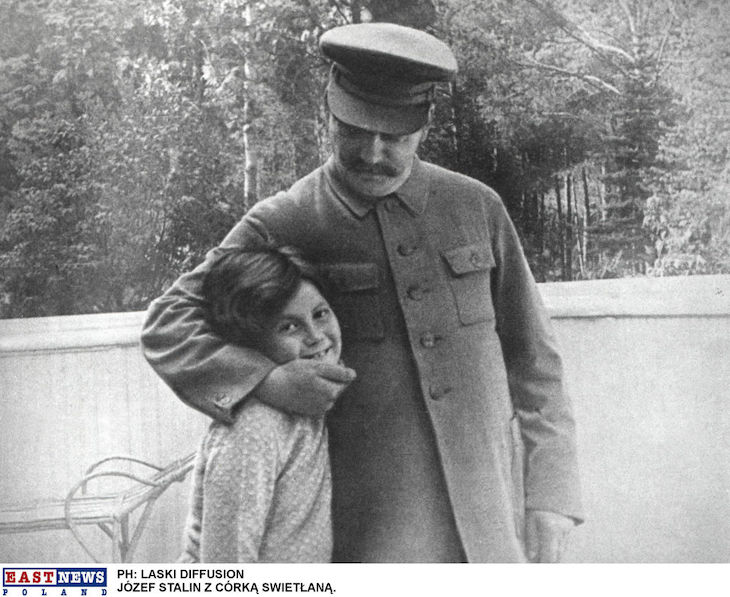
Svetlana Alliluyeva, Joseph Stalin’s daughter, would have been 100 years old today, and she is one of history’s curios worth remembering. Born when Stalin was already installed as Lenin’s successor, and dying in 2011, well into the rule of Vladimir Putin – whom she referred to as an ‘awful former KGB-SPY’ – Alliluyeva, who defected to the West in 1967, embodied all the violent ups and downs of her age. As her biographer Rosemary Sullivan put it, ‘The epoch drove right through her because she was Stalin’s daughter; all the pluses and minuses of this system went straight through her.’
‘Something in me was destroyed’, she wrote. ‘I was no longer able to obey the word and will of my father and defer to his opinions without question’
It was a system that, for the first six years of her life, gave her an idyllic childhood. Svetlana grew up at ‘Zubalovo’ – a dacha complex near Moscow sheltered behind birches and a pine forest. There she lived surrounded by a warm extended family, not just the Georgian relatives of her mother Nadezhda, but those of Stalin’s first wife too, who died in 1907. Endless luminaries from the Politburo passed through – Sergo Ordzhonikidze, Anastas Mikoyan (who lived on the estate), and Nikolai Bukharin, who, in Svetlana’s words, ‘was loved by everyone.’
But after Nadezhda’s tragic suicide in 1932 – following a bitter public argument with Stalin – the abundant life of Zubalovo seemed to wither. Ordzhonikidze committed suicide in 1937, Bukharin was executed after a show trial the following year, and Stalin, living behind gates and barbed wire at his Kuntsevo dacha miles away, imprisoned most of Svetlana’s beloved older relatives or had them shot. These, she said, were ‘years of the steady annihilation of everything my mother had created, of the systematic elimination of her very spirit.’ Zubalovo, a ghost of itself, turned into a place of silence, paranoia and painful memories.
Yet until her teen years, it was probably Svetlana whom Stalin loved most. She was, said a family friend, ‘the only creature who softened’ the dictator; she was his ‘little sparrow’ or ‘housekeeper,’ and he sent her loving letters, playing with her ‘like a bear with a cub.’ Of her mother’s death, she was told as a child it had come after a sudden, fatal attack of peritonitis.
At 16, though, leafing through American magazines, Svetlana finally found out the truth. After this, her relationship with Stalin (and Stalinism) changed forever: ‘Something in me was destroyed. I was no longer able to obey the word and will of my father and defer to his opinions without question.’
As her independence grew, relations between them wilted. She wanted to do a degree in literature, Stalin insisted she study history which – taught through the lens of Marxism-Leninism – left her cold. He refused to meet her first, Jewish husband, and pushed her into a second, disastrous marriage to the son of one of his ministers. Svetlana, souring on communism, felt drawn to the Orthodox Church, while Stalin’s airless, overbearing company was increasingly a trial: ‘I had no feeling left for my father, and after every meeting I was in a hurry to get away.’
Yet his death in 1953, to her surprise, hit her hard: ‘‘During those days of illness […] I loved my father more tenderly than I ever had…Neither before nor since have I felt such a powerful welling up of strong, contradictory emotions.’ It was only later in life she recognised him as a ‘moral, spiritual monster,’ and admitted that, along with his terrible crimes, he had ruined her life.
Following the ‘thaw’ of Nikita Khrushchev’s reforms, it was his successor Leonid’s Brezhnev’s attempts to re-Stalinise the USSR that appalled Svetlana and led to her defection. Amidst a whirl of publicity, her flight to the US – the most important Soviet defector in history – was something the Kremlin, outsmarted and humiliated, never forgave. Another black mark against her was the overseas publication of Twenty Letters to a Friend, Alliluyeva’s memoir of growing up under her father. The book, for all the KGB’s furious attempts to stymie it, was a critical and commercial hit, no foreign memoir other than Churchill’s gaining a larger advance from a US publisher. Yet, perhaps tormented by guilt over her parentage, or to show the world it wasn’t merely to grow rich she had decamped, Svetlana gave most of it away. ‘It seemed to me the wealth from Twenty Letters had never been real to her,’ said a friend. ‘Just one more turn of Fortune’s wheel.’
It continued to turn, often to her cost. Though she longed for stability, her life in America gave her anything but. Little help came from the Russian expat tribe, who broadly rejected her: Svetlana may have denounced communism but would always be ‘Stalin’s daughter,’ and accordingly damned. Others, perhaps less invested, saw her differently. She could be monstrous if slighted or let down, yet even those who got a flaying from her noted her virtues too. Those she spent time with mentioned her ‘spirituality’ and natural warmth. Diplomat George Kennan admired her ‘decency and sincerity,’ while Sir Isaiah Berlin, Russian expert in-excelsis, described her as ‘a rather noble…touching human being.’
Svetlana’s attempts to go native were mostly doomed
Certainly, she never lacked friends – ‘Fate always sends me unusual people who pull me out of the abyss’ – yet her romantic life was cruelly ill-starred. Lovers would flee from her intensity, disappoint her, even die on her. A disastrous marriage into a quasi-cult left her near-penniless and emotionally devastated, but with a baby daughter, Olga, who would remain to the end her surest companion and North Star.
As for Svetlana’s attempts to go native, they were mostly doomed. She liked the ready smiles of the Americans – so different from the Soviet Union – but loathed the Western obligation to declare yourself ‘fine,’ even if recently bereaved. She taught herself to do cocktail-party chit-chat but longed for more edifying conversation, the ‘luxury-of-talking-for-an-hour-with-someone-who-understands.’
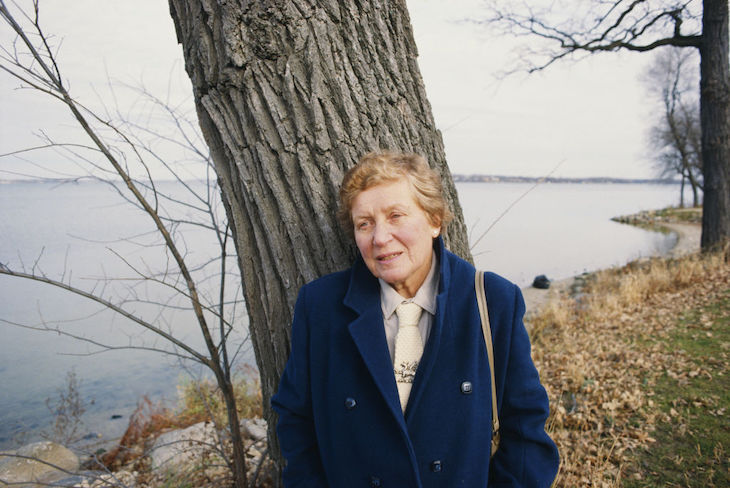
Often, she pined for her homeland. ‘No matter how cruel and harsh our country may be…no matter how many undeserved wrongs we may endure,’ she wrote, ‘No one who loves Russia in his heart will ever betray her or give her up…’ (a statement which makes you wonder what frenzy of torn loyalties and inner dialogues might have overwhelmed Alliluyeva, had she lived to see Putin’s 2022 invasion of Ukraine).
Nostalgia and feelings of loss seem to have led to a deep restlessness throughout her time abroad. She would grow bleak around November, the month of her mother’s suicide, and could settle nowhere very long. A surreal period in England, living in Cambridge and schooling her daughter in Saffron Walden, was followed by a redefection to a Russia she found, despite her longings, had callously moved on. The two children she’d left behind as young adults were now hostile or indifferent, and most of her friends had died. ‘I walk around Moscow,’ she wrote to a relative. ‘There is no one here. Just crosses. Crosses everywhere…crosses, crosses, crosses.”
By now, her funds had almost completely run out. Back in Britain, after another redefection, she lived in a series of benevolent homes as a ‘happy pauper,’ never quite losing some essential inner grandeur – ‘grand in a way a princess would be if she were living in a cell,’ one friend recalled – nor her ability to tough it out. She’d grown up in luxury, she reasoned, so it was only fair that current penury should right the balance. At other moments, a natural buoyancy seemed to fail her. ‘It’s been a heavy life, my dear,’ she remarked to writer Angela Lambert, ‘Heavy to listen to; heavy to live.’ Yet as she said it, she gave a characteristic smile.
Watching her TV interviews, or reading Sullivan’s (excellent) biography of her, you get a sense of an immensely complex, even broken woman, too scarred by experience for herself, let alone others, to handle – but also gifted, thoughtful, generous, sometimes wise. Svetlana Alliluyeva, Joseph Stalin’s daughter, may have been one of Soviet history’s footnotes – but she remains a footnote worth looking up and lingering over, with penetrating things to tell us of her nation’s bloody – and complicated – past.
About her own past too, she could be laudably clear-sighted: ‘I lived my life the way I could, though I could have lived it better – within a certain limited framework called Fate. There is something fatal about my life. You can’t regret your fate – though I do regret my mother didn’t marry a carpenter.’



Comments