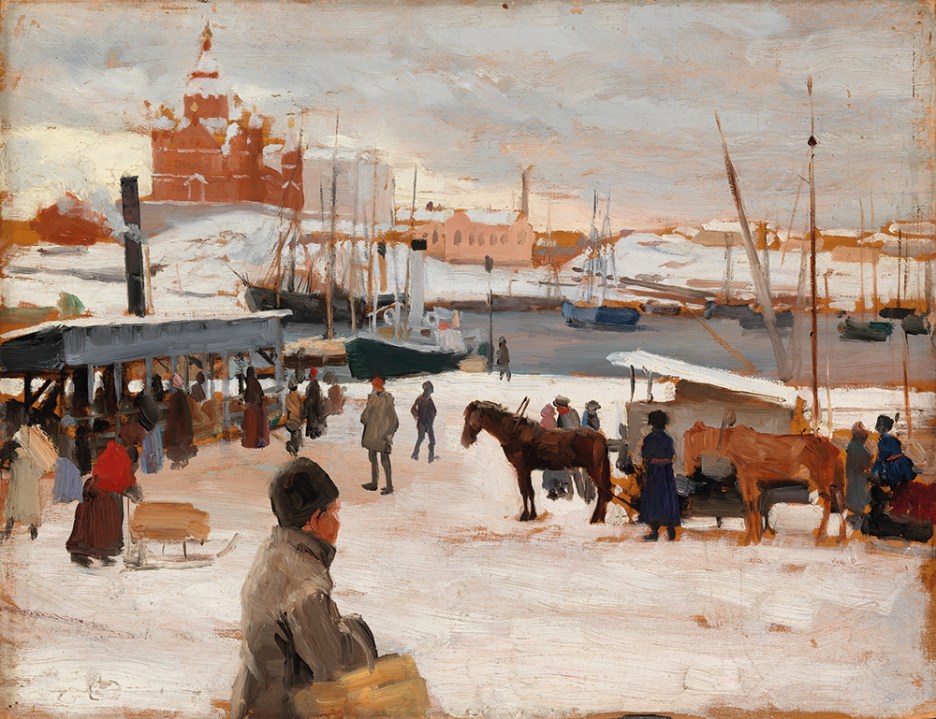
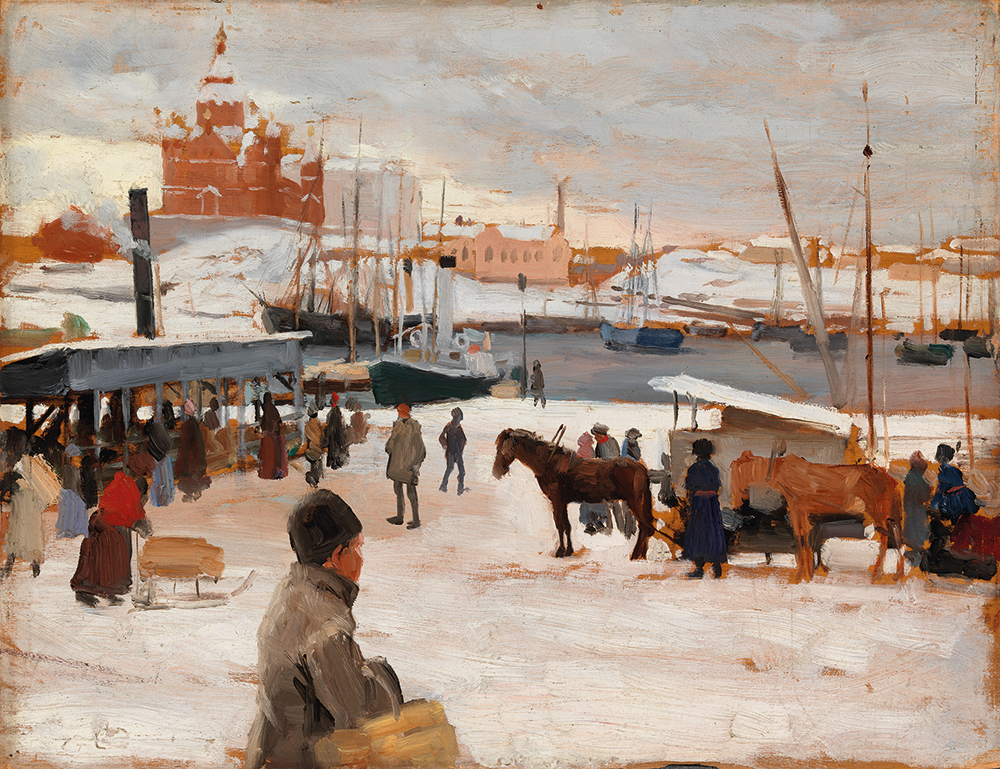
In 1920, the young Finnish architect Alvar Alto flew over Helsinki for the first time. He was aghast. ‘An aviator can see where the monkeys have been and destroyed so very much,’ he recalled. Alto’s aerial view reflected a story of fragmentation and occupation spanning some five centuries, now surveyed by the historian Henrik Meinander. The capital, explains the author, was bashed about by a series of bad actors – Swedes, Russians and Germans – until Finland stood its ground and became an independent nation in the early 20th century.
Helsinki is ‘a city shaped by the sea, a city best seen from the sea’, writes Meinander. ‘Wherever you are in Helsinki’s inner city, you will always be close to the water.’ It originated by royal order, when King Gustav I of Sweden, Finland’s ruling power in the 16th century, decided that a new town was needed on the southern coast to give Sweden a competitive edge in the Baltic trade. It received its charter in 1550.
Helsinki’s early history is a dismal cycle of building, settling, fires, rebuilding and resettling. And then there was the plague of 1710, which decimated the population. The chief progressive event of its first two centuries came in 1748, with the construction of Suomenlinna, a vast sea fortress composed of eight islands south-east of the city.
Meinander, a professor of history at the University of Helsinki, is interested in statistics, demographics and power plays between burghers, much of which is as dry as reindeer jerky. Things get juicier in the 19th century, however, when Finland was part of the Russian empire and saw huge expansion and growing tensions over the Russification of the country.
The Russian Revolution changed everything. Civil war broke out between Finns seeking Bolshevism and the anti-communist White Guard led by General Mannerheim and supported by German forces (who soon had boots on the ground in Helsinki). Two decades later, the Winter War with Russia brought further mayhem to the city. Helsinkians have long been an ‘inadvertent audience to a surrealist geopolitical drama’, Meinander observes.
A keen eye is brought to a built environment ravaged by time and conflict. The blueprints for Helsinki’s city centre, with its grid layout and grand boulevards, were drawn up by a local nobleman, Johan Albrecht Ehrenstrom, following a devastating fire in 1808: ‘It was nothing short of a proposal to completely reconstruct the city from the ground up.’
Helsinki’s early history is
a dismal cycle of building, settling, fires, rebuilding and resettling
Later, we get pungent intelligence on the refuse and drainage systems: ‘In the 1910s, the mere thought of taking a dip off the coast of Sornainen, where one of the city’s large sewers discharged its contents, must have been enough to induce nausea.’ And then there are the mid-century developments. It wasn’t just Alto’s elegant modernism; there were architectural anomalies such as Makkaratolo, a retail and office block opposite the central station characterised by a tubular bulge circling the building. Popularly known as the ‘Sausage House’, it is routinely voted the ugliest building in Helsinki.
Another curious and well covered aspect is the relationship between language and the city’s fortunes, with the population now composed of a Finnish-speaking majority and Swedish-speaking (but historically culturally dominant) minority. The one unifying linguistic characteristic is modesty. Bertolt Brecht quipped that the Finns were silent in two languages. This humility hints at the book’s chief weakness. There are too few voices from Helsinki’s avenues, squares and docks. The city is more than a piece on a diplomatic chessboard; it is home to some 690,000 people.
There are, however, glimpses of intriguing stories. While staying at the Hotel Kamp, a haven for foreign reporters, the journalist Martha Gellhorn witnessed the Russian air strike on the city in the winter of 1939. Meinander writes:
At Kamppi’s bus station, she encountered the wreckage of a number of cars and a bus in flames, beside which lay a man’s headless corpse. In her article, Gellhorn paid attention to his repaired leather shoes.
In fact the Hotel Kamp correspondents could have filled an entire chapter.
Similarly, there is frustratingly brief coverage of the fashionable postwar scene. Wiipurin Korsetti sold lacy lingerie to its racier residents, while Restaurant Lehtovaara served its bourgeoisie Finnish dishes with French flourish. Both establishments remain in situ.
Meinander would have been wise to take his lead from Nicholas Walton’s Genoa: La Superba, a study of another similarly sized maritime powerhouse. Walton delves into Genoese passions (primarily pesto, piracy and football). While there is a feast of information in Meinander’s book – and it provides a valuable record of nation-building events, such as the 1952 Summer Olympics and the Helsinki accords of 1975 – it lacks the tart and telling dishes served up on the streets.



Comments