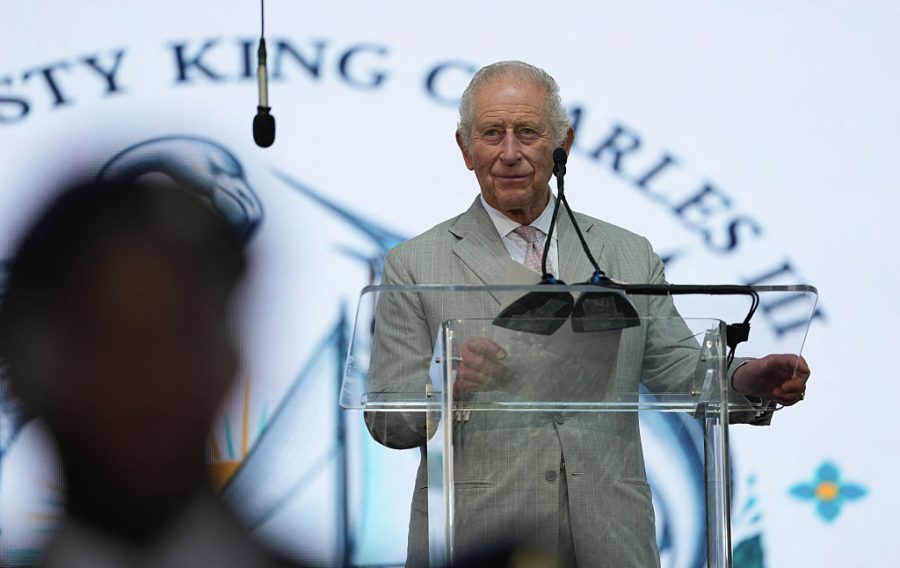
In his big Commonwealth speech in Antigua today, King Charles III is now expected to speak with ‘unflinching honesty’ and ‘sincere sorrow’ about Britain’s role in the slave trade. He may stop short, however, of issuing a formal apology, which is bound to trigger another round of agonised media discussion. But Britain has nothing for which to apologise, and the never-ending ‘slavery apology’ debate is facile and riddled with stupidity.
We can understand the concept of slavery better – and the arch ignorance that many people bring to the topic – by considering other important historical relics, less contentious than slavery now, but which equally elude our present-tense, present-day bias. Two of the most obvious are providentialism and ideas about equality.
‘Providentialism’, Alexandra Walsham, another Cambridge historian, writes in her book, Providence in Early Modern England:
Was not a marginal feature of the religious culture of early modern England, but part of the mainstream, a cluster of presuppositions which enjoyed near universal acceptance. It was a set of ideological spectacles through which individuals of all social levels and from all positions on the confessional spectrum were apt to view their universe, an invisible prism which helped them to focus the refracted meanings of both petty and perplexing events.
It was also an ingrained parochial response to chaos and crisis and an idea which exercised practical, emotional, and imaginative influence upon those who subscribed to it.
Apologising for the fact that our ancestors embraced ideas that we find ludicrous is ludicrous itself
Belief in an underlying order of the universe by a supreme supernatural being was, of course, firmly ensconced in mainstream Judaeo-Christian thinking. It is also fundamental to ancient Greek and Roman philosophy. The central concern that Protestantism focused on was the operation of Providence (with a capital ‘P’), which owed a great deal to the removal of all intermediaries between the Lord and the individual soul, from their ‘uncompromising insistence upon man’s utter impotence and depravity and complete dependence upon the mercy of its Maker and redeemer’.
God’s sovereignty stretched all the way from the ‘most contemptible’ of His creatures to the celestial, from worms and gnats and flies to the grandest angels in Heaven. It took in earthquakes and pestilence, incredible occurrences, miracles, it involved the fabulous and even improbable interpretation of ‘conveniently discovered’ ancient documents, the significance of black dogs, sulphurous stinks, ‘monstrous’ children (both mis-births and prodigies, and conjoined twins), the conviction that the very old and very young were ‘especially likely’ to have supernatural powers or afflictions (‘Out of the mouths of babes and sucklings …’).
In church on Sundays, sermons channelled themselves along the lines of the fiery Hebrew prophets, clergy worried about the perils of ‘national apostasy’ and the likelihood of heavenly wrath. Ministers treated the English and the Jews as if they were exact contemporaries, as close cousins, even at times as identical twins. Just as the Jews before them, the English were deemed to be a ‘uniquely favoured race’. ‘What had the Israelites that wee have not,’ said one, ‘ours is machable with them in every respect.’
This idea of an ‘elect nation’ and a ‘sacred homeland’ was by no means confined to Israel, France and England. Anthony Smith, in Chosen People, has shown how the idea of a ‘people of the covenant’ has existed in other places at different times in history, in Armenia, for example, in and around 400 BC, that ‘sacred homelands’ existed in Ethiopia c. 1300 AD, in Russia at the time of Ivan IV, in the 16th century, and even in Switzerland in the region of the three ‘forest centres’ southeast of Lucerne, beginning in the late 13th century.
Nonetheless. such expressions of ‘divine Anglophilia’ showed how prophetic preaching acted to encourage the incipient nationalism of early modern England, bestowing on her star billing in the cosmic struggle against the papal anti-Christ. It was even presented as if there were a ’national covenant’, as if the relationship between God and England had a legal standing almost as sacred a bond as the marriage between husband and wife. And such views were not confined to the church – it came across in ballads, in plays, in the pamphlets that were beginning to appear after the invention of printing.
As the 17th century progressed, the cry that God was leaving England for greener pastures ‘was uttered in increasingly panic-stricken tones’. Providentialism, in its day, functioned as a powerful cultural adhesive.
In his classic book, The Problem of Unbelief in the Sixteenth Century, the French historian Lucien Febvre argues that:
The conceptual difficulties in the way of a complete denial of God’s existence at this time were so great as to be insurmountable … Every activity of the day, which was punctuated with church bells summoning the faithful to prayer, was saturated with religious beliefs and institutions: they dominated professional and public life – even the guilds and universities were religious organisations.
What people ate was surrounded by religious rituals and prohibitions. In Montpellier at the beginning of Lent, the old pots used for cooking meat were broken and new ones installed, for fish. Cooking a capon on Friday was punishable by beating or public humiliation at mass. If insects or rats infested the countryside, the priest was called first to get rid of them.
People had simply not yet achieved the objectivity necessary to question the existence of God, nor would this exist until a body of coherent reasons had been established, each based on scientific discoveries which nobody could deny.
Providentialism is important, precisely for the fact that it was ubiquitous, but also because it was yet another of those attitudes or beliefs that were so different from our own today. This view remained strong right through to the end of the 19th century among a sizeable proportion of the population, including the educated population.
In the 21st century, in a predominantly secular world, providentialism is hard to empathise with. It seems to us like a set of ‘just-so’ stories: a collection of convenient, self-satisfying, self-justifying explanations for something that is actually beyond our control. Yet this would not be an accurate description of what was happening in early modern England (or anywhere else in Europe for that matter).
Dr. Samuel Johnson, I think we can agree, was a fine Englishman, the perfect example of an individual of modest origin who rose to the intellectual and cultural pinnacle. Yet Johnson, who distinguished between subjects, who do not have the vote, and citizens, who do, maintained furthermore that:
Submission is the duty of the ignorant and content[ment] the virtue of the poor … for they have no skill in the art of government.
‘Order cannot be had but by subordination,’ as Johnson also insisted. He teased Catherine Macaulay, the historian and radical, urging her ‘in the name of equality’ to invite her footman to sit and dine with them. ‘I thus, Sir, shewed her the absurdity of the levelling doctrine.’ At much the same time, Hannah More, Bluestocking moralist, patiently explained that it was fine for women, the young, the elderly, the poorly educated, and the just plain poor to be excluded from the pursuit of arts and letters: ‘The wisdom of god is wonderfully manifested in this happy and well-ordered diversity.’
For William Cobbett, ‘Sunday schools for making scholars of those whose business it is to delve [is] another species of British madness.’ Children should not be educated but ‘groomed’ for their places in a hierarchical society. Coleridge warned in 1818 against the ‘plebification of knowledge’, adding elsewhere that ‘I would that the greater part of our publications be thus directed, each to its appropriate class of readers.’ The goal of education, he also said, was ‘emphatically not to introduce them to the fevered world of coffeehouse reading and alehouse discussion, but to cultivate a sober respect for Christianity and inequality’. Writing from Italy in 1820, Mary Shelley had no desire to return to England. English subjects, she insisted, were ‘the slaves of King Cant whose dominion I fear is of wider extent in England than anywhere else.’
The paradox is that we have no problem in accepting that Providentialism in the past was real, or that selected luminaries in our history had views about hierarchy and inequality that today we find objectionable. Attitudes change with time, though so many of us refuse to adopt the same attitude to slavery.
Yet slavery was as normal as Providentialism and hierarchical ideas about human nature. David Eltis, in his recent masterpiece, Atlantic Cataclysm: Rethinking the Atlantic Slave Trades, one of the best books published last year, and using copious details from newly available digital archives, shows how utterly normal and accepted slavery was, by everyone, and how complicit so many nations were in its trade. A few examples will suffice.
Eltis tells us, for instance, that surviving trade books show that capturing and selling captives in Africa were activities that ‘involved large numbers of Africans beyond just the ruling elite’.
Attitudes change with time, though so many of us refuse to adopt the same attitude to slavery
The new evidence also provides fresh information regarding African attitudes to slavery. Africans, the late Svend Holsoe reported, had distinctive rules on the matter. Any African’s own people could not be enslaved but all ‘outsiders’ could be. On the African coast, Europeans could only buy those Africans that the sellers considered to be ‘outsiders’.
Generally speaking, outsiders were those of a different tribe, invariably speaking a different language. This is why it was so important that Africans comprised, at the time, 5 per cent of the global population but 25 per cent of all global languages. In other words, there were in Africa a lot of ‘outsiders’. When these narrow rules were broken, Africans who had been enslaved were brought back across the ocean, to regain their freedom, before any more business could be conducted.
The documents also make clear a sense of equality between buyer and seller. Most compelling are a series of ‘warm and familiar letters’ written between 1760 and 1789 by Bristol and Liverpool merchants to important African rulers at Old Calabar (South East Nigeria). So too, the digital database, proving its usefulness in all directions, also shows the changing patterns in naming slave ships, which among other things reveals the increasing engagement of slave traders with a range of African rulers. It is now that slave-ship names begin to change, from Negro or Negro Merchant or Black Boy, to King Amboe or King Pepple. The warming change of attitude is everywhere.
Finally, there is the story of James Irving, who captained the slave ship Anna in 1789, was captured en route to Africa, enslaved and sold to Mawlay ‘Abd al-Rahman, son of the emperor of Morocco. Ransomed two years later, Irving returned to trade immediately as captain of the Ellen. Roughly 25 per cent of the crew of slave ships were slaves themselves.
And what are we to make of William Wilberforce and Zachary Macaulay? As David Eltis has also shown, even the elite leaders of the campaign to abolish the slave trade both believed that Africans were ‘uncivilised’ and not ready for a free labour market.
Apologising for the fact that our ancestors embraced ideas that we find ludicrous is ludicrous itself. The same goes for slavery. History is, above all, about change. Our attitudes have to change with it.






Comments