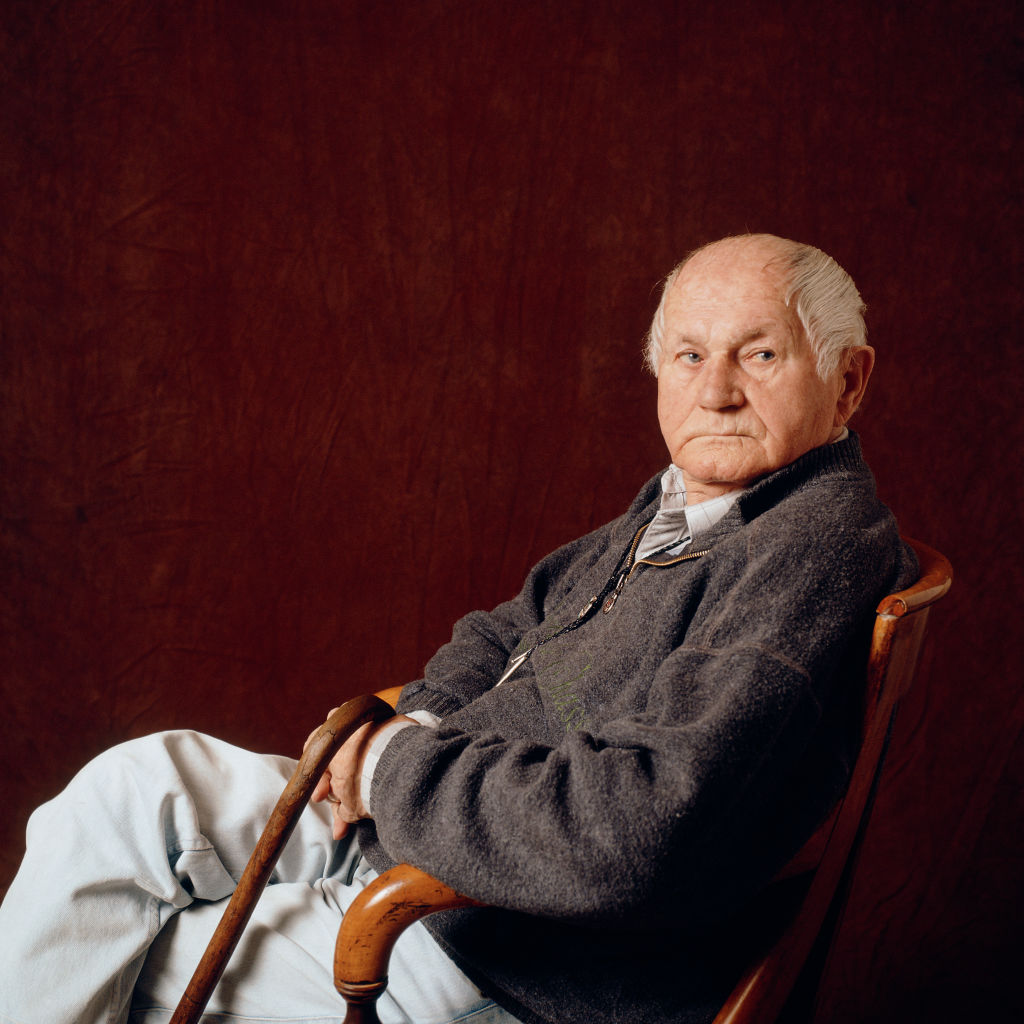
Nearly everywhere you go in Nymburk, a small Bohemian town an hour or so from Prague, there are reminders of its most famous son, the novelist Bohumil Hrabal. The Czech writer, who died nearly 30 years ago, grew up here, amid the coopers and maltsters at the local Postřižinské brewery, where his stepfather was manager.
Beer accompanied Hrabal throughout his life – much of his adulthood was spent sinking mug after mug at the Prague tavern U Zlatého tygra (‘At the Golden Tiger’). Terror stalked him too. He lived through Hitler’s occupation, grilled and harried by the Nazis who came very close to killing him. Four grinding decades of communism followed – Hrabal dogged by the secret police for being insufficiently pro-regime, hounded by writing colleagues for not working actively enough against it.
Amid all this he produced, prolifically, a series of wafer-thin novels about equally tiny people – a cobbler, a railway worker, the operator at a paper-crushing plant – and their boundless, effervescent inner worlds. Beleaguered on all sides in his lifetime, he’s nowadays a mainstay of Czech culture, one of those writers without whom – as contemporary Josef Škvorecký put it – ‘the knowledge of the literature of that distant land would be lamentably incomplete’. Many of his books were made into films by his friend Jiří Menzel (one, Closely Observed Trains, snagging the Oscar for foreign film in 1968) and several were filmed here in Nymburk.
Nymburk is, at first glance, exactly what I expected a small Czech town to be: quiet, cobbled, with lots of one-storey, red-roofed houses. Restaurants sell roast pork and dumplings with mugs of foaming, bread-coloured beer. There are between-the-wars cafés and, in a leafy public garden (‘Island Park’), a long, low, white-pillared hotel from 1922, redolent of jazz and dry martinis. On the River Elbe nearby, sluice-gate towers and a hydro-electric power station have an art deco feel about them (‘formalist’, I’m told). It’s all as dinky as a Hornby train-set.
At night the streets are eerily empty, but the taverns teem with custom. In the centre, lit-up shop-window displays – ravishing, even the humblest – remind you of that Czech genius for making things small and perfect: Jan Švankmajer’s animated films, the country’s handmade toys, its marionettes and puppet theatres, all of which seem to tell you something of how Czechs see themselves. ‘The problem of a small country is somewhat like the problem of a little man,’ said Tomáš Masaryk, Czechoslovakia’s founding father. ‘His human dignity must be respected without regard to the material difference in bigness.’ Which brings us back to Hrabal’s novels too.
By the river is the Postřižinské brewery, which has run for 130 years, scene of Hrabal’s boyhood. It towers beside the river, a stately yellow building which reminded Hrabal alternately of ‘monastery’ and ‘prison’. Today it’s little changed – the barn-like interiors are still painted white and green, the barley malt spread over the floor for germination, in rising and ebbing waves, just as it was in Hrabal’s day. There is, in places, the same delicious smell of roasting malt he captured in his novel Cutting it Short, while rhyming couplets stuck about the place – ‘Zdravi, svěžest, sílu / Vše najdete jen v pivu’ (‘Health, freshness and strength, you’ll find it all in beer’) – remind you of the advertising slogans Hrabal’s fictionalised, bumbling stepfather is always coming up with in the book: ‘Beer at every time and tide, beer refreshes your inside!’
So much did Hrabal make the place his own that the brewery proposed, while he was still alive, erecting a statue to him there. Hrabal told them to ‘fuck off!’ (I quote) but said he would accept a small brass plaque, provided it was placed at such a level dogs could piss on it (it remains there, a foot off the ground to this day). Now many of the Postřižinské beer bottles have Hrabal’s face on the label or are named after characters from his books. It’s a fitting union: Hrabal, a dedicated boozer, once spoke of drunkenness as ‘that state of unconsciousness, that tabula rasa, that silence and nothingness … when you really get a proper rest’, later adding, ‘If the gods really loved me, I would just drop dead over a glass of beer.’ But it was not to be.
There are more memorials to Hrabal in the town – near to a Hrabal museum, a statue of him with a cat sits on a bench in the main square. Opposite his childhood home is a monument with more stone cats on it. Hrabal seems to have felt compassion for all animals – the ‘beautiful, innocent pigeons’ rounded up by Prague exterminators, cows on their way to the slaughterhouse with their ‘desperate, sad, bovine eyes’, even the roe deer he frightened on his walks through the forest. But increasingly, as he got older, it was cats who followed him around: ‘I had reached an age when being in love with a beautiful woman was beyond my reach … Yet the cats loved me the way girls used to love me when I was young.’
In Kersko, a wooded settlement a few miles away, Hrabal lived with a swelling community of them (‘What are we going to do with all those cats?’ his wife Pipsi would cry in periodic panic). The cottage, a little white-and-green-painted house at the end of a long track, surrounded by tall trees, was a bolthole for Hrabal, particularly in the long years of ‘normalisation’ following the Soviet crackdown in 1968, when for seven years Hrabal wasn’t allowed to publish at all.
‘The cats loved me the way girls used to love me when I was young’
Now the house is a museum, open to the public since last year. You can see the spartan downstairs room, with its mildewy smells, green-baize floor and bunk beds; the old tile stove upstairs; the covered balcony where Hrabal sat, surrounded by windows on all sides, bashing out his books on a Consul typewriter: ‘Sometimes I might wait an hour or more, but at other times I wrote so fast that the typewriter jammed and stuttered, so mighty was the stream of sentences …’ Though his cats ‘lay there with their eyes closed, they’d be watching me through tiny slits, lulled by the clacking of the machine.’
The pets, besotted with Hrabal, would greet him as he arrived from Prague, ‘little cats’ ears poking up on the balcony, or in the open space under the gazebo floor’. When away from them in Prague, he worried constantly they’d get run over, shot by a local hunter, or snatched for vivisection. The weekly parting from them was a torment: ‘When I’d look back one last time, I always saw the same thing and it always moved me. In every available chink in the fence there would be a cat’s head poking out… following my departure and longing for what could not be altered.’ Eventually, as the cat population exploded and Pipsi’s protests with it, Hrabal was forced to acts of culling to keep the numbers down. It left him with a guilt and self-hatred that shadowed him everywhere he went and which he captured, vividly, in his book All My Cats. Cat ownership for Hrabal, like Czech history, was marked as often by brutality and betrayal as it was by moments of bliss.
The writer was to die, aged 82, in 1997, in what most now accept was an act of suicide – falling to his death from a fifth-floor window at Prague’s Bulovka Hospital, after feeding the pigeons on the ledge outside.
Since then, his legend has only grown. The little man is now a Czech icon and has, more than most writers, ‘become his admirers’. Thousands have visited Kersko, for all its remoteness, since it opened its doors last year. Many will surely identify with one elderly woman, who wrote out of the blue to Hrabal in 1989, a letter that seems to have delighted him:
One day, a normal weekday, when it is certain that neither you nor any of my relatives will be in Kersko, I will go there, I will secretly visit the places you are so fond of, and maybe I will meet some cats and think they are yours, and I will pet them. You write so beautifully about them, and I believe you are truly a ‘Tender Barbarian’. Simply stated, you are my ‘Lovely Melancholy’.

Comments