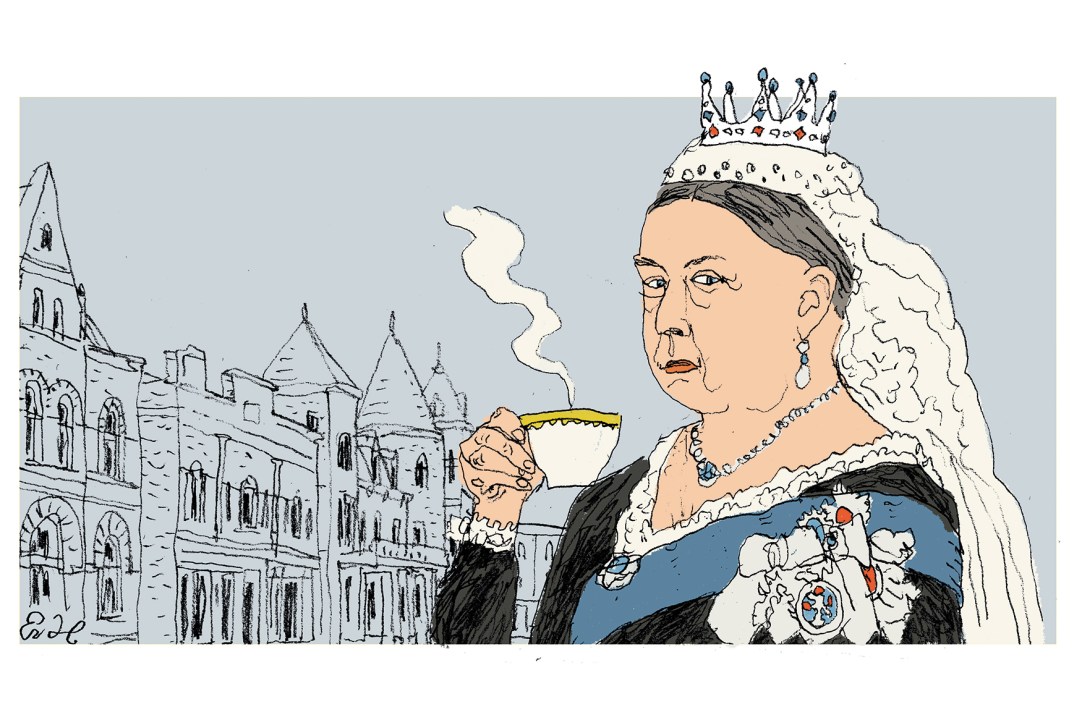
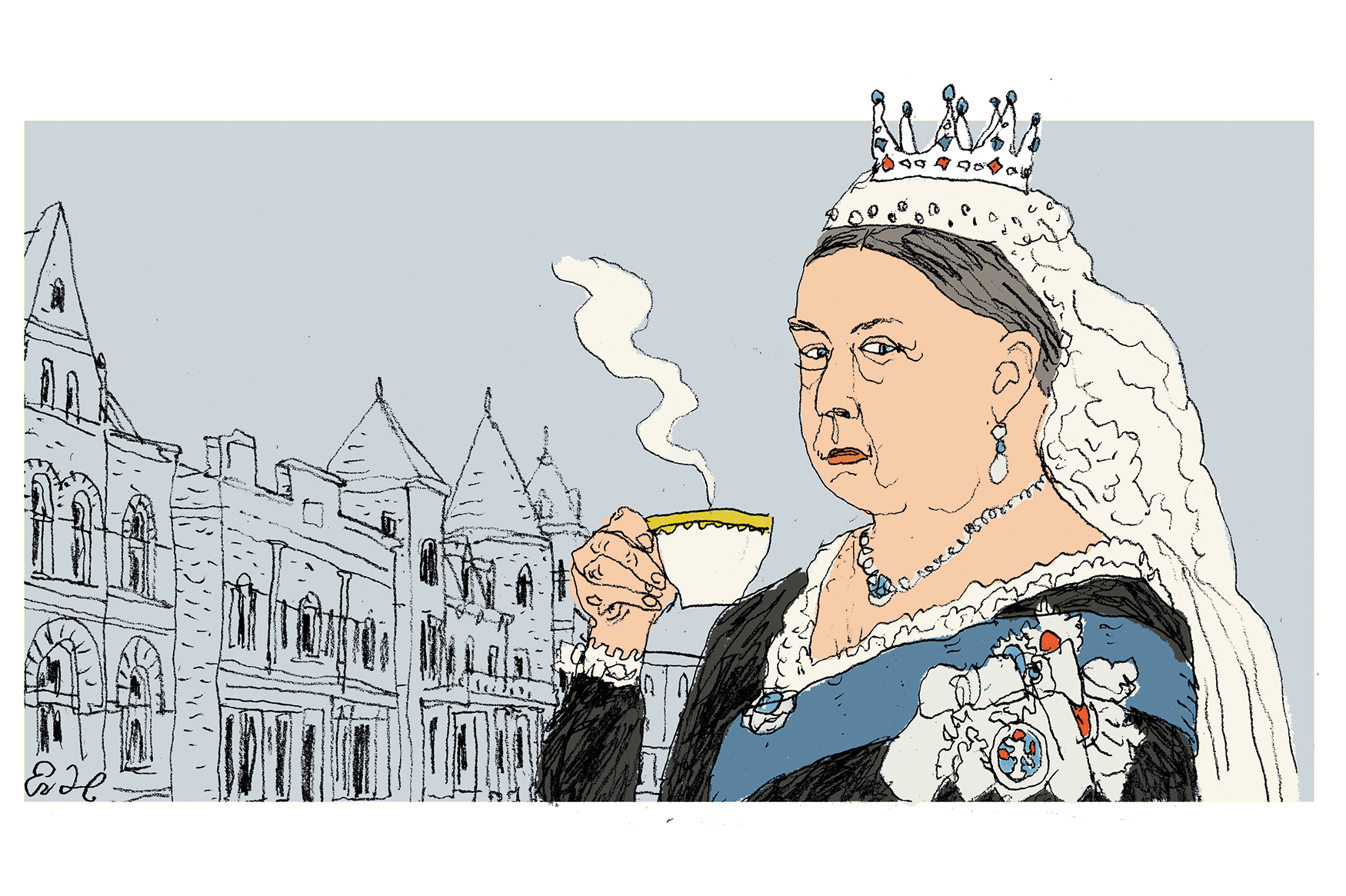
I’m sipping Madagascan hot chocolate out of white-and-gold Haviland Limoges, and nibbling on Venezuelan milk-chocolate bonbons, under an oil painting of Queen Victoria. I am on a visit to Guild Chocolates, “the finest chocolate shop in Petrolia,” in southern Ontario. The town’s population was circa 6,000 at the last census and on a Saturday morning, the chocolate shop is the place to be.
During my visit, a sign on the Dickensian, wood-paneled storefront clearly indicates the shop is temporarily closed, but people keep turning the door handle and popping their heads in hopefully. Jaclyn Sanders, proprietor and chocolatier, calls warmly and apologetically out to them. Jaclyn opens her shop only one day a week: Saturdays from 10 a.m. to 5 p.m. That’s all it takes for her stock to sell out, and then it’s time to close the doors for another week of chocolate-making.
Guild Chocolates doesn’t ship. Everything — from artisanal hot chocolate made from the world’s finest (the best stuff comes from Madagascar and South America) to bars, toffees, Easter eggs and her speciality filled chocolate bonbons — is handmade right behind the counter on the gas range, and sold in-store only. “I’m making as much chocolate as I want,” Jaclyn tells me. “When people tell me I should expand, or sell further afield, I tell them, ‘You start your own shop in your town! My shop is for Petrolia. Every small town should have its own chocolate shop!’”
There is no season that calls for chocolate more loudly than Easter. Guild Chocolates’s lineup this year includes a ridiculously cute milk-chocolate bunny, round and plump with a velvety finish, and a gracefully turned beehive of an egg. For those in search of sterner stuff, an ancestral bust of a rabbit with severe features is available. It wears a ruff and a cool, judgmental stare; its gray flocked surface comes from chilling the bunny and spraying hot melted white chocolate onto the cold surface. Easter is a time for celebration, but what are we celebrating? The foundational truth of Christian civilization — that Christ rose from the dead, and therefore wasn’t just a man, and therefore the whole world had to change along the lines he laid down. Ancestor Bunny is here to remind you that chocolate pairs best with truth and tradition.
The first time I wandered into Jaclyn’s store, I immediately felt smarter and more cultured. It was a wonderful feeling. Red brick walls were hung with original nineteenth-century paintings in massive gilded frames (me, collecting my jaw from the floor: “How did you find these?” Jaclyn, modestly: “Luckily for me, portraits aren’t in fashion”).
The King’s College Cambridge Choir wafted from the sound system. There’s an enormous collection of Pre-Raphaelite postcards on the refrigerator door, somebody holding forth on Ophelia in the corner, gourmet hot chocolate available for takeaway in tiny paper espresso cups. Don’t pinch me, I don’t want to wake up.
It’s not just me. Jaclyn says she thought at first she could keep making chocolates while the shop was open, but no. Everybody wants to come in and chat. There’s no seating area, but it doesn’t seem to discourage them. Locals tell me people line up outside to get in. “I’m lucky,” Jaclyn says, “because chocolate makes people happy.”
What does it take to make the finest chocolate in Petrolia? Kidding: it’s among the finest chocolate in the world, as evidenced by the International Chocolate Awards plastered down the window.
A lot of hard work, that’s what. Just to qualify for the world competition, an individual chocolate has to earn a national medal. Then it faces off against some very heavy hitters in the international round, not just from Latin America (which literally invented chocolate), but also from pedigreed European producers with forebears who were whisking ganache when Canadians were still boiling hemlock bark to stave off scurvy. Stiff competition. But the two World Silvers and the World Bronze show Guild Chocolates from Canada can hold its own.
The more time Jaclyn spends on each step, the harder she makes it for herself, and the more the judges love her specialty bonbons. William Morris, founder of the Arts and Crafts movement, is her guiding star and he didn’t believe in shortcuts. When he decided to print books, he made his own paper out of linen rags and designed a new typeface — and only then was he ready to get started. His books weren’t just any books. They were, from the ground up, “Ideal Books,” like his Kelmscott Chaucer, now considered one of the most beautiful books ever printed.
A man like Morris would never tolerate palm oil in his chocolate as a dairy substitute. We’ll start a dairy guild, he’d say — Morris wanted to revive the medieval guilds, and Guild Chocolates is named in honor of his vision — and we’ll breed the finest Jerseys and feed them wildflowers and sea kelp until the richest cream is produced. And maybe then we can start looking around for cocoa beans!
Ingredients aside, how is making a Morris-inspired bonbon different from making a commercial bonbon?
First, the tempering. Tempering chocolate is famously one of the trickiest techniques in pastry arts. And most chocolatiers, Jaclyn tells me, don’t bother with it. Instead, they use expensive tempering machines that are always running, keeping the chocolate at the correct temperature and consistency for immediate use. Sounds ideal, doesn’t it? Well, it’s not. Not if you, like Jaclyn, pursue the highest levels of quality in the manner of a questing Arthurian knight. With a tempering machine, you’re committed to using a single variety of chocolate per machine, and it has to be constantly running. You do not have the flexibility to make small batches of different rare types of chocolate as Jaclyn does — you have to stick with a readily available, reasonably priced, middle-of-the- road chocolate. No Trinitario or ultrarare Criollo, the Rolls-Royce of chocolate, for the likes of you. In fact, to keep down costs, many commercial chefs will cut the chocolate with up to 50 percent coconut fat, adding flavored oils to mask the coconut taste. People like that are the reason William Morris lies unquiet in his grave.
Worse yet, if you rely exclusively on a tempering machine, “You lose the whole connection with chocolate, the whole craftsmanship of it,” Jaclyn says. “There’s this intimate knowledge that comes of working by hand with it.” As she whisks away in a stainless-steel bowl over a pot of hot water, you get the sense that if the apocalypse struck and the grid went down, Jaclyn could, if necessary, whip up bonbons over the campfire coals.
The chocolate in the double-boiler has reached the right temperature — Jaclyn knows this from experience, but she checks with an infrared thermometer anyway. She pours it onto the cool marble tabletop and begins agitating it with a metal scraper, coaxing the cocoa-butter crystals into the tight crystalline matrix required. “Cocoa butter will set in five different crystal phases,” she says, “but only the fifth is stable.” This is important because in the lower phases, the chocolate won’t contract properly or release cleanly from the molds. It may also display an anathema whiteness called cocoa bloom, which ranks high in the chocolatier’s Syllabus of Errors.
Over-tempering is the Scylla to under-tempering’s Charybdis. Jaclyn explains the chef’s nightmare that is seized chocolate. “The crystallization gets tighter and tighter, and it gets too thick to work with.” Seized chocolate can’t be salvaged — the lost time and product are gone forever.
Jaclyn can tell, by the look and the feel, that the chocolate has reached the ordered tranquility of stage five. The polycarbonate molds are at hand, already painted with a few swipes of orange, yellow and silver cocoa butter: these will be Lady Grey bonbons. Natural colorants are mixed into cocoa butter and then brushed or spattered into the molds before the chocolate is poured in. When perfectly tempered chocolate contracts away from the mold, the colors adhere to the glossy shell, and it’s as if you can see through the layers of shining, translucent color into the chocolate itself.
Working quickly, Jaclyn pours the now perfectly tempered chocolate into the mold and flips it so the excess can drip off. Filling molds by hand results in thinner, more delicate shells. Most other chocolate-makers use depositors, but depositors mean thicker shells with less room for filling — a compromise on quality Jaclyn will not make.
A tray of filled chocolates is ready to be capped off. Jaclyn flashes the tray with heat before pouring on the caps, so they seal tightly against the shell. These ones are hibiscus mango, with yellow-flecked, dark-purple shells. Jaclyn tells me she collected hibiscus blooms for these, dehydrated them, ground them, and sprinkled the results into the chocolate used for the shells. I bite into a sample; at first crunch I taste chocolatey hibiscus — and then delectable, intense mango.
Shelf life is a major consideration for most chocolate-makers. When chocolates are shipped out and sit in warehouses and stores for months before being eaten, spoilage simply cannot be risked. This is why mass-produced chocolates are often filled with invert sugars, which, Jaclyn tells me, are pretty much indestructible. “You could bury the Egyptians with invert sugars because they’re anti-microbial,” she says. “They would survive nuclear fallout!”
Jaclyn’s bonbons are highly perishable, with only a few weeks’ shelf life — but that’s because her fillings are made with the highest-quality fresh dairy and fruit, and encased in delicate, eggshell-thin coatings. That’s another reason to sell only to walk-ins. These chocolates are too delicate to endure transit and too ephemeral to sit around. They are things of beauty and joy forever that must be eaten immediately. They wouldn’t last long in a nuclear bunker. But then, who wants them to?
Does Petrolia realize its good fortune? It’s rare for such a tiny community to be the sole audience of a world-class chocolatier. But Jaclyn’s happy too; she has no interest in seeking out a more sophisticated, big-city clientele.
After all, in Petrolia she can find the kind of success of which William Morris dreamed: “With the arrogance of youth, I determined to do no less than to transform the world with Beauty. If I have succeeded in some small way, if only in one small corner of the world, amongst the men and women I love, then I shall count myself blessed.”
This article was originally published in The Spectator’s April 2025 World edition.





Comments