
When I really love a book, I always buy another couple of copies from Amazon to be sure I’ve got them on hand to thrust on people I take a liking to. A few come immediately to mind: Alys, Always by Harriet Lane, The Gorse Trilogy by Patrick Hamilton and The Serial by Cyra McFadden. But a book by Jilly Cooper isn’t something I’d inflict on my worst enemy.
I’ve never read a Jilly Cooper book without being paid – and that was a grim experience
I’ve never read a Jilly Cooper book without being paid – and that was such a grim experience that even one as keen on remuneration as myself might have refused a second opportunity. So I had no idea that one of my least admired writers has apparently plagiarised one of my favourite books, The Serial. If only I had known. I could have spent all these decades admiring the Dame even less – and having a ready-made response when I encountered one of Cooper’s deluded fan club members.
Cooper, who died in 2025, is accused of poaching as many as 35 passages directly from Cyra McFadden’s The Serial to use in her early novel Prudence. The similarities between the texts are rather uncanny:
“Well he’s a Leo, of course. They’re very big on macho tripping, but he’s trying to overcome it.” (Prudence); “I’m a Leo. We’re all very big on macho tripping. But I’m trying to, like, overcome it.” (The Serial).
“It’s hard to keep your mind alive when you spend your time with people three feet high” (Prudence); “It was hard to keep your mind alive when you spent most of your time with people three feet high.” (The Serial)
Unsurprisingly, McFadden’s daughter, Caroline McFadden is furious. ‘She considers her mother’s life’s work to have been stolen in Cooper’s quest for profit’, according to the Observer’s Kate Maltby.
Sam Leith, our own literary editor, calls it ‘a righteous bust…if we’re not minded to forgive the Jason Ardays and the Jeffrey Archers of the world, nor should we be the Jilly Coopers.’
I doubt, though, that this pleasing consistency will be apparent. Her fans have rallied in defence of their light-fingered idol, such as Celia Walden in the Daily Telegraph, under the headline ‘Don’t let one mistake overshadow Jilly Cooper’s achievements’. But as someone who finds her an extraordinarily bad writer of fiction, I’d very much question the way she has been turned into some modern-day sexed-up saint – beyond criticism, really, until the plagiarism allegations came to light.
I had a run-in with Cooper after reviewing her book (not the ghastly girls-names ones, the ghastly thick ones) for the Sunday Times many moons ago. I don’t recall what I said, though I do recall the pleasing cartoon which showed Dame Jilly as a mount, with myself on her back looking well foxy. But no matter how inclement I may have been, I was amazed to receive a note from her expressing extreme displeasure. I’ve had numerous bad reviews in my time but I can’t imagine upbraiding the author. It smacks of the expectation to be loved by all, which is surely a warning sign of extreme entitlement.
Then there was the adultery incident which made one feel that ‘Jolly Sooper’ (as one admirer dubbed her) was not composed solely of sunshine and lollipops.
Her marriage, to the publisher Leo Cooper, had always been part of her brand; she got her first break as a gorgeous young woman on meeting the then-editor of the Sunday Times Magazine in 1968, and giving him a sexy summing up of her life; ‘One made love all night, then shopped all day, then died of exhaustion.’ Godfrey Smith offered her a column on the spot, and she turned the results into a book called How To Stay Married, in which she detailed breathlessly a non-stop whirl of full-time paid employment, complete responsibility for the domestic realm and nights spent acting out the Kama Sutra, all with a jolly super smile on one’s face.
Though her amusing anecdotes often centred around her being a loveable klutz, this was a new kind of wearying goal that only comes easy when in the bloom of youth – and having a job you love, whereby you are basically paid for being yourself.
Regrettably, her abysmal books are undergoing a televisual revival
We talk disapprovingly of ‘Trad-wives’ now, but Cooper was an early reboot of an old dreariness (writing that men were to be ‘honoured and praised and encouraged’) when women were starting to question whether the current set-up really was fair.
Shirley Conran’s 1975 book Superwoman was far more sceptical (and superior) than Cooper’s offerings. She was also on the money about the woes of being married to the wrong man. As a divorcee from a marriage to a consistently unfaithful husband, Conran wrote that ‘Life is too short to stuff a mushroom’. But you could imagine Cooper happily doing so with one hand while keeping Hubby happy with the other.
Alas, the Cooper brand took a hit in 1990 when a publisher named Sarah Johnson revealed that she had been involved with Mr Cooper for may years. Johnson claimed to have spilt the tea because she grew weary of reading about the ‘perfect’ Cooper marriage so repeatedly, and indeed she did succeed in driving a spoke into the wheels; though JC dismissed it as a ‘dalliance’ (inspiring a Wedding Present song with the lyric: ‘I was yours for seven years – is that what you call a dalliance?’) it saw the Coopers semi-detached for a while, though eventually they made it up, and the myth of the made-for-each-other middle-aged lovers continued until he died in 2013.
When Cooper herself popped her clogs last year, the gushing was something to behold; you’d think that the Queen Mother and Jane Austen had died on the same day, the sound of slurping being as deafening as it was.
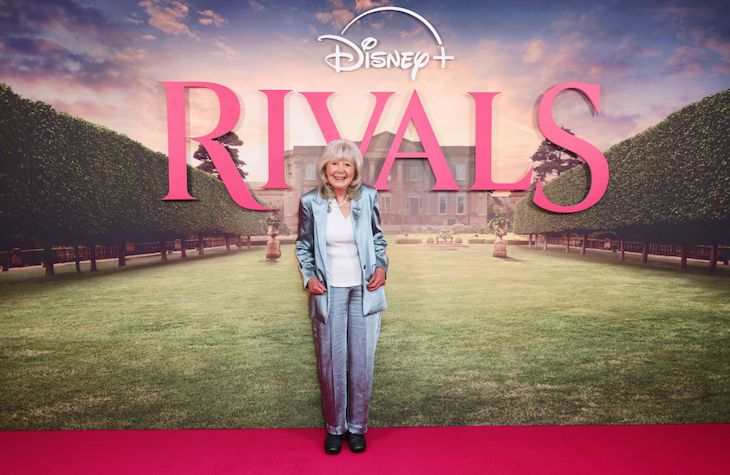
Regrettably, her abysmal books are undergoing a televisual revival (having mercifully tailed off in the 1990s) which saw Rivals become a massive success for Disney+ two years ago, leading the executive producer Dominic Treadwell-Collins to utter the terrifying words ‘We can make it go on forever!’
Among this smorgasbord of sucking-up/cleaning up, just a few voices have been raised in less than adulation
Among this smorgasbord of sucking-up/cleaning up, just a few voices have been raised in less than adulation. Some Mumsnet contributors, with typical common sense, have pointed out that male characters exhibiting extreme sexual aggression to the point of rape (‘Which book was it where they all went to Kenya and Billy and Rupert raped Helen? What japes!’) are given an aren’t-you-adorable pat on the head by Cooper, and indeed are often the ‘heroes’.
I wonder what she would make of Russell Brand? To be fair, he’s probably too common for her; she was a great snob, which may explain why she was the favourite of ‘Queen’ Camilla.
Though her appeal crossed all social barriers; Caitlin Moran once over-heatedly mooted that 1985’s Riders must have been ‘written by someone ablaze with desire’ to which Cooper delivered the rather disapproving – and kinky – comeback: ‘I just fell in love with the countryside, that was what made me come alive. I was having an affair with the whole of the Cotswolds.’ (Shades of Mr Mybug in Cold Comfort Farm!) But my loathing of Cooper’s oeuvre isn’t so much the dastardly cartoon characters who populate her books but, from what I’ve gleaned, the ghastly attempts at what pass for humour – when she wasn’t nicking good writers gags. She is to Camilla what the pitiful ‘The Goons’ are to Charles; humour for humourless people who need to tick a box called HUMOUR because to not have a sense of one is considered worse than bad breath, especially in Blighty.
To close, I’d better come up with a mea culpa or two lest I be revealed as somewhat shady, like Dame Cooper herself. I myself wrote one ‘bonkbuster’ – Ambition, which was a bestseller – but I then grew bored, and resisted the temptation to churn them out; churning is rarely a good look for a writer.
I don’t know about Dame Jilly’s legacy being tarnished. What is it, apart from a plethora of painful puns and some pretty embarrassing sex?
I have also been found guilty of plagiarism; in 1994 it occurred to one ‘Johnny Rogan’ that the middle section of a long piece I wrote about Morrissey for the Sunday Times Magazine resembled his previous biography of the great man. As the Independent put it ‘Miss Burchill said: ‘I’m very surprised. I thought once facts were written down, they were out in the public domain.’’ It’s true that I may have been cavalier in copying down salient facts about Moz’s younger days, but I never stole Mr Rogan’s gags, as I can’t recall there being any.
Unlike the juicy Cooper/McFadden case, in which – as if proving my claim to her essential humourlessness – the lovely one-liners of The Serial are the most sampled, giving a whole new and unfortunate angle to the excitable crowing of Dominic T-C of the Rutshire Chronicles – ‘We have got all these books to plunder!’ Yes – but who are they by?
All things being equal, I don’t know about Dame Jilly’s legacy being tarnished. What is it, apart from a plethora of painful puns and some pretty embarrassing sex which appears to have been informed by watching barnyard animals doing it with one eye while reading Harold Robbins with the other?
Frankly, she just wasn’t a very good writer – Jeffrey Archer with heaving bosoms and mucking-out. Still, the brouhaha has been good for one thing: I’m reading The Serial again and finding it as fresh as ever. This is a book I can thoroughly recommend to you, with the bonus that none of it was copied from the imaginative efforts of someone far less filthy rich in order to make them filthy richer.






Comments