“And this,” I was told, five minutes after arriving in Mexico, “is where they murdered the Archbishop.” I was at the entrance to the car park at Guadalajara airport. The archbishop was Cardinal Juan Jesús Posadas Ocampo, who died in a hail of bullets on May 24, 1993, along with six other people. He was murdered for daring to criticize the cartels, at least according to the official narrative.
There are other theories: he may have been caught in crossfire between rival cartels, or it may have been a case of mistaken identity, and Posadas was assumed to be a cartel head, many of whom, presumably, look like archbishops; or else it was the work of the government itself, which feared Posadas knew too much about its collusion with the cartels.
The cartels are spoken of in Mexico with weary resignation, the same way people speak of death and taxes. In the 33 years since Cardinal Posadas’s death, the situation has gotten worse. The toll from the drug wars since 2006 is estimated at 400,000 dead and 125,000 missing. The government has fought the war against the cartels and lost.
Their success is based on their ability to terrorize the population. Each emerging cartel brings with it hitherto unimaginable levels of violence. La Familia Michoacana made its debut in September 2006, when ruffians burst into a nightclub in Uruapan, Michoacán, firing shots into the air. While the clientele dived for cover, the cartel’s soldiers threw five human heads onto the dance floor. Each gang competes with its rivals, and the winners are always those who kill more, torture more and are thus feared the most.
La Santa Muerte has been condemned but it is the fastest-growing cult in Latin America
Meanwhile, ordinary Mexicans turn to religion. The Catholic bishops condemn the drug trade and the associated violence, but no one, least of all the cartels, is listening. The patroness of Mexico, Our Lady of Guadalupe, known also as the Empress of the Americas, Queen of Mexico and Major General of the Mexican Army, receives thousands of pilgrims a day at her shrine in Mexico City. Her greatest miracle, it is said, is that every night Mexicans go to bed in despair but wake up the next day to find the country still exists.
Other shrines flourish too, such as San Juan de los Lagos in Jalisco and El Niño de Atocha in the town of Plateros, Zacatecas, where patient crowds wait in reverent silence to enter the shrine to pray before a tiny image of Baby Jesus. In each of these places one senses the deeply held piety of the Mexican people.
There are other shrines, other cults. The cartels have brought a new religion in their wake. Chief of these is la Santa Muerte, the Holy Death. Mexicans are obsessed with death, as everyone knows; the Day of the Dead, November 2, is a major Catholic feast. Mexicans consider the museum of “las momias” in the town of Guanajuato a serious attraction, which it is, if you like an exhibition space full of disinterred, miraculously preserved corpses, many of whose clothes have rotted away. “I can’t believe I am looking at a dead woman’s pubic hair,” an English voice said behind me as I stood in front of one compelling mummy. It’s not for fainthearts, though the Mexican children around me seemed to be enjoying the experience.
La Santa Muerte is one such death cult. She is a skeletal, robed female figure, a cross between the Grim Reaper and the Blessed Virgin Mary. She became wildly popular in the early 2000s as cartel violence became ever more extreme. Some anthropologists would like to link the cult to the Aztecs, for they were obsessed with death, too. While the worship of Santa Muerte has a superficial resemblance to aspects of Catholicism, it is pagan, a cult that aims to propitiate the malevolent death goddess.
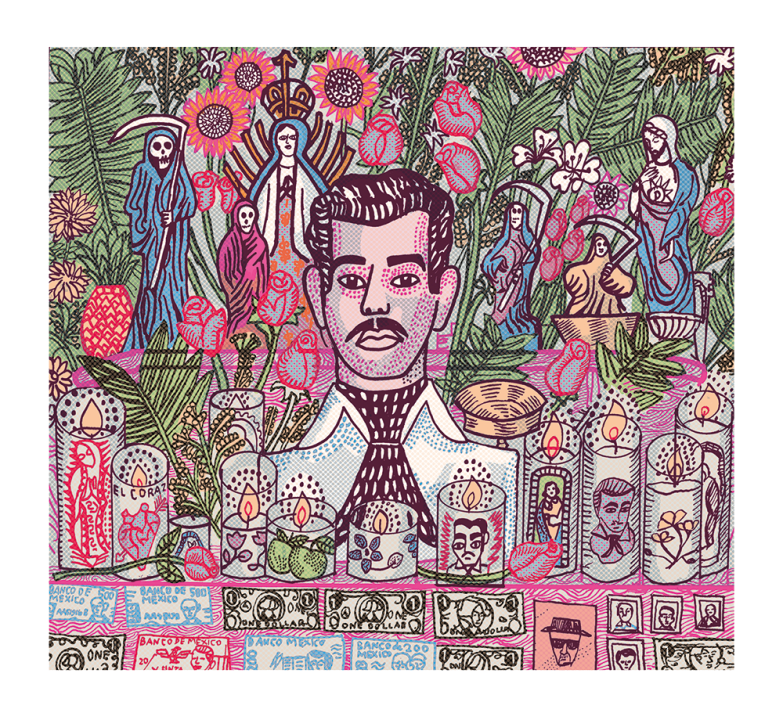
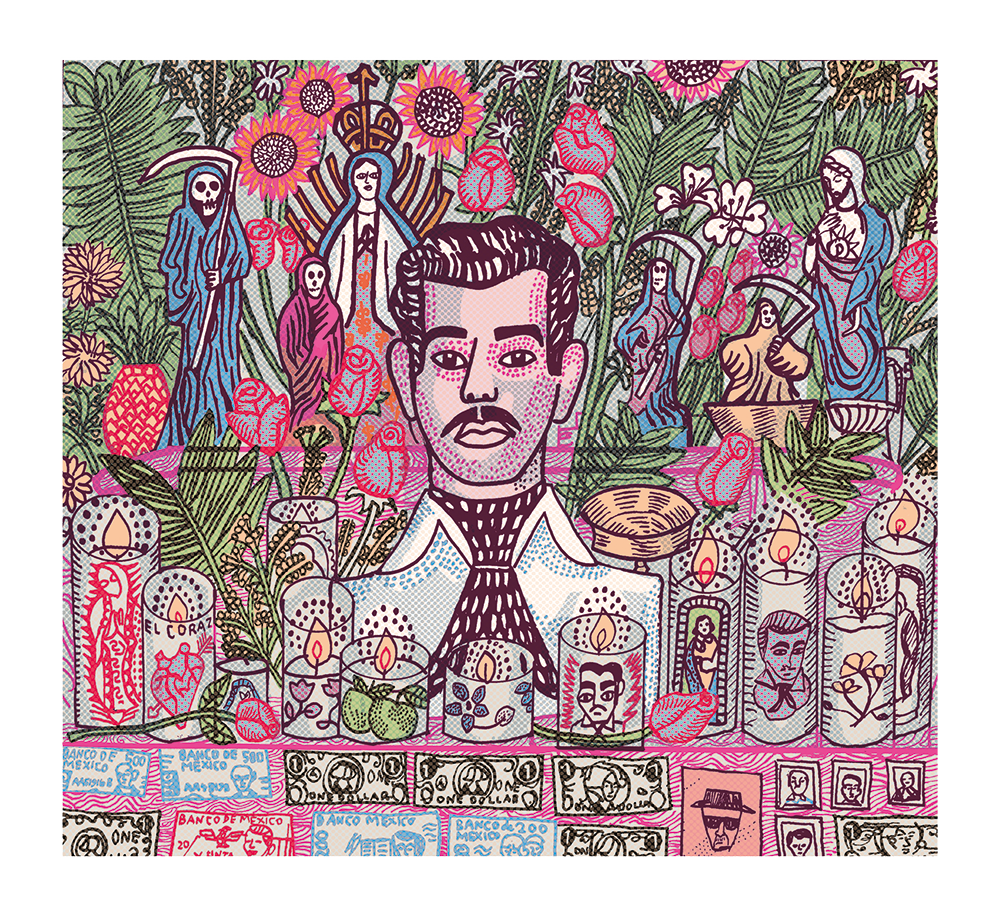
Said to be a thirsty saint, la Santa Muerte requires offerings such as beer or tequila, as well as chocolates, candy, flowers and cigarettes. Devotees keep candlelit statues of her in their homes and petition her for help. The color of the offerings suggests the kind of aid Santa Muerte might deliver. Red for love and lust, white for purification, purple for healing, gold for wealth and black for protection and vengeance. She is particularly popular with those at the margins of society and those who deal in transgression: prostitutes, street vendors and criminals.
La Santa Muerte was first mentioned in the Spanish colonial record in 1797. Agents of the Inquisition reported that her devotees “at night gather in their chapel to drink peyote until they lose their minds; they light upside-down candles, some of which are black; they dance with paper dolls; they whip Holy Crosses and also a figure of death that they call Santa Muerte, and they bind it with a wet rope threatening to whip and burn it if it does not perform a miracle.” On discovering this, the clergy razed the chapel to the ground. One anthropologist argues that the Catholic Church’s denunciation of this folk saint and the destruction of her chapels has only furthered her countercultural appeal.
In the 1980s, the remains of some 15 bodies were found on a ranch outside the border town of Matamoros. The ranch belonged to Adolfo Constanzo, a Cuban-American drug trafficker and gang member. The victims had been ritually sacrificed and were found among cauldrons, daggers and a statue of Santa Muerte. Constanzo was believed to be a syncretic satanist, tying together elements of Afro-Cuban voodoo, Mexican witchcraft and this aberrant cult.

Mexico has been Catholic for 500 years, but paganism remains a stubborn survivor. Around Mexico City are numerous signs on lampposts advertising “las limpias” – not cleaning services, but witches who will release clients from curses. La Santa Muerte has been condemned by Catholics and Protestants alike, but it is the fastest-growing cult in Latin America. One goes to la Santa Muerte for refuge from the cartels’ reign of death, and cartel soldiers are among its greatest devotees. They inflict death, and one day will suffer it themselves: praying to la Santa Muerte is their way of holding the inevitable at bay for as long as possible.
Along with the death goddess, there is also the narco-saint, Jesús Malverde. A “good” bandit, he is supposed to have lived at the beginning of the 20th century, but there’s no compelling evidence he existed. He stole from the rich to give to the poor, before being killed, betrayed by his friends.
His main shrine marks the site of his supposed death in Sinaloa. The chapel to this narco-saint is just a block from the state government building and every May thousands of devotees meet to parade his bust through the streets. Malverde is revered by cartel soldiers as a powerful intercessor and protector for these modern would-be Robin Hoods.
As in Catholicism, the saint acts as a friend in heaven, one who suffered as we suffer, one who points a path through life. He is sometimes thought of as a kind of compadrazgo, a godfather or spiritual compadre. Malverde, the “good” bandit, makes the modern killers and thieves “good” too, for they are just following in his footsteps. Malverde sanitizes evil actions. Everyone wants to be on the side of the good guys. To admit the opposite is the way to madness.
The cartels claim, astonishingly, to be on the side of right. After the nightclub incident with the severed heads, the soldiers of La Familia Michoacana left a declaration claiming: “La Familia doesn’t kill for money; it doesn’t kill women; it doesn’t kill innocent people; only those who deserve to die, die. Everyone should know… this is divine justice.” How divine justice is reconciled with being the leading exporter of methamphetamines to the United States is not clear.
What happens in Mexico has always been closely watched north of the border. In a presidential debate in 2016, Donald Trump spoke of his signature policy of building a wall along the southern border, as well as dealing with “bad hombres,” a phrase which aroused liberal condemnation. It may have suggested that Trump would take action against the cartels. Ten years have passed and the “bad hombres” are still flourishing, while America has worries elsewhere. Yet pressure may be mounting for a Venezuela-style intervention in Mexico. The cartels remain a threat to the United States, though what they have done at home is far worse. Poor Mexico, rich tales… such as those of Santa Muerte and Jesús Malverde.




Comments