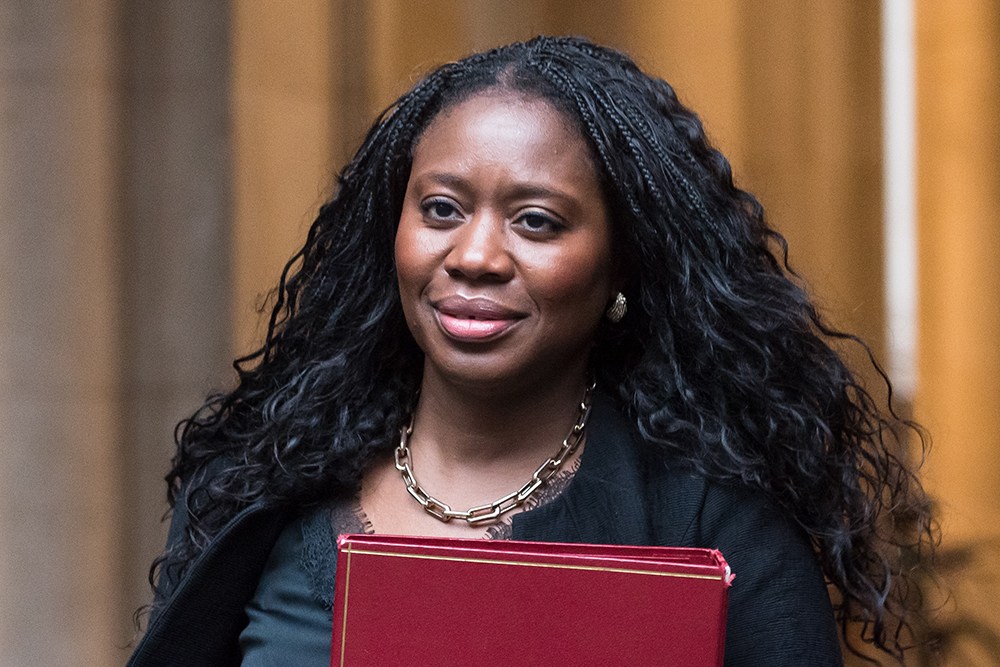


Labour may have removed hereditary peers from the House of Lords, but the party has its own dynasties. This government has a Kinnock, a Falconer, a Miliband and a Reeves, all representatives of famous political families. But the minister with perhaps the most intriguing ideological ancestry is the Energy Secretary, Miatta Fahnbulleh.
No one denies that Fahnbulleh is an intellectually formidable operator in her own right. With a PPE degree from Lincoln College, Oxford, she speaks with a poised confidence. She has described herself as a Liberian ‘refugee’ and the inference many will draw is that she is a child of poverty, not privilege. But Fahnbulleh was educated privately at Beechwood Sacred Heart School in Tunbridge Wells, where fees to board are now more than £40,000 a year.
Fahnbulleh’s parents are not, however, perhaps typical of public-school parents. Her father, Henry Boima Fahnbulleh, is generally styled as a ‘former diplomat’. He was indeed foreign minister in Liberia in the 1980s, and latterly a national security adviser to President Ellen Johnson Sirleaf. But he is also a Marxist radical who dedicated himself over a long career to the violent overthrow of those who got in his way.
In the conflicted world of West African politics, Henry Fahnbulleh was one of the founders of a far-left militant group – Front for Popular Democracy in Liberia (FPDL), whose members, several sources allege, received training from Colonel Gaddafi. And he was no mere theorist of revolution – he wrote incendiary speeches designed to inspire comrades. He also had personal connections to alleged Liberian war criminals.
Miatta’s narrative is that her family fled Liberia because of her father’s outspoken views and that was that
The story of Henry Fahnbulleh is tied intimately to the travails of his home nation. The Fahnbulleh family belong to the Vai ethnic group, one of the indigenous populations whose presence in Liberia pre-dates the arrival of freed African-American slaves in the 19th century. The dream of Liberia was of a free African republic, in a sea of colonial states, with former slaves establishing a liberal democracy modelled on the US. But the freed slaves themselves emulated the oppressive rule they had escaped from in the old American Confederacy, lording it over the indigenous peoples. Henry would call it a ‘primitive oligarchy entrapped in the sentiments of the American Deep South’.
Henry’s father was a diplomat turned dissident, was convicted for treason, pardoned, and then later ‘killed while striving for social justice’ according to Henry. But the Fahnbullehs were wealthy enough to send Henry to the US to conclude his education, and he took a degree at Howard and a PhD at George Washington University. He returned to Africa an academic, lecturing at the University of Liberia, and an aspiring activist.
In 1973 he co-founded the Movement for Justice in Africa (MOJA), a circle of radical academics, and began to agitate against the Americo-Liberian government. His ideology was, in the fashion of the time, Marxist Pan-Africanism. He celebrated the anniversary of the Soviet October Revolution, cheered the victory of the Vietnamese over the Americans, praised Chairman Mao, the Burkina Faso revolutionary Thomas Sankara and the Yugoslav leader Tito, and also quoted from Marx’s The Eighteenth Brumaire of Louis Bonaparte, ‘Hic Rhodus, hic salta!’, a call for the revolution to prove itself in action.
Henry also extended strictures to those on the left whom he thought insufficiently dedicated to the cause. He criticised liberals for their ‘fixation on “freedom of the press”’ and ‘the fetishism of “freedom of expression”’. He praised the Egyptian dictator Gamal Abdel Nasser for making Cairo a ‘political home of many freedom fighters from the Third World’ and called him ‘an inspiration’. (Miatta’s brother, the broadcaster Gamal Fahnbulleh, shares Nasser’s first name. Another brother, who died of leukaemia when he was 19, was called Fidel.)
By the late 1970s the oligarchy was in serious trouble. The oil shocks had devastated the economy and in 1979 Monrovia was wrecked by riots over the price of rice. In 1980 the president, William Tolbert, was murdered in a coup.
Fahnbulleh and his progressively minded peers backed the overthrow of Tolbert and he joined the government formed by the coup’s leader, Samuel Doe, who became the new president. Under Doe, Henry went on to become education minister. His first speech, ‘University without walls’ was nothing if not idealistic. He told students that their mission was to ‘liberate the faculties of man from the entrapment of egoism’ and that to do so they must ‘spread out into the slums and suburbs’ to teach the people ‘the values of sacrifice and dedication to noble ideals’.
The honeymoon did not last long. In 1983, Henry, by then foreign minister, was cast out of the administration. He claims this was as a result of his opposition to Liberia resuming diplomatic relations with Israel. His own views on Israel were hardline. In 1988 he attacked the Israeli government’s conduct in Lebanon, saying it was repeating ‘the gory history of Auswitz [sic] and Dachu [sic]’ and compared the Israeli ideologue Rabbi Meir Kahane to Hitler, Goebbels and Himmler.
After falling out with the military junta, Henry fled to Sierra Leone with his wife, Ada, and their three children. They left for Paris and eventually came to London. This is where Miatta’s narrative about her family’s involvement in Liberian politics usually ends – the family fled because of her father’s outspoken views and that was that.
But Henry did not settle into exile. His restless revolutionary temper took him to Ghana, where he was joined by another former Doe official, Charles Taylor. Taylor said that Fahnbulleh invited him there.
Taylor and Henry fell out, and Taylor went on to stand trial for war crimes in the Hague. He was sentenced to 50 years for crimes including terrorism, rape, murder and the use of child soldiers.
Both men were in Ghana to create opposition groups against Doe. Henry himself wrote, of a failed 1985 coup attempt against Doe, that ‘we were organising heroic men to confront the tyranny’ and that ‘we wanted a national war of liberation’.
Taylor also claimed Henry had connections to other Liberian exiles, FPDL members allegedly trained in Gaddafi’s Libya, who were working to overthrow the Doe government. According to the historian Stephen Ellis, the FPDL were ‘the guerrilla army formed by Fahnbulleh and the old guard of MOJA, which developed plans to launch an invasion of Liberia from Sierra Leone’.
Gaddafi, already an international pariah in the 1980s, was only too willing to support action against the Doe regime, which had expelled Libyan diplomats in 1981 at the behest of the Americans. Henry subsequently criticised Gaddafi, but partly because Gaddafi supported his rival Charles Taylor. ‘It is tragic that Gaddafi and others who claimed to be revolutionaries can blindly assist this petty criminal [Taylor] in his adventurism,’ Henry said. He further claimed Gaddafi had wanted to ‘create an empire of little black morons in West Africa’.
Henry has stated that he played no role in the civil war, despite describing himself as a militant
The Liberian Truth and Reconciliation Commission (TRC) looked into many of these murky dealings, but in the end did not sanction Henry. Henry has stated that he played no role in the civil war, despite describing himself as a militant. Indeed, in the TRC report he said of his actions, ‘as young militants we owe no apologies’. He has also not been shy about acknowledging his own close connections with men accused of war crimes. George Boley, who Henry has described as a ‘good friend of mine’, led the Liberia Peace Council, another militia faction, which was accused by the TRC of slitting the throats of villagers with cutlasses, burning alive those they accused of witchcraft, and the mass rape of women. Boley was deported from the US in 2012 after a judge found that he used child soldiers.
Henry justified political violence in other writings and speeches: ‘No one has the right to prescribe to a people what method they should use in fighting injustice… Thus it is said: “The tree of liberty only grows when watered with the blood of tyrants.”’ Elsewhere he called for a revolution followed by a non-democratic transitional period, at which point the ‘revolutionary masses’ will ‘be in a position to engage in democratic and popular participation’. Anything less would be ‘reactionary class obfuscation’.
His attachment to revolution did not translate into popularity with the masses. When he ran for the presidency of Liberia in 1997 – the year Miatta started at Oxford – he secured just 2,067 votes, losing to Charles Taylor.
Raised in a revolutionary household with an exiled father and fratricidal conflict as the backdrop, Miatta Fahnbulleh brings to British politics a remarkable heritage. The Spectator asked her how her father’s experience had shaped her. She said African politics was ‘brutal politics’ but that she had learned that ‘you should speak your mind and should do the things that you think are right’. Her office declined to comment about the claims made about her father in this piece.
After she initially refused to back the Home Secretary’s migration reforms, Miatta’s cabinet colleagues are learning she certainly does speak her mind. What else this daughter of a radical dynasty thinks it right to take a stand on will be fascinating to observe.




Comments