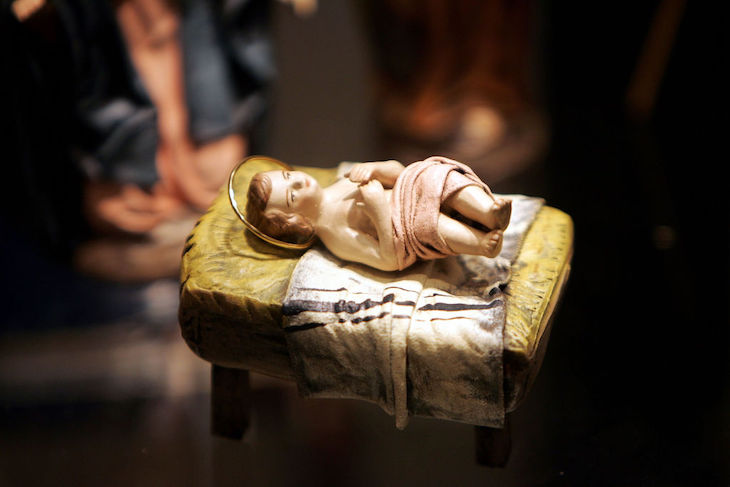
As stale as it is flawed, the Guardian columnist Polly Toynbee’s view of Christmas nonetheless encapsulates secularist scepticism in revealing ways. Published three years ago, her broadside is a variation on complaints voiced every December in allied quarters for many decades. ‘Much as I dislike most Christian belief, the iconography of star, stable, manger, kings and shepherds to greet a new baby is a universal emblem of humanity . . . But the rest of it, I find loathsome. Why wear the symbol of a barbaric torture? Martyrdom is a repugnant virtue, so too the imposition of perpetual guilt.’
The Christian conviction is that God remakes human nature by defenceless love, rather than by producing a banner in the heavens inscribed ‘I’M HERE, YOU IDIOTS’
Toynbee then produced some heroic myth-making of her own about ‘fanatical early Christians, who permitted no heresy, hacked down temples, and burned ancient classical texts’. Almost every one of these claims is either misconceived, one-eyed, or flatly untrue. Yet the narrative prospers all the same.
How can thoughtful believers reply in a context admittedly marked by schmalz as well as ill-informed polemics? First, by considering historical and spiritual claims in parts. Toynbee judges the Church’s overall record to be abysmal. Read experts in the field such as Tom Holland or David Bentley Hart or Lucy Beckett, by contrast, and you can see how Jesus’s followers made the world a far better place. Pre-Christian religion regularly mandated self-mutilation and human sacrifice. The weak were despised. Christianity’s stress on the radical equality of all, and the founding of hospitals, schools and other philanthropic institutions, were genuinely revolutionary. Legislation enacted under Roman emperors such as Theodosius II and Constantine raised the status of women. Even slavery – an institution common to all pre-modern societies that reached a certain level of wealth – was described as blasphemous as early as the fourth century by the hugely influential thinker St Gregory of Nyssa. His writings were solidly rooted in the New Testament.

The list goes on: despite the persistence of cavils about the alleged incompatibility of science and religion, it is no accident that modern science arose in a Christian matrix. Copernicus, Kepler, Galileo, Descartes, Newton and Leibnitz were all men of deep faith as well as intellectual genius.
In fairness to Toynbee, her doubts run deeper. She finds the Christian world view as such – especially the idea of atonement – absurd. While being savagely judgemental in her eyes, Christians apparently also fetishise pain and suffering. I don’t doubt that some post-Reformation readings of the crucifixion are wrong-headed or unattractive. But since none derives from the first millennium, none can be called genuinely orthodox. More traditional as well as more inviting, Rowan Williams’s account of Calvary reframes things as follows:
‘The story of [Jesus’s] life and death asks us to imagine this figure standing in the path of a crushing load of hatred, terror, guilt, panic and suspicion hurtling towards us and saying: ‘What happens if I face and absorb all this instead of passing it down the line to others? Watch what becomes possible in the wake of that. Trust. It may turn out to be more than you could have imagined.’’
Surprisingly, perhaps, this awareness catapults us back to the season we’re now in. Toynbee also misses vital ties between Christmas and Easter. The Nativity kick-starts a recasting of assumptions about God shared by believers and non-believers alike. Set aside for a moment the carols that focus on snow and a sweet baby. Think, rather, of lines that throw up mind-bending ideas. ‘God of God, Light of light . . . Very God, begotten not created’ from ‘O Come, All Ye Faithful’.
Dating back over 1,600 years, these phrases point towards the reality held to stand at the heart of the drama. Not God as such, but God ‘from’ God. In other words, divinity spills over from eternity into time. During the forging of the creed, Christians were especially exercised with how the divine life could truly be said to flow into the world through Jesus, while leaving God undiminished. They were assisted by the analogy of light. When one flame is lit from another, the originating source burns just as brightly as before.
The animating idea here can be stated straightforwardly. From a Christian standpoint there is nothing in God that is not giving or sharing. It is the divine nature to hold nothing back. This feeds not only belief about the ‘logic’ of Trinitarianism – the teaching that God’s own life is eternally marked by loving relationship – but also notions about the fittingness of creation itself. The Abrahamic faiths agree that the world is a gift reflecting divine generosity. This perspective is ratcheted up by the Prologue to John’s Gospel, with its statement that the Word of God – the divine reason and wisdom – enlightens all of humankind.
So there is continuity as well as radical change at Christmas. For Christians, the God whose life and action is held to stand just below the surface of the world breaks through like a wellspring. A crucial aspect of church teaching is that our Creator does not pick apart the fabric of creation in order to inaugurate a new way of being with us. Divine agency operates not by breaking into the world, but by filling it out from within. A crisp form of the message comes in ‘Hark the Herald Angels Sing’: ‘Veiled in flesh the godhead see, hail the incarnate deity . . . Pleased as man with man to dwell.’
It is no accident that modern science arose in a Christian matrix
At root, then, the Christian conviction is that God remakes human nature by defenceless love, rather than by producing a banner in the heavens inscribed ‘I’M HERE, YOU IDIOTS’, as the literary critic Terry Eagleton has wryly accused Richard Dawkins and other New Atheists of demanding. In brief, God’s majesty lies in his consent to become a creature, a consent which finds its needed room in Christ’s willingness to live and die the life and death dealt out to him. The two consents are wedded, with the human willingness becoming – in a famous image – a ‘tongue’ for the divine willingness.
Another well-worn metaphor can be used to suggest that a master craftsman, looking at a damaged musical instrument, might say that he will restore it with glue. But it will not manage what it is capable of performing unless the craftsman works with the grain of the wood. Here we have a sketch of incarnational belief – and through it of a revolutionary faith worth taking seriously, whether or not one accepts it in person.




Comments