
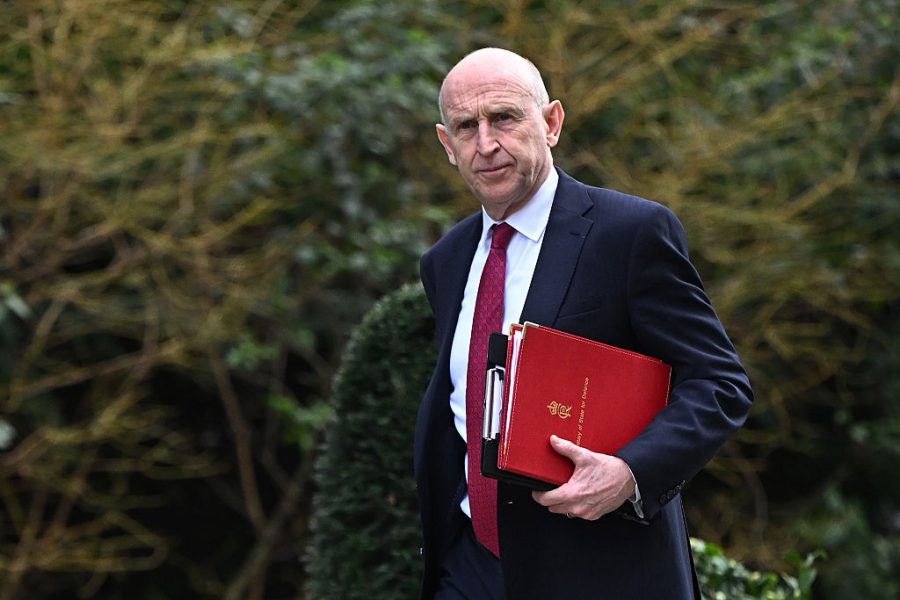
What are the odds that Vladimir Putin is going to be cowed when British Defence Secretary John Healey warns him ‘we see you. We see your activity over our cables and our pipelines, and you should know that any attempt to damage them will not be tolerated and will have serious consequences’? Pretty poor, it is safe to say. Yet what might seem like a harmless piece of political grandstanding actually carries serious risks for the UK.
Healey was briefing on a recent operation to monitor two submarines from GUGI, the Russian Navy’s Main Directorate of Deep-Sea Research, which spent a month surveying undersea cables in and near Britain’s Exclusive Economic Zone (EEZ). Extending 200 nautical miles from a country’s coastline, the EEZ is not the same as our territorial waters, which are only up to 12 nautical miles deep. Other countries’ ships can operate freely there, so long as they are not fishing or mining.
How long before voters tire of the ‘Russians are coming’ line?
The presence, additionally, of an Akula-class nuclear-powered attack submarine as a decoy or escort was a concern, but the fact is that GUGI had every legal right to be there, even if Britain is naturally suspicious of their intent. It doesn’t mean that Moscow is imminently preparing to damage these cables carrying power and telecommunications traffic (many of the attacks in the Baltic Sea for which they were blamed have later been found to be accidents). However, it is almost certain that were open hostilities to break out – God forbid, they might – such survey missions are intended to ensure Russia is prepared.
In this context, Healey’s breast-beating, flag-flanked press conference rang rather hollow. The Russians, we were told, were mounting a ‘covert’ operation – was the Ministry of Defence (MoD) expecting an invitation? – but ‘retreated’ after a month’s activity. It sounds awfully as if they carried out their mission and then returned home, regardless of being ‘watched, monitored and tracked’ by a single Royal Navy frigate and a P8 reconnaissance aircraft.
The Russians, who once considered the Royal Navy the gold standard against which to measure themselves, do not seem all that impressed by Britain’s supposed show of strength, especially coming as it does after the safe transit of several of their ‘shadow fleet’ oil tankers through the Channel. Despite Keir Starmer’s promise of tougher action, the presence of the Russian frigate Admiral Grigorovich may have helped ensure their safe passage.
It was ‘a slap for Starmer’ for the government newspaper Rossiiskaya Gazeta. ‘Britain is disgraced,’ agreed the pro-Kremlin tabloid Komsomolskaya Pravda. ‘A Russian frigate gave Starmer a public spanking in the English Channel’, crowed Moskovsky Komsomolets.
It hardly helped that the satellite photos and map of GUGI installations provided by the MoD in support of Healey’s briefing had the base at Olenya Bay marked close to the port city of Arkhangelsk and not, as it should be, Murmansk. Although the mainstream Russian press has focused on the ‘shadow fleet’ story, nationalist Russian social media accounts had fun posting maps putting Moscow in Poland and London in Ireland.
So far, so predictable. A British politician trying to sound tough on Russia to distract from the parlous state of the military and explain away the lack of any substantial commitment to the Middle East. Russian propagandists, meanwhile, happy to deride the UK as a has-been power.
Yet this kind of overblown rhetoric actually does matter, and in the worst ways. It widens the gulf between rhetoric and reality on defence and the alleged Russian threat in particular.
By contributing to a sense in Moscow that the UK and most of Europe are all mouth and no camouflage trousers, far from deterring Russia, rhetoric such as Healey’s risks the very opposite. There is no real evidence that the Russians are looking to extend their war in Ukraine into the rest of Europe. However, Putin is the consummate opportunist. If he does have any such inclinations, then seeing Europe apparently more willing to talk than act tough might encourage him.
Yet Putin is also apparently genuinely of the belief that Nato is a hostile, even aggressive anti-Russian force. Arguably even more plausible is the risk that Western politicians, eager to win points at home by some cheap Russia-bashing, convince an ageing and pretty paranoid Kremlin that Nato is actively preparing to attack. In that case, Putin’s personal predilections and age-old Russian strategic culture predispose it to strike first. This kind of a war is highly implausible, but if it does happen, it will most likely be the result of misunderstanding and fear rather than malign strategy.
Finally, European rearmament will be a lengthy, costly process. It is necessary as much as anything else to liberate the continent from dependence on a United States whose pivot away from the ‘old continent’ predates and will outlive Donald Trump. A quick sugar hit of Russia-bashing may be tempting but is no substitute for a mature and serious debate about the wider reasons and the inevitably painful policy choices involved.
How long before voters begin to tire of the ‘Russians are coming’ line in this era of attention deficit disorder politics? The risk is that people either then come to question this or demand tougher (and thus potentially escalatory) responses to the purported threat.
Speaking softly and carrying a big stick is still the way to go. Loud talk while brandishing nothing but a twig may be what politicians of every stripe tend to do these days, but is no strategy for the long term.





Comments