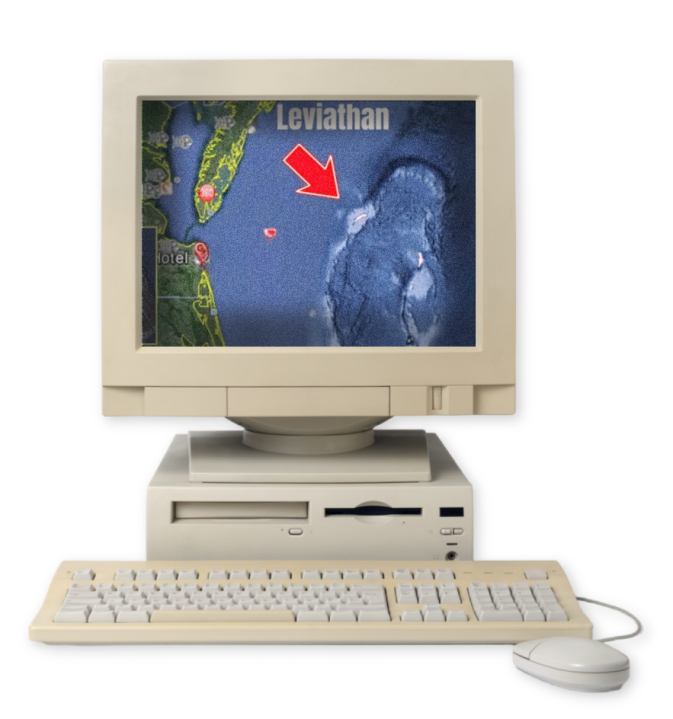


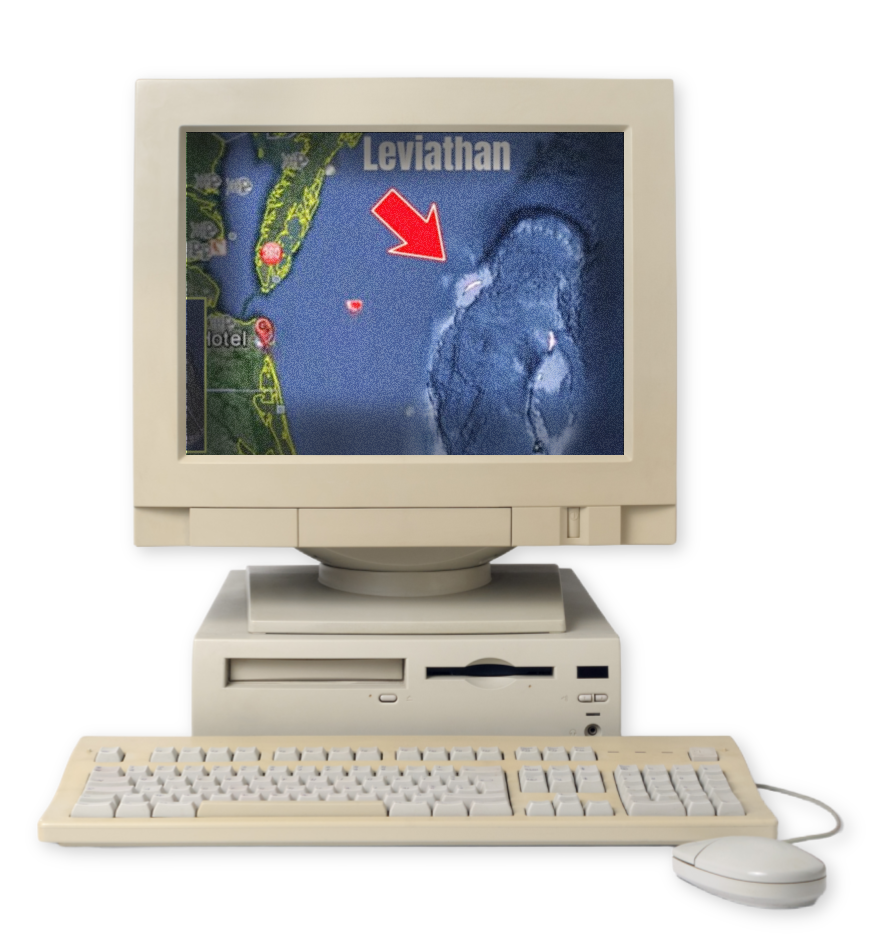
Last month, during the Arctic Blast that still has a few states trapped under ice (greetings from Illinois), someone posted an altered Google Earth screenshot to Facebook. The image displayed a snake-like shape in the Atlantic Ocean, east of Virginia. “The Leviathan is waking up,” the caption read. “This is why they are creating a FAKE snow storm and manipulating the weather so they can freeze it because of the military bases in the area.”
The post gained enough traction to land on Know Your Meme, the internet’s best-kept meme encyclopedia. But it wasn’t just a meme, at least in the sense we usually mean. A lot of people earnestly believed that the biblical Leviathan was waking up from beneath the Commonwealth of Virginia. Within days, people were cross-referencing the Bible, pulling up maps of naval installations and treating weather radar imagery like scripture requiring interpretation.
AI brings a new epistemological category, not ‘real’ and not ‘fake,’ but something like ‘plausible render’
I’ve been passively consuming cryptid material – information about mythical creatures – for most of my life. It was always a little silly, even when it scared you, and everyone knew, and that was part of why it worked. The thrill was in the “maybe.” The sound of the house settling after you finally turned off Unsolved Mysteries. Art Bell’s voice fading out as you drifted off, half-listening to a caller describing triangular lights over the desert, or maybe some kind of dog-human hybrid out in Appalachia. The inevitable shadow that passed by your bedroom window that was either a tree branch or the Jersey Devil. The fun that was any of it could feel plausible, if only for a moment.
But something shifted, and it’s hard to say exactly when. It’s not just that more people seem to believe in cryptids, though that does appear to be true. (Bigfoot belief continues to rise.) TikTok is flooded with dragon-sighting videos, for example, and the people posting them aren’t joking. The same goes for the mermaid videos that circulate every few months. Scroll through the comments and you’ll find thousands of people who apparently believe it. Tens of millions of Americans are Young Earth creationists, which, yes, includes a belief in what we’d ordinarily consider “cryptids.” What’s changed isn’t just the numbers, though. It’s the texture of belief, the way the material circulates, the feel of it. The wink is gone. Or rather, it’s become impossible to tell who’s winking and who isn’t.

Cryptid belief has followed the same trajectory as a belief in conspiracy theories – moving from the margins, and at its most mainstream, a form of entertainment, to the middle of how ordinary people talk about the world. Many have pointed out that QAnon functions like a collaborative roleplaying game, and that pundits like Candace Owens are essentially running alternate-reality games with their increasingly elaborate conspiracy arcs. That’s true, but I think it undersells what’s happening.
We didn’t just all spontaneously decide to start playing a game because of the structure of our social media feeds. A big part of it is that we’re drowning in information. Information arrives constantly without explanation, and these stories, whether they involve sea monsters or astrology or tarot or elaborate theories about celebrities being secretly transgender or time travelers or sitting somewhere at the intersection of both, offer a way to make the feed cohere into a worldview.
This brings me to artificial intelligence, which adds another layer. Not only are people primed to look for, and indeed inhabit, a story; they’re also willing to accept evidence on different terms. The evidence for monsters was always terrible: it had to be, because there was nothing there to photograph. Bigfoot hunters could produce images, but they were blurry and ambiguous and required a generous eye. You had to want to believe. It created space for your imagination to do the work. The famous Patterson-Gimlin footage works precisely because you can’t quite make out what you’re seeing. For a while, digital photography threatened to kill all this. If Bigfoot were real, someone would have captured him in 4K. The absence of clear evidence started to feel dispositive. Many of the old cryptid hunters, especially those who made a living making content, understood this problem and pivoted to “ghost-hunting” shows where the evidence was electromagnetic field readers and cold spots, things that couldn’t be photographed because there was nothing to photograph.
But generative AI has a different quality. You might have seen the images of “the Mariana Trench with the water removed” that have been circulating on TikTok. Everyone knows they’re AI-generated, that part is completely undisputed, and yet people share them as though AI has access to a view that was previously hidden. There’s an oracular quality to it. The machine knows things and can show it to you. It’s not literally true, but it’s a type of true, a truth that many are increasingly willing to accept. The same thing is happening with cryptids. Recently, a clip purporting to show a “white dragon captured at a secret government facility in China” circulated on social media. A post mocking the video’s obvious AI origins accumulated millions of views. But I don’t think the people sharing the original were all fooled, exactly. Of course, some were – maybe most. But there’s another dimension here. The video felt like it was visualizing something that could exist, as if AI had the power to access some latent possibility.
AI has introduced a new epistemological category, not “real” and not “fake,” but something like “plausible render.” The machine, in this view, doesn’t fabricate so much as explain. It shows you what the world could contain – like a medieval illustration of a unicorn. And if unicorns are possible, like the Mariana Trench without water is possible, if the AI can produce one, then maybe the world is stranger than the boring materialist account suggests. The image isn’t evidence that the thing exists. It’s evidence it could exist, which for a lot of people turns out to be enough. The machine becomes a window to a world that might be.




Comments