As I sat down to write this article, an artist friend phoned me to deliver a pithy but convincing defence of public art: it exists, he said, to extract high culture from its supposedly elitist setting, making it visible to an audience who might otherwise feel excluded. This made me think back to my own formative encounters with the art world in the late 1990s and 2000s, most of which I owe to public commissions in the northeast of England. At that moment, a Newcastle-based commissioning body called Locus+ was in close dialogue with some of the world’s best artists: they had Douglas Gordon set fire to a grand piano and Chris Burden sail a model ship from the Fair Isle to Newcastle. They enabled Fiona Banner to melt down a Tornado warplane and reconstitute it as a giant bell.
It was all thrilling and unfamiliar and genuinely popular and, crucially, all happening a long way from the capital – a counterweight to complaints of a metropolitan monopoly on serious new art. It was certainly as good as anything that was going on 300 miles south. But the outfit lost its Arts Council funding in 2014 and has been in a dormant state ever since.
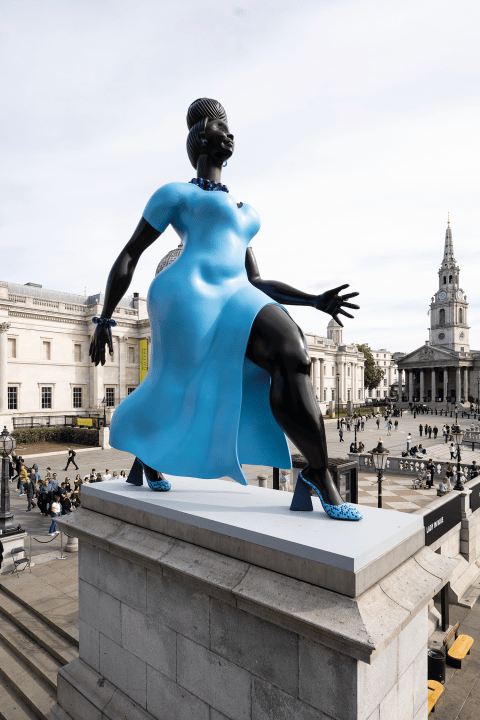
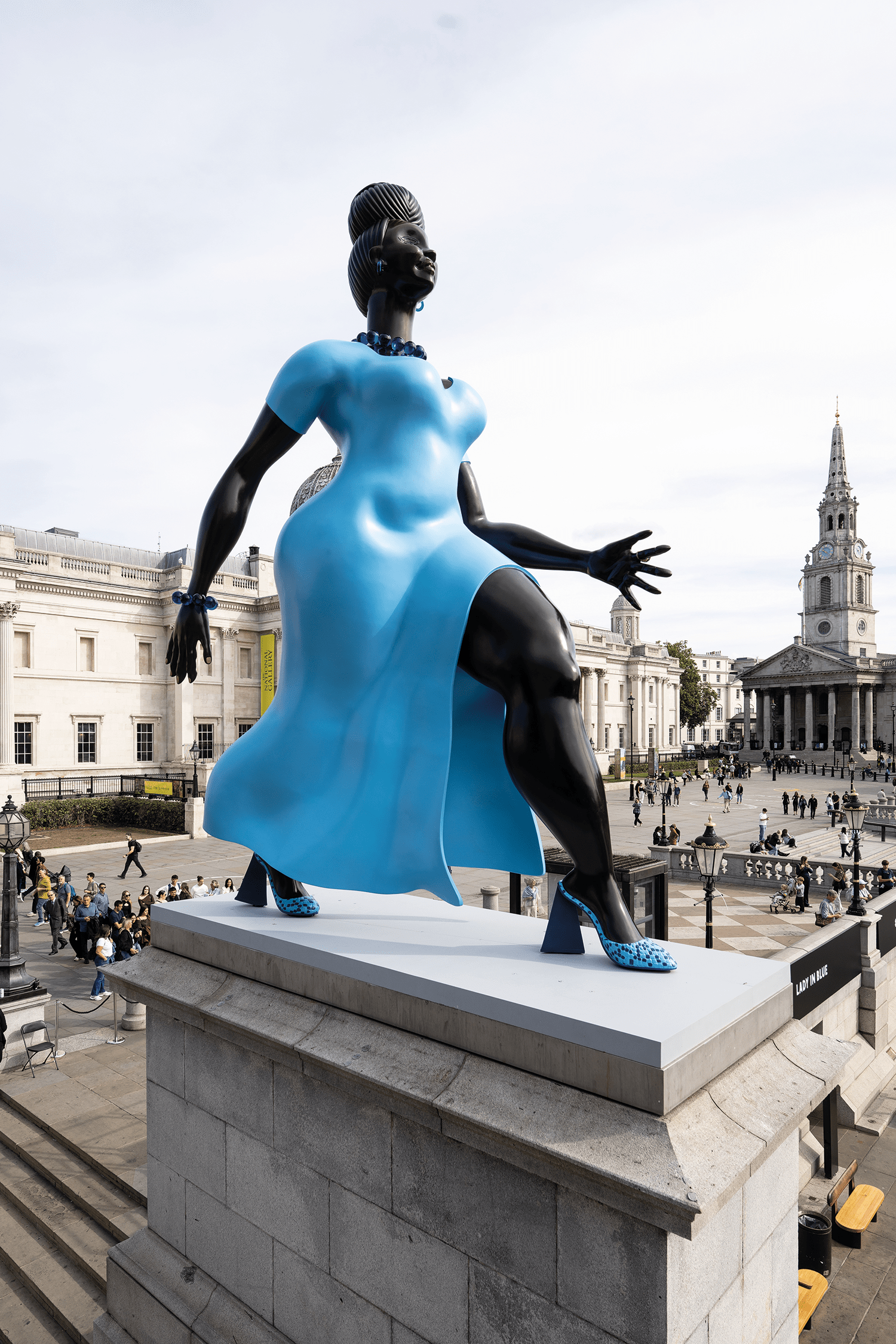
Today, even in London, things aren’t what they used to be. Take the rotating contemporary sculpture commission for Trafalgar Square’s vacant fourth plinth, for instance. The platform’s latest occupant is a vast bronze figurative sculpture by the American artist Tschabalala Self (b.1990), an operator with an uncanny talent for securing publicly funded gigs. Entitled ‘Lady in Blue’, her creation, an explanatory text insists, depicts a black London everywoman striking a ‘confident’ pose and ‘striding boldly into the future’.
It’s hard to dislike the work in an active sense, but various things about it seem decidedly misjudged. First, its optimism seems inappropriate. Would you stride ‘boldly’ into the future that we might realistically anticipate? Second, the artist’s justification for the work resting where it does strikes me as unconvincing: the effigy resembles less a Londoner than it does a production-line sculpture by Tschabalala Self.
You could be forgiven for thinking the same thing of much public art in Britain, dominated as it is by just a handful of big names. There’s nothing new here: think of the proliferation of sculptures by Henry Moore and Antony Gormley dotting the land. But the current crop of favourites are a dispiriting bunch. There’s Thomas J. Price, who specialises in stylised figurative sculptures of black subjects scaled up to heroic proportions and none the more interesting for it. There’s set designer-cum-artist Es Devlin, whose ubiquity I find entirely mystifying. There’s Conrad Shawcross, an intelligent conceptual artist whose intriguing ideas seldom meet the twain with his dull sculptures.
They are not alone, and it may be ungenerous to identify them in this context; they are far from the worst offenders. I alight on these three for a reason, however. None share a common style, but all are as respectable as they come, their sheer inoffensiveness verging on the inert. You can understand what a headache the selection process must be in the age of cancel culture, but blimey this stuff is boring. By comparison, even Maggi Hambling’s memorial to Oscar Wilde seems worthwhile: it does at least provoke a reaction.
Public art has become a byword for bad art
The picture isn’t entirely bleak. Transport for London, for instance, maintains its entirely respectable commissioning programme: highlights include Quinlan and Hastings’s engaging mosaic panels at St James’s Park. Elsewhere, successive editions of the Folkestone Triennial have transformed the town into a vast sculpture park. The work isn’t always great, but the idea is both sound and popular.
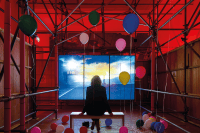
The London-based outfit Artangel, meanwhile, continues enabling artists to realise work in situations far removed from the proverbial White Cube, and still delivers the odd knockout: I think, in particular, to Naeem Mohaiemen’s ‘Through a Mirror Darkly’ (2025), a multi-channel film about the turmoil of 1970s America presented in the former headquarters of the British Transport Police. Otherwise, an approximation of ‘good taste’ rules the roost, many once formidable programmes – the Liverpool Biennial, for example – having long since lost their mojo. The consequence of which is that public art has become a byword for bad art.
Clearly money will continue to be spent on this stuff; but can this be justified when the art commissioned is so polite as to be ignorable?




Comments