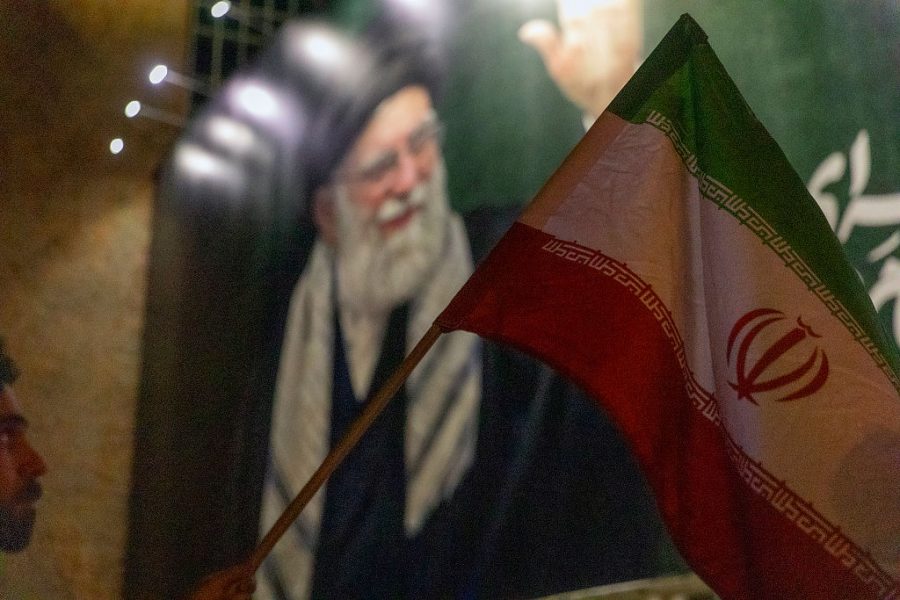
The killing of ayatollah Ali Khamenei in US-Israeli strikes on Saturday was cheered by many Iranians who have suffered innumerable atrocities under his ruthless Islamist rule of the country. While the diaspora were vociferous in their jubilation over the death of Iran’s supreme leader, many in the country also braved violent crackdowns to rejoice in the streets.
These Iranians chanted the slogan that has become a common anti-Khamenei refrain over the past four decades: ‘Death to the Islamic Republic’. The chant has echoed alongside others: ‘death to the dictator… death to Khamenei’ of the 1999 student marches; the 2009 election protests; the 2019 agitation against economic policies; the 2022 demonstrations over Mahsa Amini’s killing and the nationwide showdown against the regime that saw over 30,000 killed this January.
Since replacing Ruhollah Khomeini as Iran’s supreme leader in 1989, Khamenei has enforced brutal Islamic rule on Iran, exercising absolute authority. Inspired by the doctrine of Vilayat-e-Faqih, or ‘guardianship of the Islamic jurist’, the supreme leader was not only the head of the judiciary, legislature and executive branches, but also the commander-in-chief of Iran’s armed forces.
Khamenei’s Iranian regime had become an outcast in the Muslim world
Through his totalitarian control over the state, Khamenei eliminated any political dissent. Via the country’s army and the Islamic Revolutionary Guard Corps (IRGC), Tehran pushed its proxies in the region to similarly quell any opposition. As such, Khamenei wasn’t just the oppressor of Iranians but also of the millions of Muslims across the Middle East and beyond that were victims of Iran’s expansionist designs. None of them will be grieving his demise.
The Islamic doctrine imposed by Khamenei on the predominantly secular Persian-nationalist Iranian people didn’t limit itself to the confines of a nation-state. The ayatollah and his clergy appointed Iran the custodian of the Shia half of the Muslim world, with the IRGC propelling Shia proxies in order to safeguard Iran’s sectarian and colonial ambitions. These included organised militaries such as Iraq’s popular mobilisation forces and Yemen’s Houthis, as well as jihadist groups such as Hezbollah in Lebanon and Liwa Fatemiyoun in Syria.
Iran’s proxy militia and allied rulers, such as Bashar al-Assad, carried out massacres across the region, cleansing populations and altering demographics. Lebanon, once a Christian-majority country, saw an exodus of non-Muslims after it became a theatre of jihad following the Iranian revolution. Even secular Muslim Kurds were long denied their right to self-determination by Khamenei and his allies, who ravaged the region in the name of a fight for Palestinian autonomy.
The foundation of imperial Iran under Khamenei was its laughable self-identification as an ‘anti-imperial’ force pitted against the US and Israel, with Tehran and its allied forces dubbing themselves the ‘axis of resistance’. Given that Tehran and its proxies have allowed Israel to expand further into the region, both militarily and diplomatically via the Abraham Accords, any resistance that Khamenei upheld was limited to the rights of the people subjugated by Iran’s gory jihadism across the Muslim world. Islamists and leftists, especially in the Muslim world, are united in their eulogies for Khamenei. This underlines that, just like the ayatollah, they too have very little regard for the plight of the masses they claim to be championing.
Of course, Khamenei’s Shia Iran was just one side of the Islamist conflict. The other was Saudi Arabia and its fellow Gulf states, who had been perpetuating Sunni jihad for decades. But where Gulf monarchies had the opportunity and luxury to be able to undertake reforms and gradually diffuse radical Islam from their monarchical rules, Khamenei and his clergy have had nothing but hardline Shia Islam – and animosity for the US and Israel – to seek any legitimacy from. Hence, the ‘anti-imperial struggle’ of Khamenei, who lived under the tightest security and rarely made public appearances, has been a bid for self-preservation, more than any fight on behalf of Iranians or Muslims.
Far from being representative of any Muslims, Khamenei’s Iranian regime had become an outcast in the Muslim world. This is obvious from the Gulf states openly being a part of the ongoing US-Israel-led assaults that eliminated Khamenei. Many have covertly supported Israel’s war against Iran in recent years. While the US and Israel have been at the forefront of suppressing Iranian attempts to build the atom bomb, it is rival Gulf states, spearheaded by Saudi Arabia, that have been the staunchest opponents of Tehran acquiring nuclear weapons, describing it as the ‘head of the snake’.
It might be Islamists who continue to dominate the narratives of many Muslim countries, but many state leaderships and previously silent protestors aspire for integration with the rest of the region and the world. Many now hope that Khamenei’s demise will signal the end of this longstanding Islamist hysteria that has brought nothing but misery and destruction to the Muslim world. That is why the Middle East is currently ablaze, united in the aim of ensuring that Khamenei’s successor bears as little in common with him and his ideology as possible.

Comments