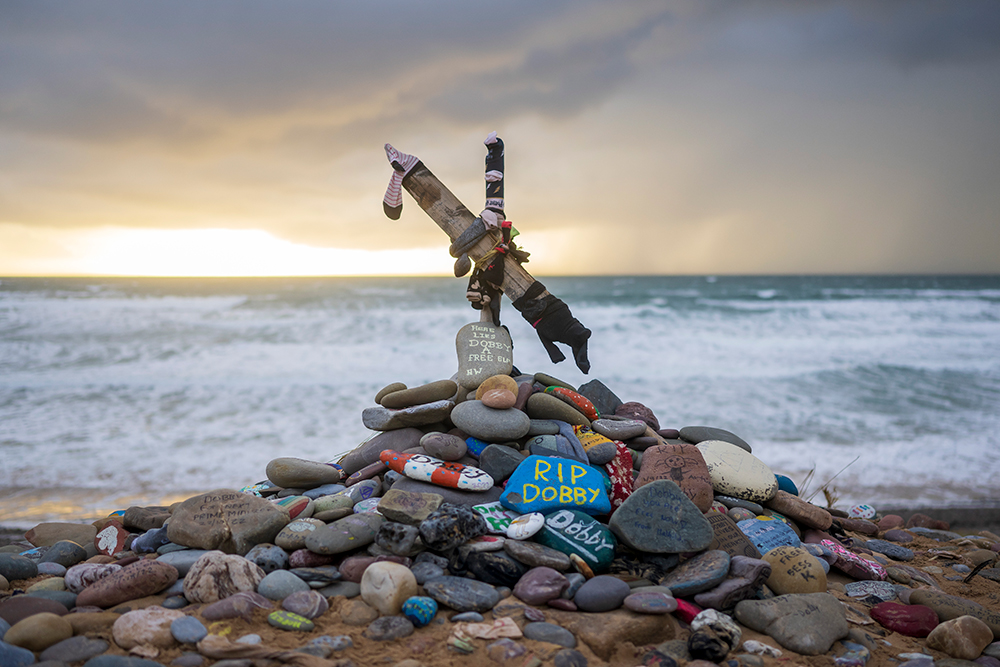


I don’t know how many readers have visited the grave of Dobby the house-elf, but any who have should immediately be sectioned and have their subscriptions to The Spectator canceled.
This strong course of action occurs to me after reading one of those stories that can make you laugh, cry and smack your head into your hands all at once. It relates to a “memorial” which apparently sits on Freshwater West beach in Pembrokeshire, Wales. The area is run by the National Trust – a charity which used to look after the UK’s heritage sites.
The beach in question was where filming took place for Harry Potter and the Deathly Hallows. Since then, fans of the film – which spawned a new generation of mewling, ungrateful actors – have been laying stones and pebbles at the spot at which Dobby died, many of them with messages on (“Here lies Dobby, a free elf”). The National Trust has already asked fans not to leave socks on the pile (don’t ask), but stones to form a kind of cairn appear perfectly acceptable.
The Dobby’s grave phenomenon is indicative of a country where the adults have taken leave of their senses
At this stage it might be worth noting that “Dobby” is a fictional character. No such house-elf ever existed. Therefore you might think this rather whimsy-infused “memorial” should not detain us much longer.
Except that this is one of those increasingly typical moments in modern Britain when a fantasy world and the real world come into conflict – and the real world loses the encounter. A £430 million ($580 million) undersea cable linking the UK and Ireland had been due to pass through the area but – thanks to Harry Potter fans complaining in their hundreds – was rerouted. Indeed, the cable now passes nearer to some Bronze Age human burial remains in order not to disrupt the non-existent grave of the never-existent Dobby.
The project manager of this farrago told the media that the hundreds of complaints the company had received had ensured that it took the issue very, very seriously. Simon Ludlam said that, in the end, the cable “went quite close to some real Bronze Age remains, but we avoided Dobby’s grave.” This solution made “a lot of people very happy,” he added, “and Dobby’s happy.”
At this point I would be happy to pull my head out of my own hands and smack Mr. Ludlam around the face with a sock, a stone or anything else that came to hand.

Firstly, due to matters of taste. Of all the sentimental attitudes which are most painful, surely the worst is this sort of modern British “whimsy.” It is as one with the sort of people who, after the death of Elizabeth II, chose to leave Paddington Bear toys among the flowers, or pass around memes online of Paddington leading the late Queen towards the gates of St. Peter.
The Queen Mother’s favorite poem – “The Gate of the Year” – includes the line that on treading into the unknown you should “put your hand into the Hand of God.” It seemed telling that by the time her sovereign daughter died the country had ditched the hand of God as hard to put faith in and replaced it with a theology in which the departed should instead place their hand into the hand of Paddington Bear before being received into glory.
Until the past few years, I would have dismissed such sentimental claptrap as being distinctly un-British. Further, I would have said that while such mawkish sentimentality might still thrive among the Irish, the British would surely keep it at bay. I mention the Irish with justification. Some years ago, a motorway bypass in County Clare had to be altered in order to protect a “sacred” fairy bush. Local “experts” had claimed that if the fairy bush was destroyed to make room for the £100 million ($135 million) bypass then the new roadway might suffer a “curse.” More recently a new housing scheme in County Wicklow found itself at the center of a similar row after a “fairy tree” was put at risk. Fortunately the fairy tree survived as the builders built around it.
In relating these stories I do not intend to plant in the minds of readers any idea that the Irish are a superstitious and backwards people. I do not say that at all. But it does seem slightly regrettable that protecting the sacred fairy bush of County Clare, or the fairy tree of County Wicklow, seems like perfectly sensible propositions beside diverting an undersea cable in order to avoid disturbing the site of a fantasy character’s burial place.

Which brings me to the second problem in all this: that such a story seems awfully telling about a country and its priorities. Over recent years Britain has found it impossible to complete almost any major infrastructure projects. Most of the time this is due to the discovery of a rare earthworm or – as anyone who has tried to restore a property in the countryside will know – that there is evidence of bats. You do not have to have seen a bat, merely have evidence that bats may once have eyed up your property, and you’ll discover that your house is no longer your own but has fallen into the joint custodianship of Dave from the local council and any passing bat.
Even this is merely a good-ish intention taken to a typically bureaucratic extreme. No such excuse can be made for the Dobby’s grave phenomenon. It is simply indicative of a country where the adults have all taken leave of their senses and handed over the decision-making to children who were never told “no.”
I suppose that if these are the new rules of the game there is an argument for playing along. I would be happy to start by claiming there is a horcrux to be found somewhere in the oil reserves in the North Sea and that unless we start extracting all that oil we risk not finding it and therefore failing to defeat the Dark Lord. Which is not the maddest energy policy I’ve heard lately.



Comments