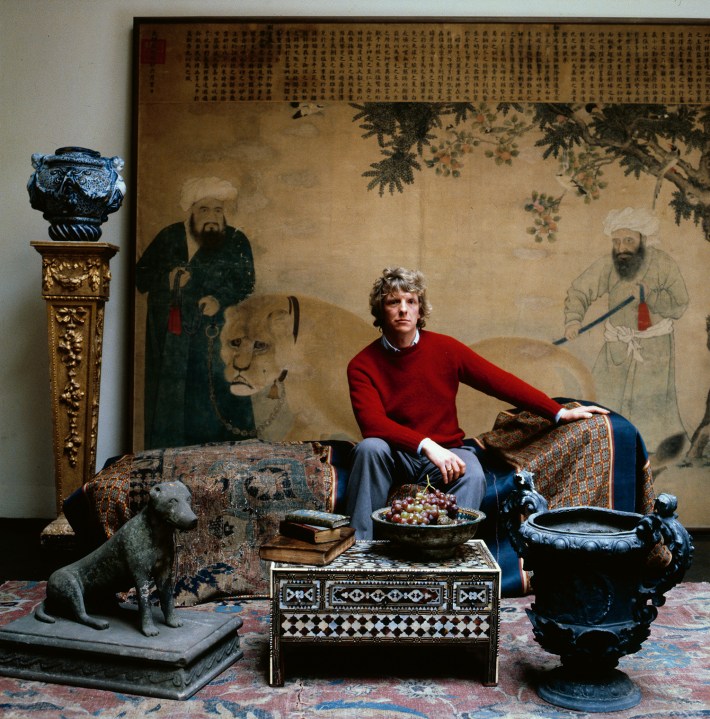

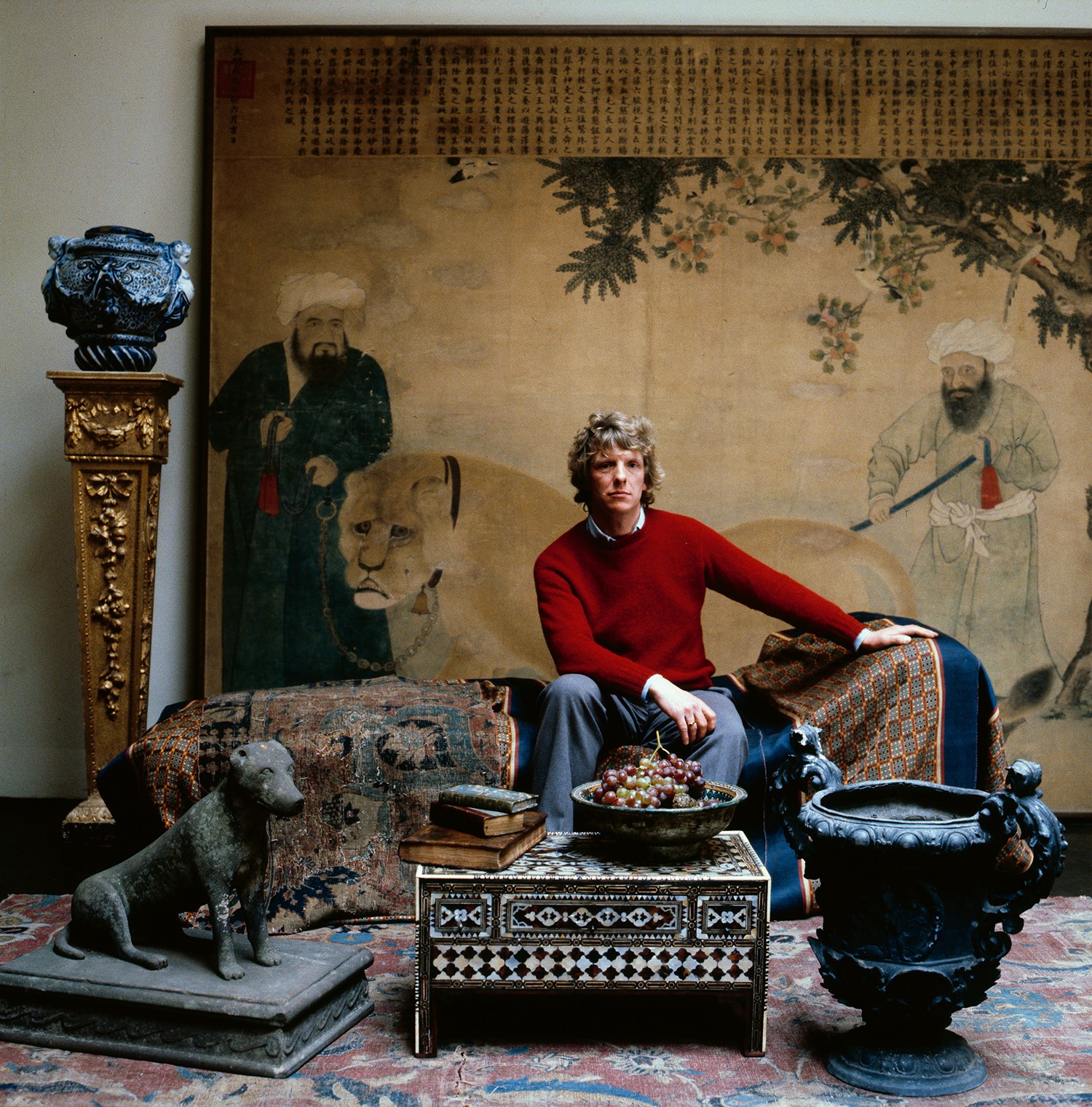
Style, self-evidently among those who pursue an interest in such affairs, is, according to the Comte de Buffon, the man himself – the essence, the heart, the bowel, the Bovril. While, among the much greater majority who pursue an ignorance in such affairs, it is an assumed gamut of off-the-peg tics, props, accent – style is something bolted on to a being’s chassis and core in the hope that it will hold.
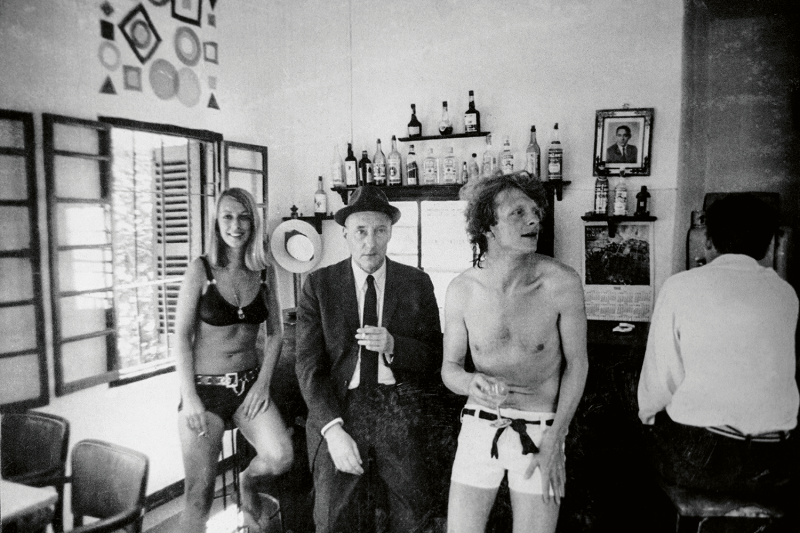
We can be certain which of these two nugatory classifications better suits the late Christopher Gibbs (1938-2018) who in the course of his long, more or less antiquarian life encountered Everyone, absolutely Everyone. “Everyone” in this instance unhelpfully signifies little beside the people, per se, whom Gibbs met, smiled at, sold to, bought from, bought for, advised and charmed. How he charmed! His name and the promise of his presence defined a once significant strand of 20th-century society and never failed to nourish one’s amour propre. It transcended generations.

Whether your hashish comes from Joujouka and your rugs from Taroudant is today no longer a matter of any minute: it was, however briefly, a most urgent preoccupation of Everyone when Everyone was young, i.e. three quarters of a century ago. And because that was a good while back this scrapbook of Gibbs’s polyvalent life is constellated with personae, places, incidents and kit (furniture, objets de vertu) intended to put his world in some sort of context which differentiates it from the mainstream Saturday parade of grockles and nostalgics for a Swinging London which had decades ago moved on: “The Chelsea Potter’s where it’s at.” No longer (and never was).
On that count the smallness of this world is perhaps not as emphatically stressed as it might have been. It was bound to just a few seconds and places in Chelsea, no further west than World’s End. Lucy Moore tends to treat the pernicious era as a monist entity. She was not born when Gibbs was at his clamorous and stealthy zenith.
Gibbs’s world was not built with an eye on legacy. Though it got one – and how – in the form of the craze for really shockingly trashy clothes, grotesque cars, music, witless ugliness and lapels that filled a room with their wearer’s humiliation. Sometimes it felt as though the world had been redesigned for maximum oafishness by Donald McGill and Benny Hill. That was the 1970s, the decade that forgot taste and probably had none in the first place.
It was what happened when Gibbs’s essentially arts-and-crafts sensibility and foraging eye were traduced by the crassest sort of manufacture: an Aston Martin gave way to an Austin Allegro packing five blue rinses. That every piece about tailor John Pearse or the club Alibi or the restaurant Casserole is forced to rely upon the same few photographs and same few well-rehearsed witnesses rather gives the game away.
This engaging book is not, then, another tired yarn of Mini Mokes, Getaway People, nylon and microskirts on rugby footballing thighs: such entertainments were by and for the proletariat who sang along with ex-brickies in velvet. And they predated the covert hush of Gibbs’s microcosm. Note the title: Christopher Gibbs: His World. That’s a warning of exclusivity as certain as a Great Dane’s maw.
Here we learn about secret swathes of silk velvet, about Baghdadi cooking behind an occluded door on Fulham Road, about reading Borges aloud and cavorting on drystone walls dressed as minstrels and troubadours. Nor, thankfully, is it an inventory of a decorator’s consigns. It is a skewed portrait of Gibbs. He was not quite an artist – though he flattered himself as a designer – more a collector and collagist, an eye, a domestic deity sprinkling Maghrebin magic from a cumin censer. In this microworld of dandiacals, designers drink from translucent cup and saucer while lower-caste decorators slurp from sugar-crusted mugs that mark them as salt of the earth – the kind who know their place. In Gibbs’s world rank and hierarchy – quasi-martial but often flimsily dissembled – endured so long as Everyone (the initiated) was alive to recognize its codes till the very end.
At the level of trade, where Gibbs operated, discretion was all and a man’s word was said to count. Incorrect attribution is a tort, and dodgy provenance is more than that for it is applied to buyers, sellers, families of blood or of no blood worth transfusing. Gibbs once showed me a startlingly strange tessellated portrait of a man (c. 1600) which, he claimed, he could not sell because he knew nothing of its back story save that it was probably Neapolitan. It reminded me of Meade Falkner’s The Lost Stradivarius, a book which now, 50 years later, reminds me of Gibbs himself. That tessellated portrait itself has gone to the mattresses. It’ll turn up.
At the level of trade, where Gibbs operated, discretion was all and a man’s word was said to count
Gibbs was also a writer on design for magazines read by aspiring people with little imagination but plenty of money: design in this context means rooms cluttered by those very magazines, bibelots, Directoire ormolu, minor masterpieces. He wrote without cognizance of his pomposity or fawning: “A house has to be awakened, furnished, lived in and made a home. There are those who have a natural aptitude for such activities but they are a rare breed, for special houses require a special understanding bred of knowledge and experience. Often, these days, the help of professionals is sought.”
The special style Gibbs sold was his own special awakening. Inflated and proud, yet cautiously so. English understatement raised its timid head. It was, to say the least, hybrid. And it was learned young. At the family house of Tyntesfield – built near Bristol to the designs of the unorthodox goth Henry Woodyer and a couple of other less wayward high Victorians – styles and sources clash with abandon. It is not that far from a well-appointed junk shop. Gibbs wrote of it with his precious chum Bruce Chatwin murmuring pretty “poetic” prose in his ear, prose which really needs a thorough kicking from some louts on the way back to barracks.
In another life Gibbs might have been an exemplary dealer in Pimlico or Bond Street. But that would be anti-Gibbs, far from the Gibbs who connected with Everyone: the Queen Mother, numerous Sainsburys, Rothschilds, a Getty or two, Talitha Pol, Gavin Young, Gavin Lambert, Poppet John, Barbara Hutton, and surviving bright young(ish) things such as Juliet Duff whom David Herbert (a sort of sage to Gibbs) called “a four-masted schooner with mink sails”.
The connection that most colored Gibbs was with Mick Jagger, whom he was jokily said to be teaching to be a “gentleman.” Given Jagger’s chameleonic deftness this was no more than a modest leap. Fifty years ago every rock band’s boast that “we are the new aristocracy” was a pathetic delusion. Gibbs and Jagger – au fond devotees of the old order, of literal aristocracy and huge families – did not change all that. But they did create a new patron class. His World shows how they did it.
Christopher Gibbs: His World, edited by Lucy Moore, is published by Clearview Books.





Comments