

‘I’m done with Trump,’ fumed a normally MAGA-supportive retail trader as he watched an investment that was particularly Hormuz-sensitive collapse. But, perhaps surprisingly, his frustration at the war is not shared more widely by stock pickers.
Despite the geopolitical turmoil of the war in Iran, equities (shares in listed companies) have been on an upward romp for the past year. Since Donald Trump was inaugurated for the second time, the Standard and Poor’s 500 index is up 25 per cent. Stock markets almost everywhere have been hitting record high after record high.
It doesn’t make much sense. This hasn’t been a good year for the world economy. The constant closing and reopening of the Strait of Hormuz sent oil prices skyward. In turn, expectations of resurgent inflation across the globe have pushed bond yields ever higher. Britain has suffered particularly badly thanks to our structural susceptibility to higher prices. But, oddly, equities have seemed immune.
The strategy turns weakness into opportunity through the assumption that the stock will bounce back
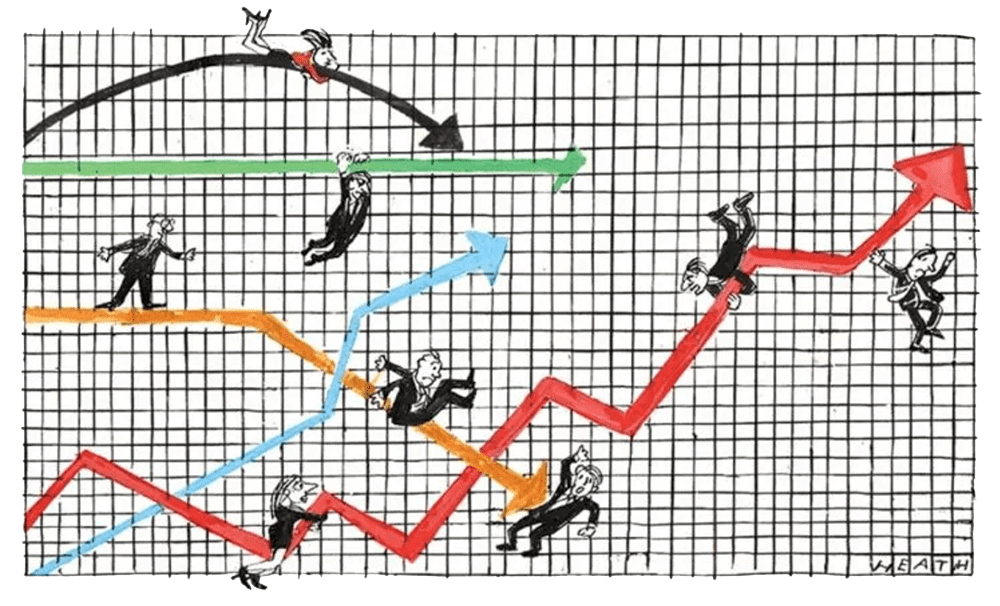
Why? One answer seems to be thanks to retail investors ‘buying the dip’. The strategy takes the age-old market maxim of ‘buy low, sell high’ and turns weakness into opportunity through the – often blind – assumption that the stock will bounce back. When markets are surging and the rise of a stock looks relentless, the day-to-day news cycle or a quarter of underperformance can cause a share price to dip. Traders then look to buy at the bottom of this dip period and unlock maximum profits when, all being well, the price heads north again. The strategy has become particularly popular with retail investors because there’s an inherent optimism to it. It almost seems community-minded.
And it’s happening more than ever before. According to Citadel Securities, the first half of this year has seen three-and-a-half times the average daily amount of buying on days the S&P has dropped. That’s the most buying of the dip since Citadel began tracking. It’s even higher than in the GameStop meme-stock frenzy of 2021, when buying the stock of a struggling video-game chain became a viral trend which sent shares up by more than 1,500 per cent in a single month and inflicted ruinous losses on hedge funds that had been shorting the stock.

For the time being, buying the dip seems to broadly work. If the market crashes, it’s bouncing back quicker and higher than veteran stock pickers have been used to. When there are market-wide dips, whether it be Covid or the 2022 inflation shock or Trump’s ‘liberation day’ tariff hikes, recoveries have become faster and faster. After the bursting of the dotcom bubble caused the S&P to collapse, it took 1,166 days for the market to return to pre-crash levels. After the Iran war began and markets plunged nearly 10 per cent, the same recovery took just 11 trading sessions.
Trump has played a role in speeding up this process. Before Iran, he had been seen as the stock market’s greatest ally. Even once missiles started flying and mines were laid by the Iranians in the strait, traders took comfort in the Taco (‘Trump Always Chickens Out’) mantra – the idea that when market pressures build enough, the President will back down from whatever action he was taking and markets will rebound. The faith in Taco creates the perfect conditions for dip buying.
Buying the dip has become so prevalent that some veteran market-watchers now believe the phenomenon explains, at least in part, why equities have proved so resilient in the face of what should be gale-force headwinds. A close look at the S&P 500 supports this view.
In truth, most stocks have been hamstrung by the war and oil prices, while the huge AI firms and chip-makers have done extremely well (last week’s wobble aside). Retail investors still chase that momentum. And nowhere is momentum – and optimism – directing trading behaviour more than at Elon Musk’s SpaceX. After its initial public offering last month, the rocket, AI and satellite firm’s market capitalisation passed $2 trillion, compared with revenues of just under $19 billion. That’s a price-to-sales ratio of more than 100 – unprecedented in the history of capitalism.
To justify this kind of valuation on traditional revenue ratios, SpaceX would need to be raking in closer to $200 billion a year in revenues. That imbalance is partly responsible for the collapse SpaceX’s stock has since experienced. But dip buyers are not fussed and instead see opportunity, as do some hedge funds holding the stock. Musk’s ambition is so big that there’s a belief he might really justify the hyper-inflated value. But retail investors will need to be prepared to hold a lot steadier than they normally do – true value is probably decades away.

In London, there’s hope among some UK-focused funds that our own FTSE has a big boom in its near future too. The government believes that part of a British path to prosperity and growth involves getting Britons into investing. But if it succeeds, most of these new stock market players will not be buying the dip. Instead, they will, sensibly, dip their toe in via fully or semi-managed funds where professionals do the picking for them or simply buy an existing index which tracks a basket of usually well-performing stocks.
One UK-focused fund manager explains to me that this increased use of ‘indexation’ could reap massive dividends for the FTSE. UK stocks increasingly feature in those tracked by indexes.
The dip-buying phenomenon, when executed correctly, is clearly working for investors, but the pros believe that success will be short-lived. Our new hordes of retail investors have not lived through a prolonged fall in prices and have not really experienced recession. When they do, the surprise could be nasty, as the dip they think they’re buying turns out to be just a light reprieve before new depths are plumbed. When that happens, retail investors would do well to remember that old, slightly patronising adage: it’s time in the market, not timing the market, that really gets results.



Comments