
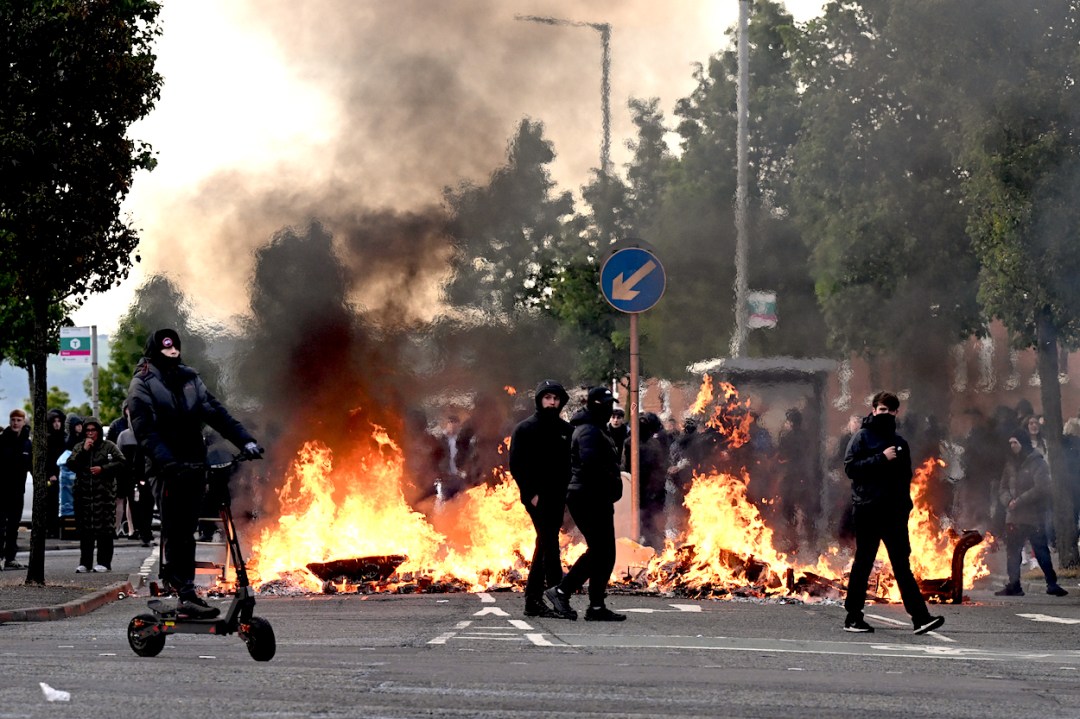
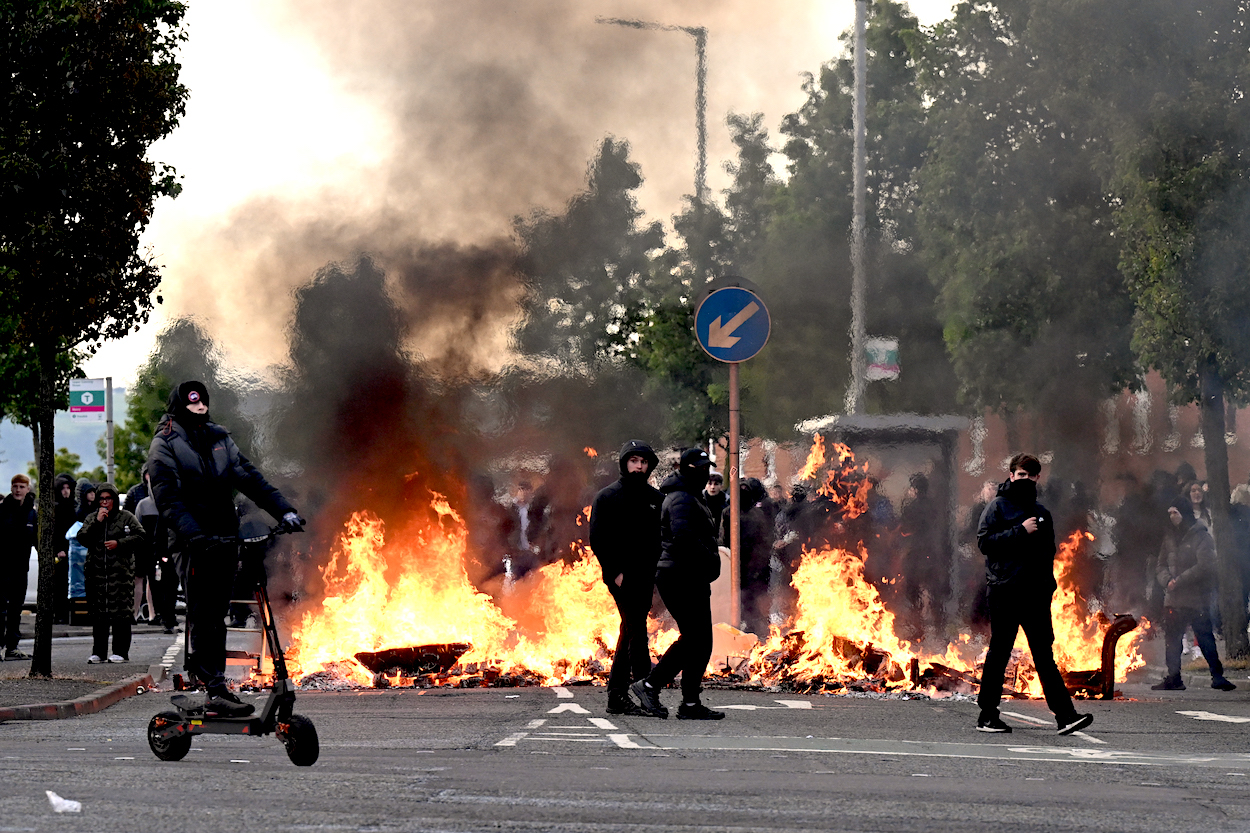
On Ardoyne Road on Wednesday afternoon, the original conflict resumed. Two loyalists passed a couple of nationalists, and they exchanged hostilities. ‘Go on then, come here and do something!’ said one of the nationalist kids. The young loyalists – recognisable in black tracksuits and balaclavas – continued up the hill as a third nationalist wheelied past them on a motorbike.
On Tuesday, the first night of the disorder in Belfast, Ardoyne seemed to be taken by a providential Christian comradeship. In one of the city’s harshest ‘interface areas’, Catholics and Protestants came together in protest against the knife attack on Stephen Ogilvie. Less than 24 hours later, however, things had returned to normal.

Night one of rioting was won by the most extreme participants. They wanted to expel not just asylum seekers but migrants living legally in the area. They got their way. On Oakley Street, a short row of Victorian houses coming off Crumlin Road (which descends from the Belfast Hills through Protestant Ballysillan past Ardoyne and into central Belfast), a Spanish family was among those who fled. A group of protesters torched the first house on the left side of Oakley Street – it looked like a smoker’s lung by Wednesday morning – and smashed the windows of the next five. Police tried to stop them but were overwhelmed.
‘They didn’t have any intel or nothing, they just burned it,’ said Josh, a white man born and raised in Belfast who lived at the top of Oakley Street with his partner and child. (Names have been changed.) He looked down his road as he spoke. Union Jacks and Ulster flags decorated many homes, telling rioters that they were occupied by Brits. Josh said the only reason the fire didn’t spread was because of an easterly wind blowing out of Oakley. ‘The guy that owns the first house, he rents it out to aeroplane stewardesses. No one in this street is bad. We used to have bad people, but they all moved out after the last protest’, Josh said.
During those last protests, in June last year, I was in Ballymena, where the Northern Ireland-wide trouble started when two Romani teenagers were accused of raping a local girl. There, local white women cried when telling me about the violence, but said that it had ‘been coming’. Foreigners had made Ballymena unsafe, they said, and children couldn’t walk alone in certain areas of town.
On Belfast’s Oakley Street on Wednesday, many residents were similarly sympathetic to the rioters. Paul, another local-born man who’d served for 22 years in the Irish Guards and had lived on the road for the past year, said there was ‘reasoning behind what’s going on’. David, smoking a joint in his porch, said: ‘Our culture has been completely blown away.’
Paul and David and others reluctantly accepted the damage to their street. Why? Because immigration riots work. The Roma have not returned to Ballymena, the asylum seekers in Belfast will be rehoused, and many of the immigrants living legally in places like Oakley Street will likely decide elsewhere is safer.
Whitehall has been unwilling or unable to create homogenous communities as quickly and definitively as bottles, bricks and petrol do. If anything, decisions made by the government have made violent methods more effective. The policy of moving more of Britain’s 93,000 asylum seekers from hotels to HMOs has not only given people reason to argue that illegal migrants are taking homes that many taxpaying citizens are struggling to afford, but has also made migrants easier targets during disorders. It is relatively easy for police to defend a hotel. (On Wednesday night, they had no trouble pushing rioters away from the Chimney Corner hotel in Newtonabbey.) It is harder for them to secure lots of homes on many streets.
At a bus stop on Crumlin Road, near Ballysillan, a young Polish man called Tomasz told a local woman, Margaret, that he was scared. He lived on Legann Street, and his neighbour’s home had been firebombed and graffitied with the words ‘STOP THE BOATS’. ‘You’re safe, you’re Polish, don’t you worry,’ said Margaret, who was an older lady on a mobility scooter. ‘The Polish helped us defeat the Nazis during the war, and we’re thankful. We have no trouble with you.’
Margaret explained that her trouble was with Muslim people. She said that she had neighbours who were Indian and Chinese and Filipino whom she liked – ‘they don’t expect us to bow down to their culture’ – but that she was ‘frightened’ of Muslims. Some ‘blacks’, she also said, didn’t respect women. Tomasz said he agreed about Muslims. ‘They are fucking nuts’, he said.
Margaret was a Protestant and Tomasz a Catholic. Margaret hoped that the two branches were ‘more together now’. ‘My friends from work are all Catholics,’ she said, ‘and they have the same worries as me about immigration.’ She nodded backwards, the way of Ardoyne, a short walk down the road. ‘But they’re not allowed to say so because the IRA still have a grip.’
Ardoyne is a tough, nationalist, working-class place. Ninety-nine people from the community died in the Troubles, and the area saw a quarter of the conflict’s fatalities. Ardoyne Road, where I came across the fighting kids, was the scene of a five-month blockade in 2001 where a mob tried to stop Catholic girls from attending the Holy Cross Primary School. The school was in neighbouring Glenbyrn – a Protestant, loyalist area joined to Ardoyne via Ardoyne Road.
Today, there remains a peace wall that cuts through the back-to-back gardens of people living on the edges of these two communities. Access through the road is unrestricted, but the border between Glenbyrn and Ardoyne is marked by a CCTV sentry tower and a sudden absence of Union flags. Ardoyne is home to many prominent republican families – the Bradleys, McCanns, Wilkinsons and others – and at the bottom of Ardoyne Road is graffiti that reads ‘INLA’, the acronym for the Irish National Liberation Army. In January, a faction of the INLA was blamed for shooting a man in both legs by an Ardoyne alleyway.
Almost in sight of this graffiti was where, on Tuesday night, loyalists and nationalists came together to protest the stabbing of Ogilvie. They stood on a nearby roundabout and talked. In the crowd was an Ardoyne man whose father was shot dead by the Loyalist Volunteer Force in 1998. He said he was there to show ‘solidarity’ with Protestants, and that he wasn’t far right. He wanted to stop ‘third-world savages’ from ‘cutting people up’.
On Wednesday afternoon, I met Fr Gary Donegan, who was a priest at Ardoyne’s Holy Cross church from 2001 to 2016, and is now the director of the area’s Passionist Peace and Reconciliation Office. Fr Gary has spent his career trying to bring Protestant loyalists and Catholic nationalists together, and to end violence on Ardoyne’s pained streets. He said he was ‘shocked’ to see the two communities stand side by side. Something he had spent 25 years working for had been delivered to him, but in the worst possible way. Fr Gary said he doubted the harmony would last.
At the bottom of Ardoyne Road is graffiti that reads ‘INLA’, the acronym for the Irish National Liberation Army
That same afternoon, Dee Fennell issued a statement on Facebook. Fennell is an Ardoyne local and a dissident republican who was a founding member of Saoradh, the political group associated with the New IRA. He said he’d just been to visit a black family on Jamaica Street, one of the roads in Ardoyne. Masked men had been at the family’s door telling them to leave the area. ‘Make no mistake,’ Fennell said, ‘local republicans will be defending this family and any others attacked like this by any means necessary.’ A few hours later, he reposted a video of a young white kid following the man from this black family, calling him the n-word and saying ‘youse are fucking despicable people’. ‘If anyone knows who this “patriot” is,’ Fennell wrote, ‘feel free to let us know.’
He was too late. The republicans of Ardoyne couldn’t stop Tuesday’s roundabout intermingling, and the British state has currently found no way to stop immigration riots being successful. Belfast was a reminder of how weak the establishment is, how lucky the rest of the United Kingdom has been, and how easily disorder can arrive. It doesn’t take much to scare people out of homes – just a few highly motivated citizens. All Keir Starmer could do was say he would ‘not tolerate’ violence and send 200 police officers to Northern Ireland. They arrived yesterday, after all the damage was done.




Comments