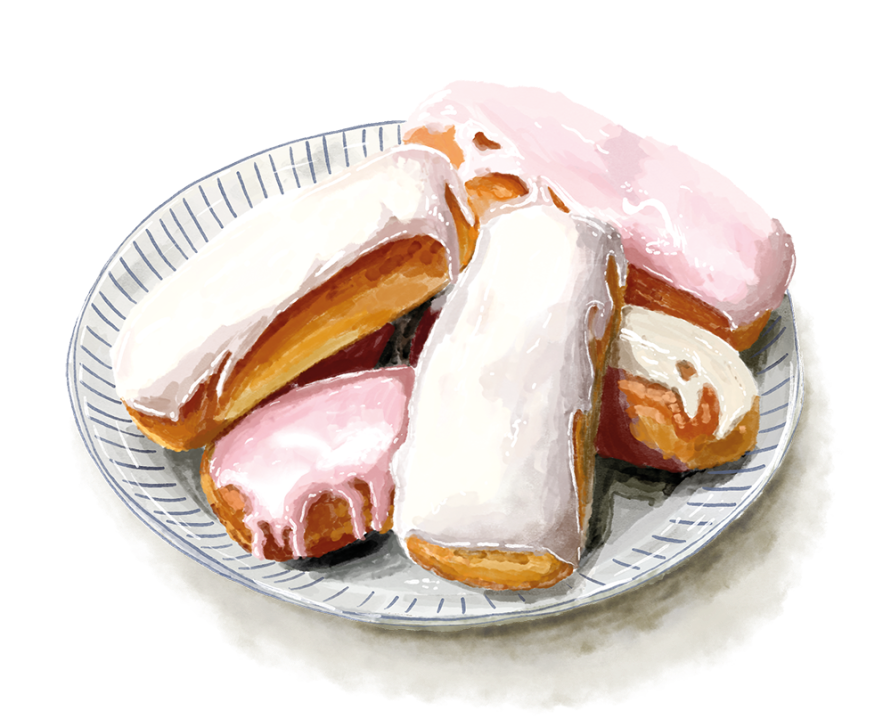

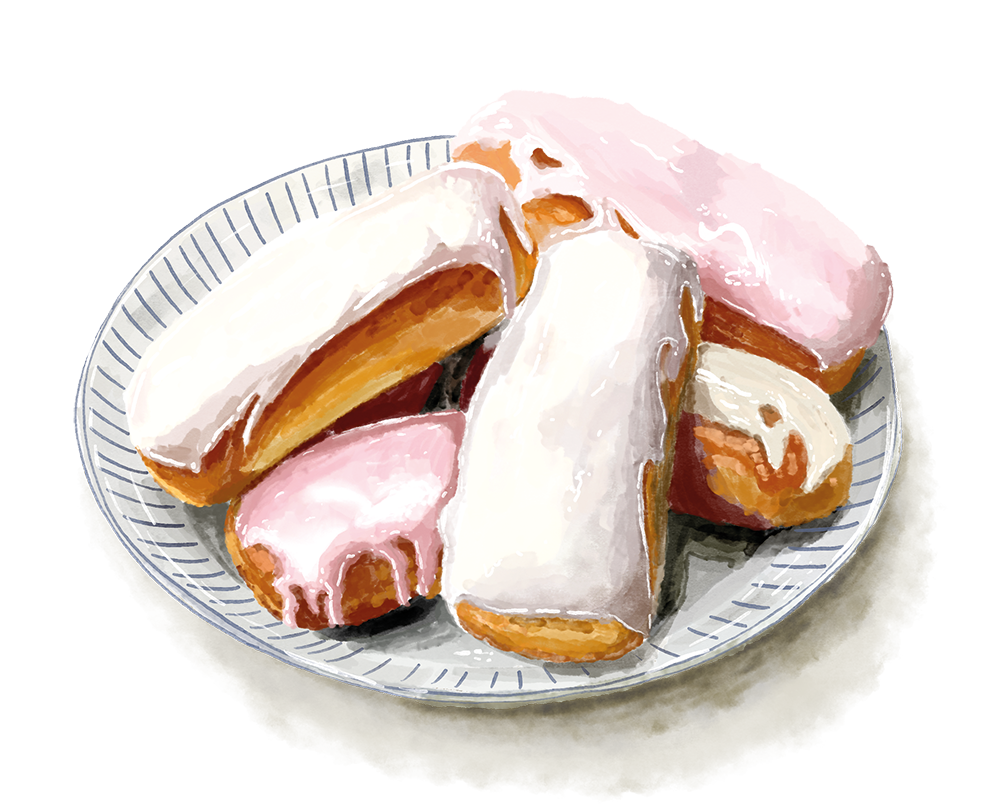
‘It’s just a hot dog bun with icing!’ the iced-bun detractors will shriek. I’m a lady with a lot of opinions about fairly esoteric foodstuffs, many of them declamatory, immovable, or strident, but I do not understand taking against the iced bun. I’m not sure what awful bakery-based trauma must have happened to you during childhood to make iced buns the target of your ire, but they are undeserving.
For anyone not a self-proclaimed detractor, iced buns (also called Swiss buns or iced fingers) prompt reveries: forgotten childhood memories of plump buns in trollies and sticky fingers holding grown-up hands.
Yes, OK, technically, it is just bread dough with some icing on top, but the just-sweetened, soft bun, the thick icing and the careful proportions of the two make iced fingers far more than the sum of their parts.
Much of its appeal is the bun’s simplicity: unspiced, unadulterated bread dough, unflavoured icing
Much of its appeal is the bun’s simplicity: unflavoured, unspiced, unadulterated bread dough, unflavoured icing. That’s it. In today’s world of stabilised, emulsified, Franken-treats marketed to children that bear no relation to real food, they do seem like sweet relief. So, for once, I am not going to encourage you to freestyle and experiment with various possibilities, or tweak to taste.
I surprise myself with the near-visceral bristle I feel when I spy so-called iced fingers that are cut down the middle and piped with wiggly chantilly and dribbly jam, like some kind of Devonshire split. This is sacrilege. Paul Hollywood, I’ve seen your recipe: you know better than this. I will concede that I do remember pink iced buns stuffed with raspberry jam, but whipped cream, or splitting the bun in half like some kind of lobster roll, feels unconscionable. Occasionally you’ll find iced buns with hundreds and thousands scattered on top, and in New Zealand, where iced fingers are a favourite, desiccated coconut is a popular topping.
These are understandable although, to my personal memories, untraditional. The single permutation I will permit is a little fruit juice in the icing, to introduce a subtle flavour along with colour – raspberry is traditional, but plum works well, and morello cherry is my favourite. I’d like to justify this with some kind of wholesome story, or rejection of chemical additives, but usually the answer is simply that I don’t have food colouring to hand, and brightly coloured fruit works just as well to achieve the icing’s old-school pink.
I confess that iced fingers have been the source of baking chagrin for me more than once. Initially this was because I subscribed to the idea that they should, in fact, be made with classic white bread dough, which resulted in, well, hot dog buns. I shaped them carefully, diligently spaced them apart, baked them – and encountered disappointment. Slightly too hard, not quite sweet enough, all crust and edges.
But I was making some obvious mistakes. First, the clue to success was in the name: an iced bun needs bun dough. Slightly enriched, with a single egg, a little sugar, a couple of knobs of butter and a proportion of milk. This doesn’t just change the flavour, but the texture too. The crumb in enriched dough is soft, close, giving. It’s a different beast to brioche, which relies on more butter and eggs. Bun dough is lighter in flavour and colour, with a fluffier, breadier crumb. It’s delightful. Second, when you bake the buns, they need room to expand, but should be set quite closely together in the pan. This means that as they cook and grow, they will bake into one another. This stops the buns being enclosed in a hard crust. When you tear the buns away from one another, soft wisps of bread are exposed.
The icing too is crucial to the bun’s success. It must be thick. It should sit on top of the bun, echoing its shape, colouring it in within the lines. At the right thickness, it will settle at the edges, sitting without slip-sliding down the sides of the bun. Bright white and ballet-slipper-pink icing are the traditional colours, like culinary cherry blossom.
Serves: 12
Hands-on time: 30 minutes
Cooking time: 20 minutes
- 500g strong white bread flour
- 7g instant yeast
- 10g fine salt
- 60g caster sugar
- 150ml milk
- 150ml water
- 1 large egg
- 60g soft butter
- 1 egg for glazing
For the icing
- 200g icing sugar
- Pink food colouring or fruit juice (optional)
- Place the flour, yeast, salt and sugar in a large bowl and stir together. Add the egg, milk, water and butter, and bring together to form a dough. Knead the dough until it is elastic and pulls away from the edge of the bowl – about seven minutes in a stand mixer, 15 if you’re kneading by hand. Cover the bowl with clingfilm and leave to prove for two hours until doubled in size.
- Knock back the air from the dough, then divide into 12 even pieces. Rub a little oil on to a 20x30cm deep-sided rectangular tray.
- Take each piece of dough, and fold it in on itself, then roll it under the palm of your hand to form a tight ball. Roll the ball into a sausage, pulling it over on itself to create tension in the dough. Transfer to the tray, and repeat with the rest of the dough pieces until you have two rows of six dough sausages. Cover and prove for 90 minutes.
- Preheat the oven to 180°C. Glaze the fingers with a beaten egg. Bake for 20 minutes, then leave to cool completely.
- Sieve the icing sugar and mix with water (or fruit juice), a teaspoon at a time until it is thick and gloopy. Spoon the icing onto the top of each bun, and leave to set.
Join Olivia Potts for Truffles and Trattoria in Rome on 2-6 December 2026. For more details about this Spectator Club trip, go to spectator.com/tastings





Comments