
We all did mad things during the first Covid lockdown. For some it was getting a dog or starting up a microbakery. For me, it was signing up for a NVQ Level 2 in butchery. I’m still not quite sure how it happened, but, once the schools reopened, I spent my Tuesdays in a cold butchery store in east London, socially distanced from my septuagenarian master butchery tutor, who would teach me how to break down whole carcasses, the art of seam butchery and the trick to linking sausages.
For much of those lessons, while trying to feel for a muscle group I couldn’t see, or conjure up the answer to a question about a sheep’s physiology, I would look straight ahead, gazing at a poster almost as old as me which showed different ‘value-added’ dishes that the traditional butcher could offer to the time-poor customer, a way of making the most of cheap cuts that would take the faff out of cooking. Most were familiar: kebabs on skewers, chicken kievs, marinated chicken breast. But among them, one intrigued me: the beef olive. It was hard to tell from the poster what it actually was. I prided myself on having reasonable culinary knowledge, but the beef olive was a mystery to me. I’d certainly never seen one, let alone eaten one.
My butchery teacher was appalled: how did I not know what a beef olive was? They were a staple of the butchery counter. And it’s certainly true they have a long history.
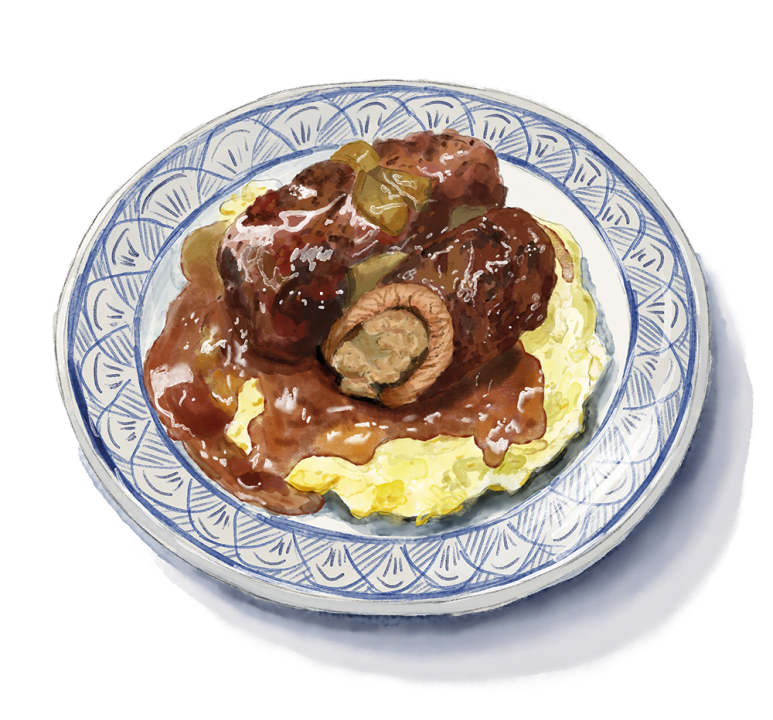
Thin, gently cooked steak and a highly seasoned stuffing, all bathed in a rich gravy. It’s classic comfort food
The first thing to say about beef olives is that half the title is misleading. There are zero olives in a beef olive. If I had £1 for every time I had to write ‘we’re not actually sure where the name comes from…’ – but you guessed it, we’re not quite sure why they are called beef olives. Some will tell you it’s because the finished product looks like a stuffed olive, but given the age and English or Scottish origin of the dish, this seems unlikely. According to the lexicographer John Ayto, the ‘olive’ in the name is a corruption of the Old French word alou, lark, because the rolled beef resembled stuffed larks. What we do know for sure, thanks to written records, is that the name has been around since the late 16th century, although it was initially used to refer to veal. By the 18th century, beef was more common, and a beef olive meant a thinly pounded beef steak rolled around forcemeat, stewed in a sauce.
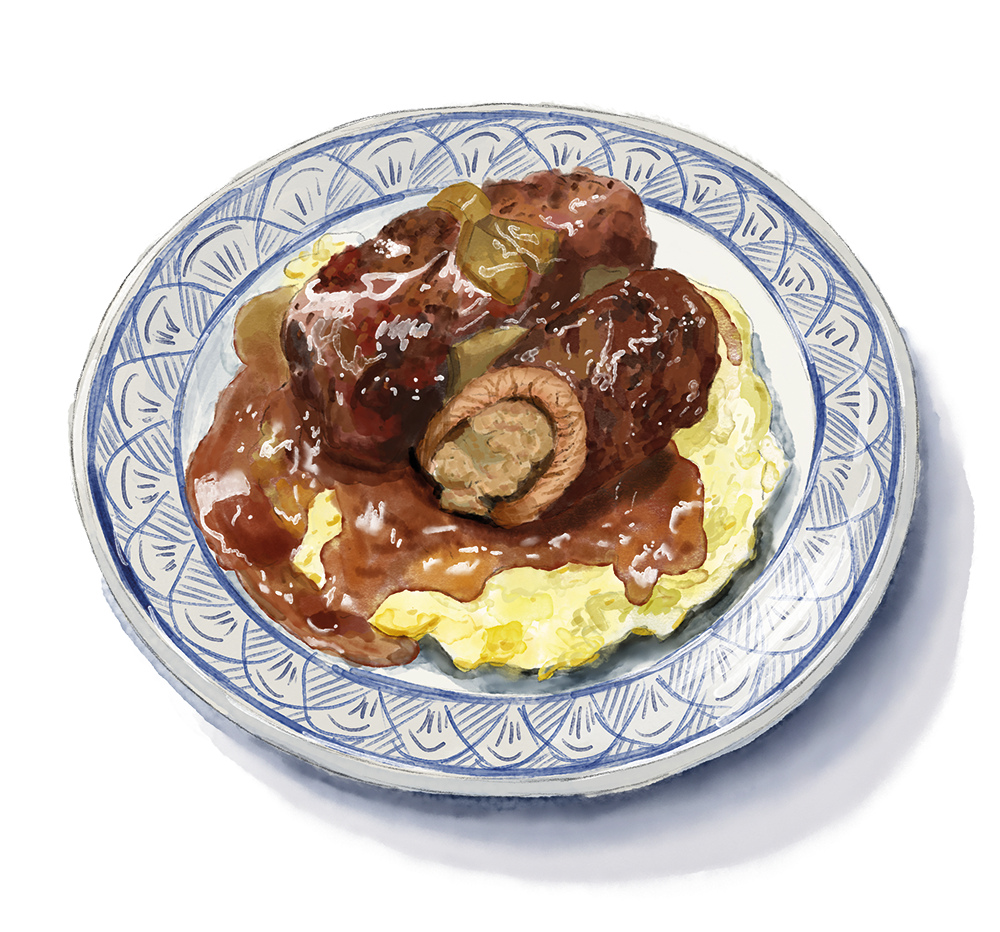
Once you actually know what a beef olive is, their appeal is obvious: thin, gently cooked steak and a highly seasoned stuffing, all bathed in a thick, rich gravy. It’s classic comfort food.
Rump or topside are best for the exterior beef: they’re lean and cheap so they respond well to a low, slow cook, and it’s harder to flatten out a marbled, fattier cut than it is a leaner cut. And you really want the beef as thin and as large as you can get it, so that it wraps right around the mixture. I do this by sandwiching each steak between two sheets of baking paper, and gently battering it with a rolling pin; glancing blows work the best. The stuffing is, as all good stuffing is, a flexible mixture of highly flavoured constituents mixed with some kind of binding. I like sausage meat and breadcrumbs – it’s a perfect blend of lean and fat from the sausage, while the breadcrumbs will absorb the flavour and moisture as the whole thing cooks – with sage, finely diced onion and a generous amount of freshly ground black pepper. But you’ll often find bacon or mushrooms, mustard or nutmeg or even haggis in there.
To roll, I just tuck the beef in and around itself, but you can use butcher’s string or cocktail sticks, as long as you remove them before serving. Then the beef is browned off, before the whole is cooked low and slow in an onion-heavy, red wine-laced gravy.

I tend to serve beef olives very simply, on a generous bed of mash, onion gravy spooned lavishly over the top, and some steamed green veg on the side. But like all extremely brown gravy-drenched comfort food, it will sit just as happily alongside chips, doorstops of bread and butter, or cheesy polenta.
Serves: 2
Hands-on time: 15 minutes
Cooking time: 1 hour 30 minutes
- 4 large, thin slices of topside of beef
- 1 tbsp olive oil
For the stuffing
- 4 pork sausages
- 3 tbsp breadcrumbs
- ½ onion, finely diced
- 1 tbsp sage, finely chopped
- ½ tsp black pepper, freshly ground
For the sauce
- 1 onion, sliced
- 1 tbsp plain flour
- 100ml red wine
- 300ml beef stock
- Preheat the oven to 175°C/160°C fan. In turn, place each of the slices of beef in between two sheets of baking paper, and bash gently with a rolling pin until they are larger and thinner.
- Make the stuffing by removing the sausages from their casing, and mixing the meat with the breadcrumbs, finely diced onion, sage and black pepper.
- Divide the stuffing into four equal parts, and place one in the centre of each of the steaks. Tightly wrap the beef around the stuffing, tucking the ends in and around, so the stuffing is all completely sealed. You can use butcher’s string here if you need to.
- Season the rolled beef olives, then heat the oil in a frying pan over a medium-high heat, and brown them off. Set to one side, and reduce the heat.
- Cook the onion until soft but not coloured, then stir the plain flour through it, and cook for a minute or two more. Add the red wine followed by the beef stock and bring up to a simmer.
- Place the beef olives in a snug oven dish, and pour the sauce around them. Cover with foil and cook for 90 minutes. Serve hot.
Join Olivia Potts for Truffles and Trattoria in Rome on 2-6 December 2026. For more details about this Spectator Club trip, go to spectator.com/tastings





Comments