
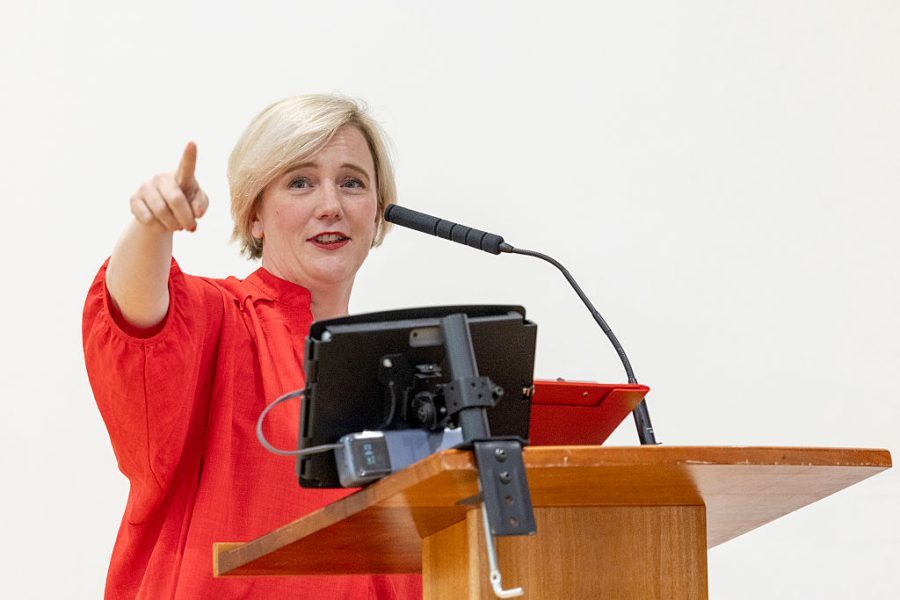
Stella Creasy may be a bona fide adult – a Member of Parliament, no less – but when it comes to politics, she’s still very much a student. There’s her knack for making herself the main story, no matter what else is happening in the world, whether through her inane use of social media or stunts like breastfeeding her son in the House of Commons. There’s her performative feminism, very much in evidence when poor Stella complained about the ‘motherhood penalty’ after missing a Christmas party to pick her kids up from nursery. And of course there’s her eagerness to spout the latest fashionable nonsense, like that time she claimed that a woman can, indeed, have a penis.
Our Stella’s clearly been dredging the Student Union playbook because she’s back at it this week. The MP for Walthamstow has been sharing her views on free speech – and they are straight from a university bar circa 2015. At a Labour conference fringe event, Creasy said that she’s all for free speech – as long as it is controlled, regulated, shut down and censored. Confused? As anyone with a degree in gender studies can explain, it’s all about ‘power relations’.
For Creasy, free speech means state-regulated speech
Creasy told the audience that free speech must be curtailed when it ‘stops somebody else’s view from being heard’. We must, she elaborated, recognise ‘the impact and the context in which people have conversation and debate’. In other words, because everyone has a different identity and unique personal circumstances, free speech is not possible without regulation.
The ‘power relations’ theory has it that rich, white men will dominate discussions and poor black women will be unable to have their voices heard. As Creasy explains, this means that for ‘progressives and socialists’ the first rule of debate is ‘tackling the barriers that stop people from being allowed to be heard at all’, because ‘those barriers don’t disappear’ when speech is unregulated. By this logic, free speech requires progressive guardians to dictate who gets to speak and who must shut up.

Now, Stella is nothing if not logical. So she made clear her support for enhanced harassment legislation, explaining that, in order to protect spaces where ‘people do feel they can have a discussion’, we have to:
Stand up for the right of people to say stop – actually, you’re not going to change my mind, this conversation isn’t one I want to continue being part of and how you go on behaving means that I don’t feel that I can speak at all.
It goes without saying that no one should be forced to participate in conversations against their will, but Creasy’s nod to legislation is revealing. When ‘progressives and socialists’ say ‘we’, they do not mean ordinary people, collectively or as individuals; they mean the state: lawyers, police officers and regulatory bodies.
For Creasy then, free speech means state-regulated speech. It means only people with approved views can speak, and anyone who steps out of line must be silenced and, if necessary, punished. Think it is ridiculous to suggest that a person with a penis is a woman? In Creasy’s world, where we must ‘recognise various identities’, you either self-censor and keep schtum, or the law must be changed to shut you up.
This argument has myriad gaping holes and irony a-plenty. Not all members of ‘under-represented’ identity groups struggle to get their voices heard, and white men should have as much right to speak as anyone else. Not everyone wants to speak fluent woke: compelling people to use female pronouns to describe transgender women is not an expression of free speech. State-regulated speech is not free speech. Arresting people for expressing their views is censorship, not a way of permitting debate.
Yet despite all her bluster, one thing is clear. Stella Creasy is as hopeless at defending free speech as she is at identifying parrots. If this were a decade ago, she’d be lauded on university campuses by Stepford students wailing ‘freeze peach’ in their bid to deride one of humanity’s most democratic and egalitarian principles.
Fortunately, not everyone in the Labour party is as censorious as Stella. The impressive Jonathan Hinder, MP for Pendle and Clitheroe, told the same fringe event, ‘If you don’t believe in free speech for your opponents, you don’t believe in free speech.’ He’s right, of course. So Labour is as divided on free speech as it is on gender, migration and the benefits bill. Sadly for the rest of us, Creasy, not Hinder, seems to have the most support among the rank and file.



Comments