
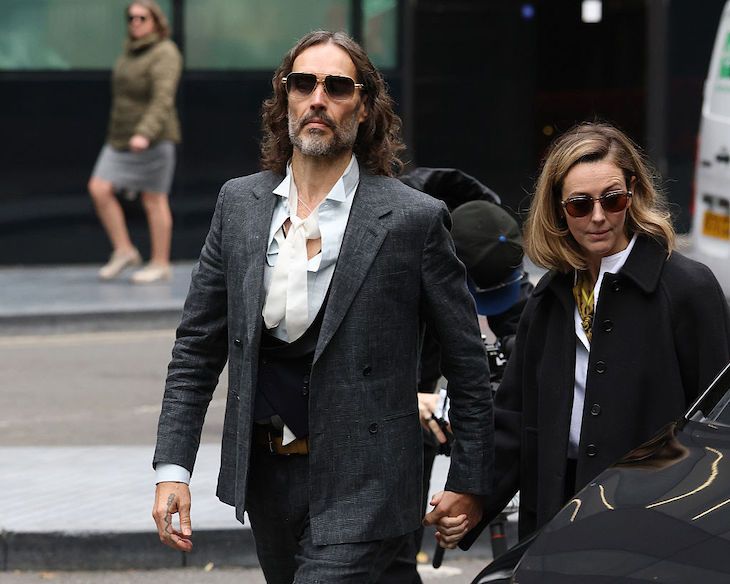
With Russell Brand convicted of rape and awaiting sentencing, his former acolytes and enablers are on the defensive. First, they issued statements expressing outrage at Brand’s wrongdoing while simultaneously denying all knowledge of his antics. Then came the promises to ‘learn lessons’. Good. No other media star must ever be allowed to abuse women so openly and prolifically. But in the rush to act, a gap risks emerging between the reality of Brand’s offending and the solutions being posited.
We are being told that ‘rape myths’ are the real problem
We need to ask why, for almost two decades, those in the entertainment industry, on the comedy circuit, in journalism and in politics ignored Brand’s bad behaviour. Instead, people from the Prime Minister down are now asking us to focus on what happened in just four weeks in one London courtroom. We need to ask why celebrities and politicians alike were so readily deceived by Brand, even while accusations were levelled against him in private and in public. Instead, we are being told that ‘rape myths’ are the real problem and that in order to prevent a future Russell Brand, we need to reform the way sexual offence trials are conducted. None of this makes sense.
Last week, Brand was found guilty of one count of rape and three counts of sexual assault. The jury did its job correctly and should be praised, not criticised. Justice was served. Yet, the very next day, up popped Metropolitan Police commissioner, Sir Mark Rowley, calling for a change in the law to ensure juries are warned about ‘rape myths’. He told Radio 4’s Today programme that ‘People fall into myths about [how] a rape victim must behave in a certain way, must react in a certain way […] when the evidence is very clear, we’re all very different [in] psychological and personal make-up, and in the most extraordinary horrific moments, of course, people react very differently.’

Rowley was responding to complaints about Brand’s barrister, Ian Winter KC, who, during the trial, told the court that none of the complainants ‘resisted or screamed or even tried to leave’. His scurrilous implication was that because they did not resist, the women had not been raped.
Other ‘rape myths’ include the idea that women frequently lie about being raped, that it doesn’t count as rape if a man and woman are in a relationship, or if the woman has had too much to drink, or doesn’t say ‘no’ to unwanted sex.
But, here’s the thing. No matter what Winter told the jurors, no matter how much he tried to persuade them of his client’s innocence, the eight men and four women who decided Brand’s fate were not convinced. They did not fall for rape myths.
And in this regard, Brand’s jury was not unique. A large-scale study carried out by academics at University College London in 2023 found that once a rape case reached court, juries were more likely to convict than acquit offenders – as had been the case for the previous fifteen years. In fact, conviction rates for rape stand at around 58 per cent; higher than for other serious violent offences.
There are, of course, problems with women being reluctant to report rape and cases not coming before court in the first place. But the UCL research suggests that either jurors are not taken in by rape myths or judges are already sounding the alarm and warning them to be wary.
Yet this did not stop the Prime Minister from announcing that he would ‘look closely’ at Rowley’s concerns. He told Times Radio: ‘I think we need to constantly look at the way rape trials are conducted to make sure that they do not leave the woman feeling like she is on trial in court, as has been the experience of people in the past.’
A cynic might suggest that focusing on legal proceedings, and the conduct of juries in particular, usefully shifts attention from the way that, not so long ago, a media and political class – of which Andy Burnham was very much a part – not only gave Brand a platform but knowingly used his public profile to gain kudos for themselves. They cannot be allowed to get away with this. Not only does a focus on rape myths avoid a broader discussion about how Brand’s abuse of women was, seemingly, an open secret, but it also risks tipping the already precarious scales of justice.
Much as some campaigners may wish it were otherwise, even men accused of rape must be able to defend themselves. This means their accusers must be questioned. Sometimes these questions may appear harsh or make the woman feel uncomfortable. And, controversial though it is to acknowledge, context does sometimes matter in determining whether a crime has been committed, particularly when guilt hinges on the reasonableness of assuming consent. All women who allege rape must be taken seriously. At the same time, justice requires that the men they accuse are considered innocent until proven guilty.
It may suit Burnham and Rowley to start a conversation about courtrooms, juries and rape myths. But this will do nothing to stop another predator like Russell Brand from abusing women in plain sight.





Comments