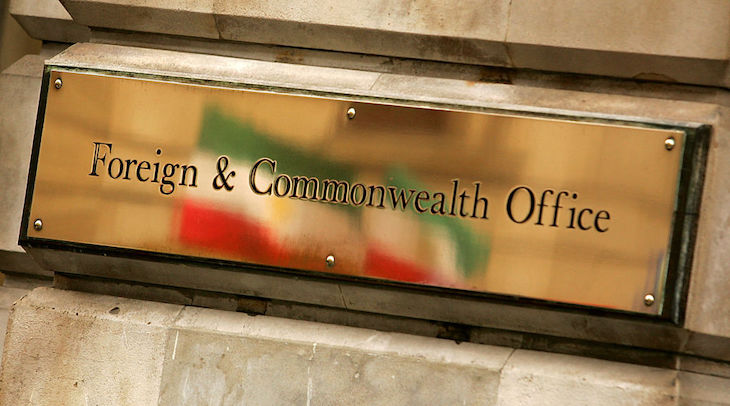
I have often joked that in the unlikely event that Iran launched a direct, full-scale attack on Europe, Foreign Office officials would be frantically scrambling around, trying to find a way to bring Iran back into dialogue about its nuclear programme. Needless to say, dialogue is beneficial to all parties, and we should not be surprised when diplomats pursue it – after all, it is their job. Dialogue in the abstract, however, is worthless. Without a broader strategy grounded in a real understanding of Iran’s history, political culture and strategic outlook, it becomes a hollow end in itself rather than a sharp instrument of statecraft. As with many other elements of British public life, dialogue, debate and discussion have become comforting rituals through which difficult decisions are deferred and the appearance of purposeful activity sustained.
Britain has buried its head in the sand in the hope that Tehran will ‘leave us alone’
We appear in this country to have lost the ability to think creatively and imaginatively about Iran. This is not so much a failure of imagination, as one former British ambassador argued, but an absence of imagination altogether. Britain has adopted the unhelpful habit of reacting to events with short-term fixes which (at best) defer the problem, and more often than not make it worse by enabling those very forces in Iran that seek to do us harm.
Underlying this pattern is the lost ability to think in the long-term. Our horizons have narrowed, and our historical reach diminished. An appreciation of change has given way to a fixation with the status quo, to the point that we sometimes appear to prefer inertia simply because it is familiar. ‘Masterly inactivity’, that great hallmark of imperial policy, had a certain logic when Britain held most of the cards and, from an advantageous position, wanted as little as possible to change. Today, wilful inertia has been fetishised, elevating it to the status of governing strategic principle. As former Security Minister Tom Tugendhat writes in the Foreword to my report for Policy Exchange, Britain has buried its head in the sand in the hope that Tehran will simply ‘leave us alone’ – this is an unrealistic expectation.
This is not really a question of talent; to a significant degree, the FCDO (Foreign, Commonwealth & Development Office) still attracts the best and brightest graduates. Rather, the issue lies in its governing ideas, institutional weaknesses and structural flaws. The paradigms within which we operate were born out of victory in the Cold War, since which Britain has sought to comfort itself with the assumption that the liberal international order was a durable, self-sustaining and broadly shared settlement, apparently oblivious to the concerted efforts of the authoritarian states which seek to undermine it. To paraphrase Winston Churchill, intoxicated with victory, we have squandered the peace. The new world order suited us; we adapted to it even as others sought to undermine it.
A fixation with legalism constrains us even as our opponents are dismissive of the ‘rules-based order’, rendering all disagreements technical misunderstandings that could be resolved by dialogue. ‘More engagement’ became the perpetual watchword of status-quo-ism, a wanting substitute for strategy. While Britain was certainly not alone in this view, and arguably we were ahead of the curve as far as Vladimir Putin was concerned, we are still woefully unprepared for the challenge Iran and similar regimes pose.
As I write in my report for Policy Exchange, British Policy and the Iran Crisis, the decline of Persian expertise is a case in point. Persian, once a core area of competence, is not only underfunded, but poorly managed. Planning and placing expertise are poorly thought out, career paths are rarely structured, and the three-year appointment cycle frequently results in basic lessons having to be relearned. Meanwhile, the digitisation of archives, intended to make information accessible, often does the reverse and encourages an unfortunate tunnel vision which ensures we can’t see the wood for the trees. The wider context, regional and historical, is often missed in favour of getting to the particular problem, creating a dynamic in which the immediate matter may be examined (typically without having been predicted), while the forces that produced it remain poorly understood.
It should come as no surprise that morale is low, and this permeates the entire Office. The absence of leadership and the absence of vision have consequences, and at a moment of supreme crisis, Britain was absent. The American military build-up was plain for all to see, and despite this, Britain conducted no adequate contingency planning. HMS Middleton, the Royal Navy’s last Gulf minesweeper, had returned home the month before and is yet to return. The UK’s naval base in Bahrain had no Royal Navy presence, and the spearhead of the Government’s response, HMS Dragon, struggled to reach Cyprus.
Against all of this unfolding, the Peter Mandelson debacle had left Britain without an ambassador in Washington. Following this, the Prime Minister publicly announced that Britain would stay out, only for the Government quietly to accede to American requests. Arab allies, in receipt of support from Ukraine, justifiably wondered where on earth we were, putting a considerable dent in British relations with key regional partners. None of this was indicative of forethought, still less of a clear-headed strategy.
Britain is capable of reversing this trajectory, but it must act with urgency and focus in equal measure. The Government must restore the intellectual foundations of policy by rebuilding Persian-language and regional expertise, creating proper career paths for specialists and ensuring that historical and cultural knowledge informs decisions before a crisis erupts. That expertise must be translated into strategy bound by a clear conception of interests, serious contingency planning, and a willingness to contest Tehran’s political narratives – efforts underpinned by credible hard power. Beyond Whitehall, this means actively supporting our Gulf allies, protecting freedom of navigation and working with European partners to construct a durable settlement which constrains Iran’s nuclear programme and maintains pressure over its human-rights abuses. Dialogue remains essential, but it must become an instrument of strategy.
It is often said, downstream of its soft power, Britain tends to punch above its weight. This is so oft repeated, it has become a cliché, carrying a complacency that Britain cannot afford. Soft power without supporting hard power enjoys little credibility, but it is worth remembering Lord Hannay’s belief that Britain may box above its weight, but this demanded ‘a good deal of ingenuity and fleetness of foot if it is to be done successfully’. The sad truth is we have not had much ingenuity nor fleetness of foot for some time.
Ali Ansari is a Senior Policy Fellow at Policy Exchange



Comments