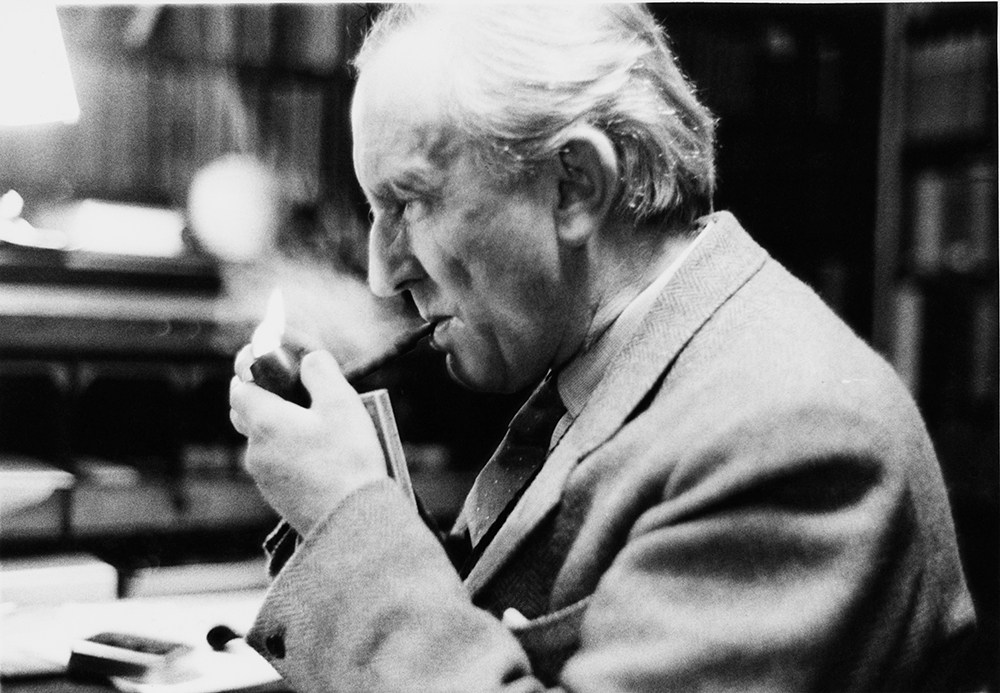
It was December 1942 and J.R.R. Tolkien was having doubts about his new book, a sequel to The Hobbit published five years earlier. “Is such an ‘epic’ possible to consider in the present circumstances?” he wrote to his publisher Stanley Unwin. The specific circumstances included the second world war; but the literary climate was hardly more propitious. The warden of Merton College, Oxford, where Tolkien was Professor of English Language and Literature, was “visibly shaken” when Tolkien showed him the blurb for that sequel, eventually titled The Lord of the Rings. Reviews were largely poor: the American critic Edmund Wilson was not alone in thinking it “juvenile trash.”
In a sense, Tolkien’s question to Unwin holds good. What is the place of an “epic” in the modern world? That it has one, thanks to Tolkien, is unarguable. Yet, despite millions of readers and a thriving scholarly community, Tolkien remains stubbornly outside the norms of literary criticism. As D.J. Taylor writes in his fresh, incisive but uneven new study of the man and his work: “He is too unlike anyone else, too detached from most of the discernible mainstreams and too opposed to most of the things they hold dear.”

Tolkien’s resistance to those mainstreams was deep rooted. He considered himself an outsider all his life. In part this was a statement of circumstance. Born in South Africa in 1892, he lost his father when he was three. He was brought up in straitened gentility back in the West Midlands by Mabel, his devoted mother, whose conversion to Catholicism in 1900 alienated her from both her own family and that of her in-laws. She died in 1904, and Tolkien, 12 years old and bereft, was boarded with an aunt who burnt all his mother’s papers.
It was also a statement of disposition. At school, Tolkien spent his spare time reading Anglo-Saxon and Old Norse and his pocket money on German books about philology. Yet, as Taylor notes, there was “practically no precedent for the course of study on which he pined to embark.” English was a new, much-contested subject for academic study, and Tolkien steered for its philological margins. In old age, he claimed that his career had been spent “combatting the relentless hostility of nearly all academic teachers of English.” Taylor reflects on “the remorselessness of [Tolkien’s] spiritual beliefs,” but there was something of that quality about all his passions.
It is there in the way he protected his privacy, refusing to countenance almost any personal context for his work. His estate has followed his lead. Humphrey Carpenter’s brief biography remains the only authorized account of his life. Published four years after Tolkien’s death in 1973, it was heavily censored – “castrated,” Carpenter said – by Tolkien’s son and literary executor, Christopher.
Neither a conventional literary biography nor purely a critical study, The King Under the Mountain is Taylor’s attempt to pierce Tolkien’s self-defined literary and cultural isolation – that great negative space that is itself part of his art. Taylor writes as a fan – “the discriminating sort,” he is careful to stress – and there are indeed some sharp passages of exegesis, including an entertaining sociopolitical survey of the Shire.
But the strongest sections of the book invite us to see Tolkien from a range of sometimes unfamiliar social and literary perspectives. As an academic, he attracted extreme reactions. W.H. Auden proclaimed himself “spellbound” by Tolkien’s Beowulf lectures; Penelope Fitzgerald thought him “odious.” He encouraged writers as diverse as Roger Lancelyn Green, Geoffrey Hill and V.S. Naipaul. A.S. Byatt explored her generation’s fascination with his books in her Frederica Quartet, teasing out both his work’s appeal and the way it amplified, and perhaps distorted, more private obsessions, so that, Taylor writes, “good and bad alike will find things in it to spur them on.”
Auden proclaimed himself spellbound by Tolkien, while Penelope Fitzgerald thought him “odious”
Taylor’s book comprises 11 broadly biographical chapters, interspersed with nine briefer essays exploring Tolkien’s writing from different perspectives, including faith, poetry and fairy stories. These are a mixed bag. One on Tolkien and Orwell ends just as it gets interesting, with a glimpse of Elon Musk addressing the Tommy Robinson march in Trafalgar Square last year. Tolkien’s influence on the American right is surely an important aspect of his contemporary reputation. A book which promises to discuss in part what uses Tolkien has been put to and to what causes he has been assigned might be expected to have addressed that.
Nevertheless, The King Under the Mountain is a perceptive addition to its field. “Tolkien… is the worst person in the world to tell us what his books are about,” Taylor writes, and, given the gulf in quality between The Hobbit and The Lord of the Rings and the 20-plus volumes of largely inert prose and poetry published posthumously under Tolkien’s name, one wonders whether even the man himself ever understood what had made those books successful. Taylor does – which is to say he understands what made these epics possible in the modern world.





Comments