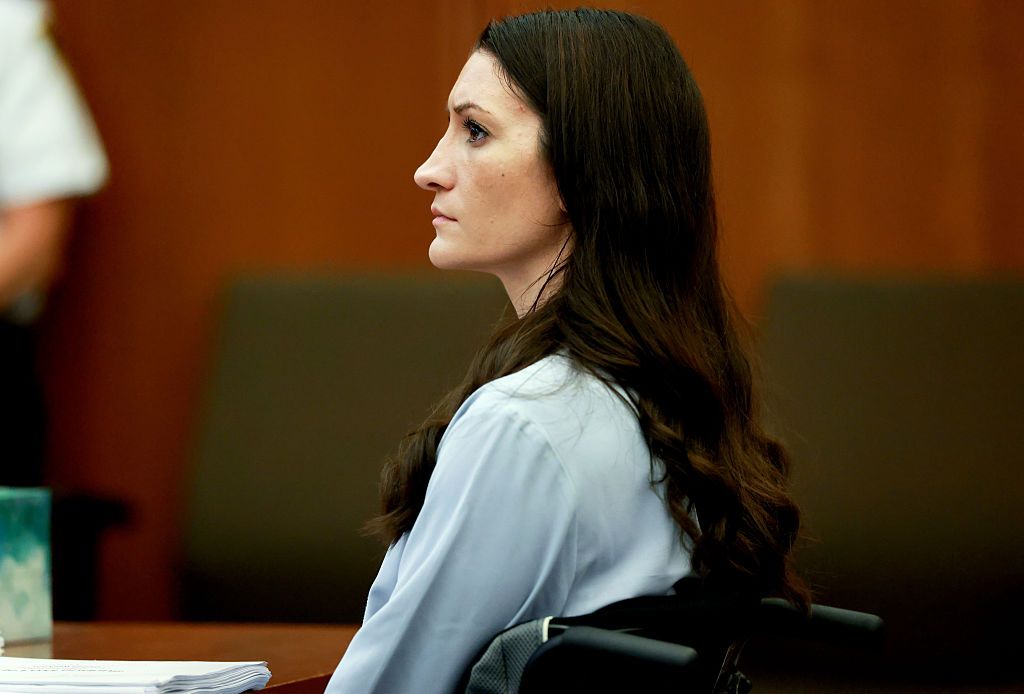
In 2023, Lindsay Clancy, a former labor-and-delivery nurse from Duxbury, Massachusetts, strangled her three children to death with exercise resistance bands in the basement of the family home. She then cut her wrists and neck and jumped from a second-story window, an act that left her paralyzed from the waist down. Her murder trial opened in Plymouth Superior Court in July and is expected to run for six to eight weeks.
Both sides agree Clancy killed five-year-old Cora, three-year-old Dawson and eight-month-old Callan. What is contested is whether she should be held responsible. Prosecutors say Clancy “acted intentionally, rationally and swiftly,” and point to the fact that she texted her husband, Patrick, to grab takeout and stop by the pharmacy shortly before the killings, thus ensuring the house was clear. Her defense says she was in the grip of postpartum psychosis and undiagnosed bipolar disorder, made worse by 13 psychiatric medications from a revolving cast of providers, and that a voice told her it was her “last chance” to kill the kids and herself. Psychiatrists who’d seen her in the preceding weeks testified they had not noticed signs of psychosis.
We are watching social-media-induced insanity taking hold of otherwise normal women
The case is harrowing. Yet a surprising number of women online are eager to put themselves in the accused murderer’s shoes. “Same, Lindsay” is trending on TikTok. The videos follow a template: a phone propped at an intimate, low angle, a woman rocking or nursing her own toddler against her chest, voice catching as on-screen text quotes lines lifted straight from Clancy’s personal diary entries – the same ones read aloud in Plymouth Superior Court – before the caption lands on “Same, Lindsay.”

After one such clip circulated, critics accused the creator of “fake crying” while “using Lindsay Clancy’s diary words read in court” as content. One account, @courageandchaosss, fired back at the backlash: “My children are the furthest from being in danger. They have one damn good mama.”
Another posted the caption “me when I had to ask the neighbor to bathe her because I thought I would drown her,” treating a private, terrifying thought as a bonding credential. From there, the videos curdle into acquittal theater: women film themselves “hanging out their windows” to argue Clancy’s innocence despite her own lawyer conceding she did it. Others insist “he killed the kids” – pointing at Patrick, who made the 911 call – or, in one case, claiming to have dreamed that Patrick abused Cora, captioned, “Hopefully Lindsay gets justice.” Some have simply declared her the winner of a trial that hasn’t ended because she “proved postpartum psychosis the moment she killed her 3 children.”
Astrology has made an appearance too, with commenters noting she’s “a Leo” and reasoning that, per “the rules of astrology, she must not have done it.”
On Facebook, a movement called “We Are Lindsay Clancy” has drawn thousands of women. The money has followed the sympathy: donations to a GoFundMe run by Clancy’s parents are fast approaching $900,000 of a $2 million goal from more than 27,000 donors. A separate fund started by a Wisconsin TikTok mom with 109,000 followers has pulled in another $900,000-plus from nearly 30,000 donations.
Postpartum psychosis is a real, terrifying condition. A woman who feels herself sliding toward that darkness deserves compassion. But that’s not what we are seeing in most of these videos. Thousands of women are publicly rehearsing, “I had those thoughts too” about killing their own kids, a signal as scary as any actual homicidal impulse. The desire to be seen has trained these women to perform proximity to the worst transgression there is, killing a child, to gain validation from strangers online. It’s as if they are saying, “I held back, so I am the heroic, self-sacrificing good mother.” Broadcasting the thought serves as proof they didn’t act upon it.
At the same time, the craving for attention that drives the “Same, Lindsay” trend pushes women to admit, on camera, to intrusive thoughts about harming their own children. If any of them ever actually did harm a child, they would be making a prosecutor’s job very easy, with their self-incriminating trail of statements.
Modern parenting can feel unbearable sometimes. For many mothers, there is no village, no grandma next door, nobody dropping by to take the baby for an hour so you can shower in peace. Yet if you stood in a suburban kitchen after book club and said out loud that you’d had intrusive thoughts about killing your child, the other mothers wouldn’t nod along and hand you a Ring light. They would stop talking to you. Someone would quietly call social services. That’s not because there’s some lingering stigma around opening up about postpartum depression – it’s because in real life, you don’t get clout for murdering your kids.
What we’re watching unfold around this case is social-media-induced insanity taking hold of otherwise normal women.
Being seen online has become its own addiction, one strong enough to override the most basic human instinct there is – the instinct to guard your reputation as a mother, if nothing else.
Women are choosing to claim they relate to strangling their kids in public over the alternative of nobody looking at them at all. That trade – self-branding as a potential child killer just to get a few seconds of eyes on you – tells you more about where society is heading than any verdict from the Clancy trial.



Comments