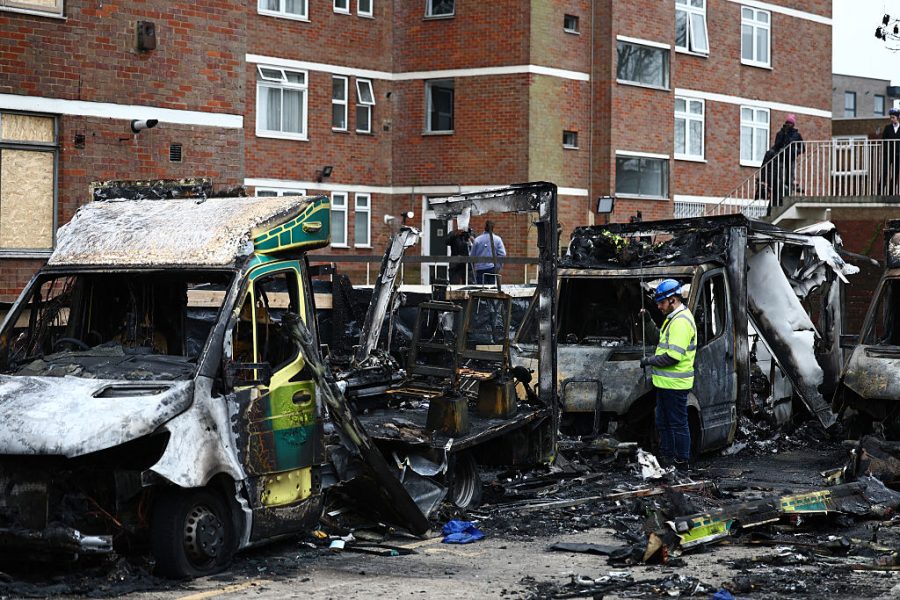
Four ambulances were set on fire in Golders Green in the early hours of the morning yesterday. They were not police vehicles or abandoned cars but emergency vehicles belonging to a Jewish volunteer ambulance service, parked near a synagogue and deliberately targeted.
What is changing is not just the frequency of these incidents, but the atmosphere around them. There is a growing willingness to excuse, downplay or contextualise hostility towards Jews in a way that would be unthinkable for other groups. The result is a quiet normalisation, where anti-Semitism is not always overtly endorsed but increasingly tolerated, explained away, or allowed to pass without consequence.
The vehicles belonged to Hatzola, a volunteer-run, non-profit emergency medical service embedded in the Jewish community but serving far beyond it. Its medics are on call around the clock, responding to emergencies, providing immediate care and transporting patients to hospital, entirely free of charge. They work alongside the NHS and respond to anyone in need, regardless of background.
Anti-Semitism is no longer confined to the margins
These were ambulances that saved lives. Jewish lives, certainly, but just as often non-Jewish ones. To target them is not only an act of hatred; it is an act of wilful disregard for what those vehicles represent. It requires a kind of blindness in which the mere association with Jews is enough to justify destruction, irrespective of the human cost.
In practical terms, the damage was contained. The London Fire Brigade was called shortly before 2 a.m. Cylinders inside the ambulances exploded, shattering nearby windows and forcing residents from their homes, with around 30 people moved to a local shelter. Six fire engines and dozens of firefighters were needed to bring the blaze under control. No one was injured. The vehicles can be replaced. Life, as it always does, continues.
And yet it is precisely that sense of continuation that feels uneasy. It is possible to list the facts, acknowledge the response, and move on. That is what increasingly happens with incidents like this. They are shocking, briefly, and then absorbed. But each time that happens, the threshold shifts. What once felt unthinkable becomes something that can be explained away, contextualised, or simply forgotten.
Anti-Semitism is no longer confined to the margins. It is louder, more visible, and increasingly acted upon. Each incident builds on the last, steadily enough to create a sense that something is changing. For those outside the community, it may still feel sporadic. For those within it, it feels cumulative.
Eli Beer, founder of United Hatzalah, described the attack as ‘not only an assault on a Jewish community, but an affront to our way of life’. That is not an exaggeration. Ambulances represent something fundamental: the idea that when someone is in danger, help arrives without question. To attack them is to strip even that away, reducing everything to identity.
The location only sharpens the point. Golders Green is not incidental. It is one of the centres of Jewish life in Britain, where synagogues, schools and community organisations sit within walking distance of each other. As Sarah Sackman, the local MP, put it, this is ‘the beating heart of the British Jewish community’. The attack was, in her words, a ‘symbolic act of hatred’.
Within hours of the fire, Hatzola was operating again. Phones were ringing, volunteers were responding to calls, and the service continued. Laurence Blitz described what happened as ‘shocking in the extreme’, before adding ‘we have no time to grieve’. It is an extraordinary response, but also a revealing one. There is a sense that stopping is not an option, because incidents like this are no longer rare enough to demand it.
The deeper issue is not what was lost, but what is being revealed. This is what escalation looks like. Not a single dramatic rupture, but a series of acts that grow incrementally more severe, more targeted, more confident. Burning ambulances is not the beginning of that process. But it is a point at which the intent becomes impossible to ignore.
What makes this moment sharper still is the disconnect between words and reality. It is easy to say one stands with the Jewish community. It is much harder to confront the conditions that allow this kind of hatred to flourish. A climate in which anti-Semitism is softened, redirected or folded into broader political narratives does not remain abstract. It manifests in acts like this. And unless that climate is challenged directly, the gap between rhetoric and reality will only widen.
That climate is not created in isolation. It is fed by the language that is allowed to circulate without challenge, slogans that are repeated often enough to lose their meaning, or worse, to be stripped of their consequences. Chants of ‘globalise the intifada’ are dismissed by some as rhetorical or symbolic, but they carry a very real implication: the legitimisation of violence against Jews beyond any one conflict or border. When that kind of language is normalised in public spaces, it should not surprise us that it finds expression in acts closer to home. Words do not remain abstract. They shape what becomes acceptable, and in time, what becomes actionable.
The idea that a service which saves lives, including non-Jewish lives, can be targeted without provoking universal outrage points to a deeper moral failure. It suggests that, for some, the association with Jews overrides everything else. When acts like this are absorbed or minimised, they do not simply disappear. They set a precedent. They make the next act easier, and the one after that easier still.
For many Jews in London, that is a reality which is becoming harder to ignore. Not just the existence of anti-Semitism, but its direction and its momentum. And once those lines are crossed, they are not easily redrawn.



Comments