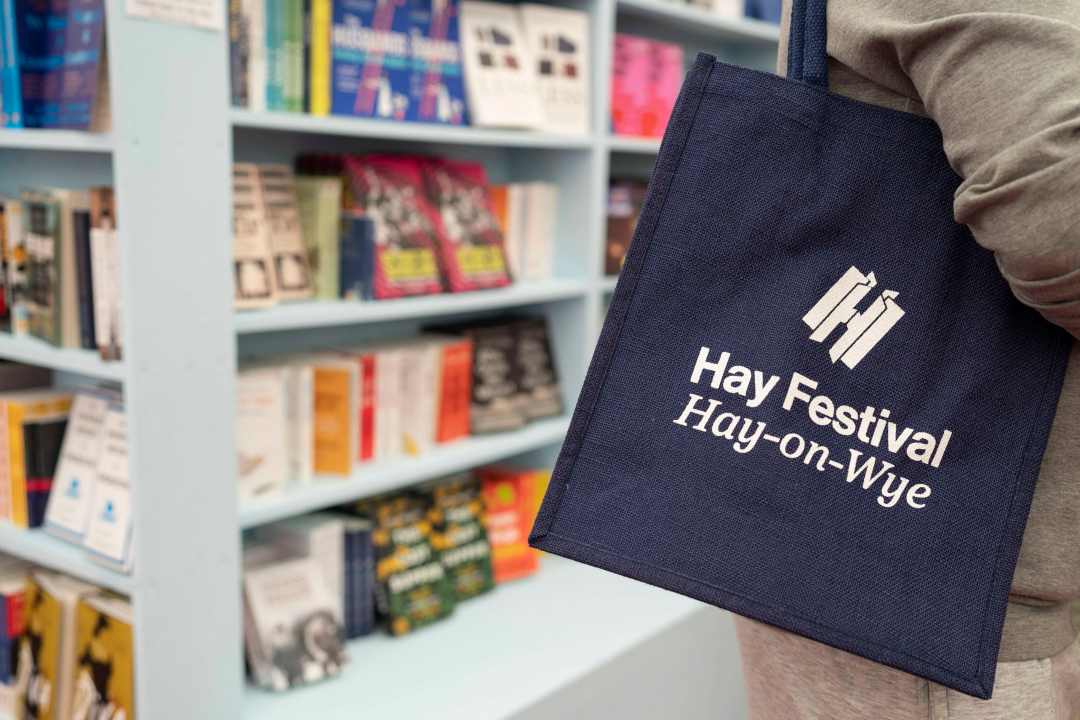
Can it be anything more than sour grapes when a writer (who has not been asked) gets snarky about Hay Festival? I’d like to think it can. For there is a lot to snark about.

Don’t get me wrong. The one time I was invited to speak at Hay, about a decade ago, it was jolly nice. Benedict Cumberbatch said hi to me in the green room, thinking I was someone he was meant to recognise, while Ian McEwan milled about topping up his coffee. Hay is, of course, a pornographically pretty town amid the rolling sheep-studded fields and quaint little streets with pop-up Eccles cakes shops and independent bookshops.
The problem with Hay these days, though, is the problem with everything relating to the cultural establishment: it takes itself seriously in ways that are no longer merely fodder for some fond eye rolling. In short, it has become sinister. Gaza cheerleading, the signal toxin of our era, is one example that comes to mind. In one event scheduled to take place next Tuesday, the terrorist group Palestine Action is normalised as part of civic culture and treated as if it might have a point by being folded artfully into an event called ‘Just Stop Oil, Palestine Action: A Public Nuisance or a Public Good?’
See the switcheroo there? The laundering of violence, sabotage, terror and vandalism – to say nothing of the pro-Hamas elements of both groups – as nothing more, at their worst, than a ‘nuisance’. The festival’s 2024 sponsorship row over the massive support of Baillie Gifford (deemed to have links to Israel) left – for this Zionist – an indelible stain.
What sells out is fairly predictable: Malala Yousafzai and BBC-core; think The News Quiz and Hugh Bonneville. So let us consider the festival’s themes this year. ‘Hay Green’ concerns ‘climate emergency solutions’. Then there is ‘South to North Conversations’ and memorial lectures on ‘truth’, ‘representation’, and ‘nuclear threat’.
Amid all the debates, discussions and important stories there is at least a little attention given to literature that people actually buy. Like Romantasy– only this one has all the romance firmly taken out of the equation. ‘Are you obsessed with Romantasy yet?’ pants the event description on the genre. ‘Book sales are growing faster than in any other genre… Here a panel of experts explain why it’s so successful and consider what we should learn about the huge appeal of worlds where women are in control.’ Good to see there is a panel of experts to explain what we should learn from tales of sexy queens and dragons.
If once the Hay Festival was a place that finance bros or military men might have been looked at askance, now it is clearly not a place where someone with, say, family in the Jewish state, or serious concerns about the green movement, would feel particularly at ease. So perhaps it’s best for our ilk to focus on its more solidly amusing aspects.
It is good to know that the macchiato drinkers of the festival, 95 per cent of whom arrive by car, are still doing their bit for climate justice
For me, the happiest pinnacle of all that makes Hay Hay is its food and drink. The sheer number of buzzwords it crams into its website bumph detailing the treats available for purchase by the hordes of Guardian-clutching greyheads is really something. Obviously, it’s all ‘sustainable catering, with plenty of plant-based and gluten-free options’. And obviously, as you rush from Malala to Nazanin Zaghari-Ratcliffe via Emma Thompson and David Miliband, you will be grateful that the coffee shops all serve Fairtrade. And not just that! ‘All our whole milk is being delivered to the site in reusable churns directly from a local farmer, supporting our aim to source local ingredients while further reducing our use of single-use plastic’, reads the website. This is, of course, a great relief, and it is good to know that the macchiato drinkers of the festival, 95 per cent of whom arrive by car, are still doing their bit for climate justice.
Those reusable churns are key, if, as the festival website opines, ‘the combined climate, biodiversity and nature emergencies are an existential threat to us all’. And given that ‘we all have a responsibility to help find solutions’ it’s a relief to know that the festival is ‘mobilising, harnessing and inspiring our whole community of writers, thinkers, readers, scientists, academics – everyone – to make the significant lifestyle changes that are urgently needed’. That’ll be why they all arrive by car, then? Not that I am displeased to read about how the festival embraces the Welsh Workplace Recycling Regulations.
The festival, if you are a punter who shares the politics of it all, or a speaker offered nice free accommodation and wined and dined, is a form of bliss. Wales is always lovely. And to be sure, there have always been many clichéd potshots taken at the festival. But it is important not to miss the darker side of all those reusable milk churns: the laundering of evil through phrases like ‘shared challenges’, ‘diverse voices’, ‘climate catastrophe’ and the most dreaded of all: ‘conversations’. Obviously, if I was invited to go and have one of those conversations myself, I’d say yes. I have a book to promote, after all, and I really do like Eccles cakes.



Comments