
A pious Caravaggio
JASPREET SINGH BOPARAI
The Spanish painter Francisco de Zurbarán is sometimes thought of as a pious equivalent to Caravaggio – a Caravaggio without the bad temper, brutal vices or criminal record. But it seems difficult to argue that Caravaggio had any direct influence on his work. After all, he died when Zurbarán was 11 years old. Since Zurbarán never left Spain, he could not have seen any of Caravaggio’s paintings with his own eyes. Indeed, he might never even have heard the artist’s name. Still, there are unavoidable similarities between the two men’s work.
Zurbarán shared Caravaggio’s sense of drama and his love of shadows broken up by patches of strong light. He also absorbed many of Caravaggio’s worst artistic habits: you sometimes suspect that he preferred dark, minimalistic backgrounds because he never quite mastered foreshortening or perspective.
Zurbarán was never comfortable painting women, even though he married three times and fathered at least nine children. Indeed, he seems to have been positively bashful in front of his models, preferring to lavish his attention on their clothes rather than their faces or hands. He was fascinated by the play of light on various textiles and also on petals, leaves, water and various kinds of fruit. Like Caravaggio he was a brilliant still-life painter. But there is never the same sense of showing off. His art has a sincerity that could only come from deep faith.
Zurbarán was born in November 1598. His parents lived in Fuente de Cantos, 70 miles north of Seville, which was then the wealthiest city in Europe thanks to its control over trade with the Americas. Zurbarán trained there for three years, from 1614 to 1617, then moved back to the provinces and married a rich widow, who died giving birth to their third child. He soon married another rich widow just as his career as an artist was taking off. The city fathers of Seville officially invited him to settle there in 1629, even though he was not a member of the local painters’ guild. Disgruntled artists circulated a petition demanding that he undergo their official accreditation process. Despite their jealousy, he managed to win prestigious commissions, mainly from churches and monasteries, and was even invited to paint for the royal court at Madrid.
Zurbarán always prefers to suggest suffering rather than wallowing in it
After a decade, Zurbarán’s good luck began to run out. His second wife died in 1639. He lived with his son Juan (1620-49), one of the children from his first marriage. In 1644, Zurbarán married a third time; his wife had another six children. But none of them survived him. Most of Zurbarán’s family died in the Great Plague of Seville in the late 1640s. By 1650 he was all alone.
Zurbarán’s fifties were sad and painful. His work was out of fashion, and his finances were a wreck. In 1658, shortly before his 60th birthday, he gave up his house in Seville and moved to Madrid, where he died in 1664. Zurbarán’s first famous painting is a 1627 “Crucifixion” (Art Institute of Chicago) that is 10 feet high and 5 feet wide. The dead Christ on the cross is set against a stark black background. In reproductions, the effect is startling enough; in real life, the painting looks genuinely three-dimensional. From a distance, you can easily be tricked into thinking that you’re looking at a painted wooden statue. In fact, it was often mistaken for precisely that when it was hung in the sacristy of a Dominican friary in Seville, until it became obvious that Christ’s white loincloth would be impossible to carve in wood with that degree of delicacy.
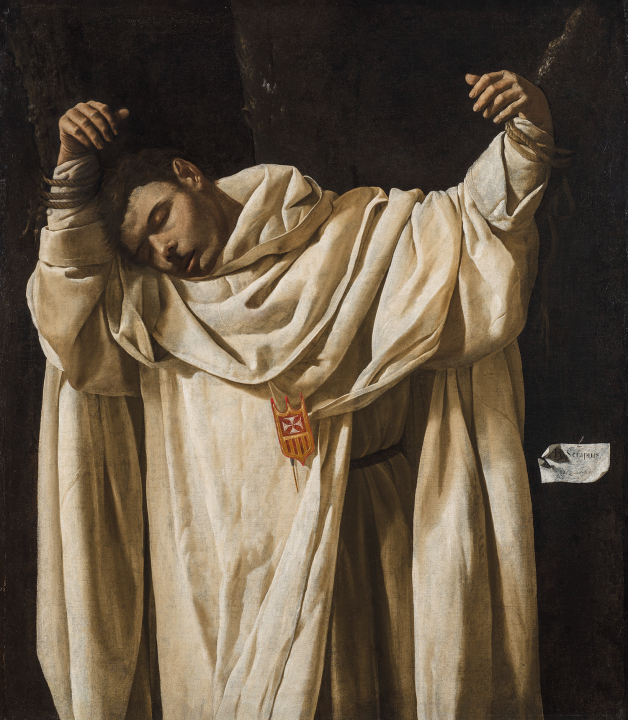
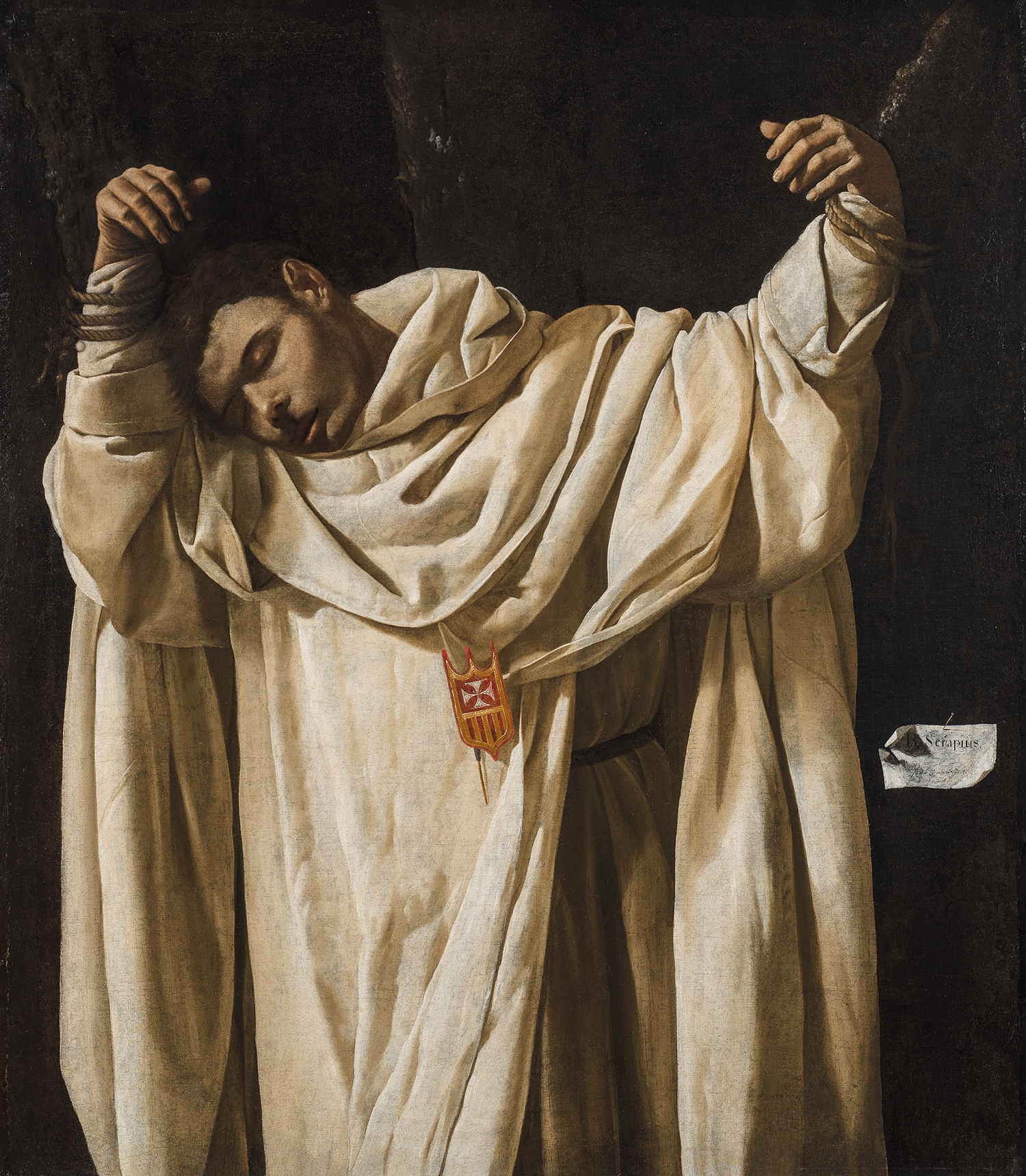
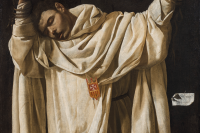
This Christ looks a little too healthy to be a corpse: evidently the model was a soldier or athlete. But the slight unreality of this image is a conscious choice: Zurbarán always prefers to suggest suffering rather than wallowing in it. This is especially obvious in his astonishing 1628 painting of Saint Serapion of Algiers (Wadsworth Atheneum). Saint Serapion was an English friar who was martyred on November 14, 1240 while trying to free Christian slaves in the Mediterranean. His captors tortured him, then cut his body to pieces. Somehow, Zurbarán manages to paint Saint Serapion’s martyrdom without melodrama or sadomasochism. He shows the saint unconscious, exhausted by all the beatings. His head lolls to one side; his face is swollen with bruises, which are hinted at rather than fully shown. He is held up by ropes around his wrists. Somehow there is no blood on his heavy white friar’s habit. Again, Zurbarán has sacrificed the illusion of reality to reveal deeper truths. Few other depictions of martyrdom demonstrate as convincingly just how much a martyr must suffer in order to achieve eternal glory in heaven. It may seem a paradox but a gorier image could not have made the point more forcefully.
Despite the gravity of his subjects, Zurbarán’s paintings are joyous. The bottom half of “The Vision of Saint Alonso Rodríguez,” 1630 (Museo de la Real Academia de Bellas Artes de San Fernando), with the saint kneeling in prayer, would seem forbiddingly austere were it not for the angel in a golden satin robe who stands behind the old man directing his gaze to heaven, where Jesus and the Virgin Mary are seen directing the light from their hearts toward the saint. Meanwhile, in the upper right corner, a small choir of angels sings to the accompaniment of a lute. Zurbarán was delighted by color and must have actively looked for excuses to paint the effect of light on satin and damask silk – they are everywhere in his paintings.
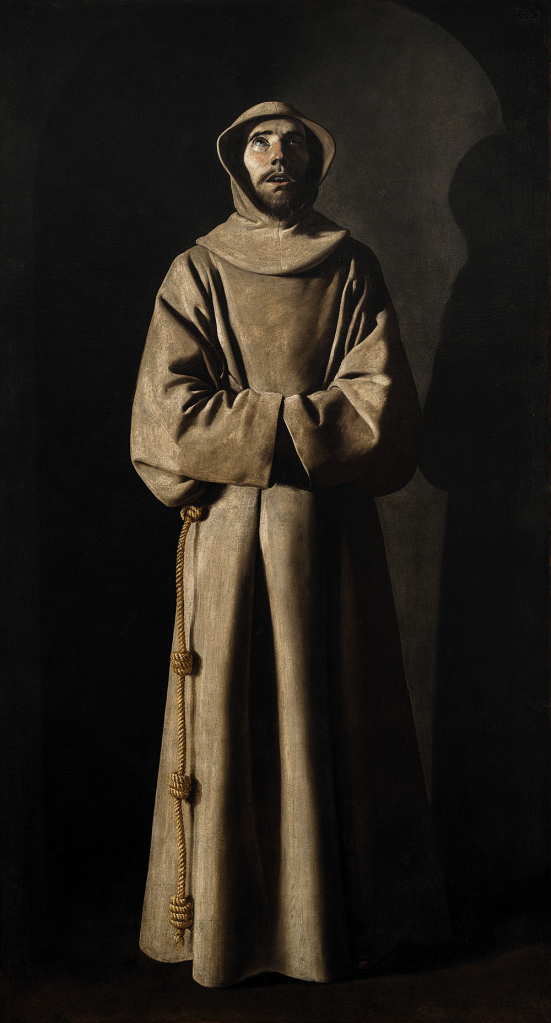
Perhaps Zurbarán was at his most creative when he restricted himself to representing the internal operations of the soul. His 1635-9 portrait of Saint Francis of Assisi kneeling in prayer in a patched, dirty robe (National Gallery, London) is so emotionally intense that many viewers will fail to realize that Saint Francis is singing. A 1636 standing image of Francis in ecstasy (Musée des Beaux-Arts de Lyon) is even more powerful, the saint appearing simultaneously dead and alive (see p37). In this second canvas, Zurbarán paints not Saint Francis of Assisi himself, but a vision witnessed by Pope Nicholas V when he visited the saint’s tomb in 1449. Saint Francis’s body was said to be uncorrupted; allegedly there was fresh blood on his hands from the stigmata. When the pope lifted the hem of the saint’s habit to kiss his feet, he saw the vision that is re-imagined here, Francis floating above the ground in the dark.
The National Gallery’s Zurbarán exhibition features almost 50 paintings. The climax of the show is surely “The Crucified Christ with a Painter” (Museo del Prado), which Zurbarán painted in around 1650, after most of his family had died. Against a dark gray background, the crucified Christ, his arms spread in a Y-shape, his ankles crossed, his toes pointed and his head bowed, seems turned toward the painter almost as though this were a curtain call. In the bottom right of the image, illuminated by the same light that shines on the cross – or perhaps by the body of Christ himself – a bald, bearded painter in a mauve robe looks up in adoration, his right hand against his breast, his left hand holding his palette and brushes.
The painter here is meant to be Saint Luke the Evangelist, who is (among other things) the patron saint of artists. But this must also be a self-portrait in some way. Zurbarán had nothing left when he painted this work. Even so, he seems youthful, unaffected by grief, angst, bitterness or self-pity. This sense of serenity must be the secret to Zurbarán’s art. Or is there more to it than that? In the Catholic tradition, religious art is intended to encourage or inspire prayer, or serve as a reminder that we ought to live a holier life. This is why so much Christian art leaves us cold: most artists think that they can help us pray simply by showing us someone else who is praying. Even the old masters rarely succeeded at creating art that is genuinely useful in spiritual terms. Zurbarán figured out how to capture the experience of prayer on canvas. “The Crucified Christ with a Painter” is thus more than a painting: it is the spiritual testament of a great artist.
Modern man
JONATHAN RUFFER
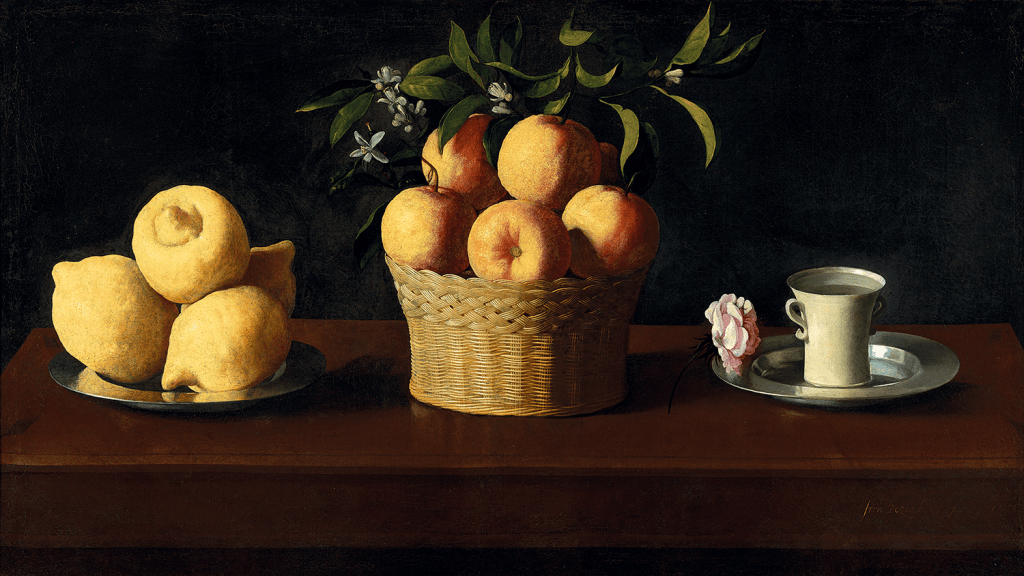
Some artists are born famous, others have fame thrust upon them. Today Francisco de Zurbarán is a household name: his still life, “A Cup of Water and a Rose” (c. 1630), given to London’s National Gallery by Alan Clark, and quite possibly only a fragment, is its most popular picture.
His story is an interesting one, since it throws a light on what it is that makes art a part of who we are. After his death, Zurbarán simply disappeared. The 13 paintings that make up “Jacob and his Twelve Sons” (c. 1640), which form the basis of our Auckland Palace collection in Durham, were simply unknown outside these four walls. In the blinkered world of the Grand Tour and the domestic admiration of the Dutch Masters, Spain’s art didn’t really feature. The opening of the Prado in 1819 was a revelation, but it was the Prado of Brueghel and the Netherlandish school, without the heavy emphasis on Catholic orthodoxy that, to the cognoscenti, marked out the painters of the Spanish school as savages. It was the French who rediscovered Zurbarán. First came General Jean-de-Dieu Soult, who paid him the compliment of seizing his work during the Peninsular War (1807-14) and taking much of it to France. Second was the French critic Théophile Thoré, who described him as “le Caravage espagnol” in an article for L’Artiste magazine in 1835.
By then the whole world was marveling at the Spanish collection of Louis Philippe I. This had been augmented by Frank Hall Standish’s estate, which had been given to France in a fit of petulance because Lord Melbourne wouldn’t give Standish a baronetcy. Sold by Christie’s in 1853, Louis Philippe’s trove – which included no fewer than 83 Zurbaráns – was disseminated around the great galleries of Europe. The National Gallery, under Charles Eastlake, got the best two – and was roundly condemned for his poor judgment. On paper, Zurbarán’s career reads conventionally – endowed with a prodigious talent, he came from a comfortable merchant family in the backwaters of Extramadura. Moving to Seville, he found a city prosperously sophisticated. Zurbarán’s directness of expression and his singularity quickly established him. His bright colors, his accuracy and intensity of feeling resonated with the religious orders. The most interesting moment in his career came in 1634 when he was asked to paint a dozen pictures for the Hall of Realms, the centerpiece of the Madrilenian royal palace under construction. Velázquez only got to paint one. Zurbarán’s ten were to be of the Labors of Hercules – who was considered a mythical ancestor of the Habsburg King, Philip IV – and two battle scenes, of which one survives. The battle scene is conventional stuff – the Hercules series is not. They are crudely monumental, Hercules’ body not quite hanging right, but it’s the not-rightness of Picasso’s ladies whose eyes seem to have lost bearing with their nose.
Zurbarán was unable to hold his pre-eminence in the marketplace. He had an unnerving lack of perspective, which at the time looked old-fashioned and therefore incompetent, but which today appears pleasingly odd. At the time the sweetness of Murillo trumped the stillness of Zurbarán, just as Murillo had also seen off the intermittently prodigious talent of Juan de Valdes Leal.
Today, we see the Spanish Golden Age as a bit of a slog. The saints tend to suffer, the religious seem to be pleased with themselves. Zurbarán offers a feast for the eyes, but he is resolutely not a portrayer of pain or a citizen of the world. The collecting world is still wary of his religiosity, but his edginess has appealed to the je-m’en-foutisme of the modernists.
Zurbarán is at the National Gallery from May 2 until August 23. It will be at the Art Institute of Chicago next year.
Jaspreet Singh Boparai is a senior fellow of the Pharos Foundation and a contributing editor at the Lamp.
In 2013 Jonathan Ruffer rescued Auckland Palace and its priceless collection of Zurbarans.



Comments