To accompany an exhibition of paintings by Philip Guston at the Royal Academy of Arts in London in 2004, a performance was arranged of Morton Feldman’s composition written in homage to Guston, for which I was persuaded to page-turn. For Philip Guston runs non-stop for four hours and the thick A3 bundle of manuscript paper balanced precariously on a flimsy music-stand was a matter of concern: what could possibly go wrong? Once the performance ended, I snatched the bundle of £20 notes that I’d been promised, sprinted to the bathroom, then fortified myself with the chunkiest slice of cheesecake I could find in Patisserie Valerie on Old Compton Street. Nothing had gone wrong but, boy, did I need a sugar-kick.
For Philip Guston is returning to London on 18 January at Kings Place, performed by pianist Siwan Rhys and percussionist George Barton – who perform together as GBSR Duo – with the flutist Taylor MacLennan, the occasion being Feldman’s own centenary year: his 100th birthday would have fallen on 12 January. When Feldman died in 1987, he was hugely respected within experimental music circles. His quiet, hushed compositions, famous for their extravagance of duration, encouraged fresh ways of perceiving sound.

But whereas most composers suffer a decline in reputation following their death, Feldman’s has continued to rise. His lengthy, muted scores happened to suit the emergence of a new recording medium, the Compact Disc, and labels such as HatArt and Mode started documenting his music in abundance. Brian Eno and Sonic Youth’s Thurston Moore spoke of him as the composer everyone needed to listen to. The soft, pastoral palette with which Mark Hollis painted his Talk Talk albums, with digressive songs in no hurry to sign-off, was obviously indebted to him. Performers ordinarily associated with the mainstream classical repertoire have been bitten by the Feldman bug, too. Marc-André Hamelin has recorded Feldman’s 70-minute solo piece For Bunita Marcus, Michael Tilson Thomas his orchestral music. The Sheffield-based Another Timbre label has made Feldman something of a speciality, and the 18 January concert is the launch of Rhys, Barton and MacLennan’s audacious six-CD set of Feldman’s music for flute, piano and percussion.
Feldman had the ears of a Pierre Boulez matched with a wit that was pure Larry David
When they play For Philip Guston I’ll be there this time strictly in a listening capacity, but my page-turning two decades ago gave me an inkling of the extreme demands this music places upon performers. To love Feldman’s music is to submit entirely to its universe. While the Guston piece, written in 1984, stretches to four hours, his String Quartet No. 2, written a year earlier, hits the six-hour mark, and Feldman would reassure listeners who doubted they could last the course: ‘Relax, it’s a short six hours.’ Feldman, Jewish, born in Queens, New York, had the ears of a Pierre Boulez matched with a wit that was pure Larry David. Claiming his six-hour string quartet as ‘short’ was funny because the joke contained a kernel of truth. Feldman constructed his grand compositional labyrinths out of petite, pared-back melodic cells that you’d reckon might just be enough to sustain a ringtone. The grand scale of his music sat in inverse proportion to its notes.
Feldman talked about his music being concerned not with form, as were most composers, but with ‘scale’. His own favourite composers included Schubert and Webern, and it was at a 1950 performance of Webern’s Symphony, Opus 21, at Carnegie Hall by the New York Philharmonic conducted by Dimitri Mitropoulos, that he bumped into John Cage for the first time. The pair met on the stairs fleeing from the Rachmaninov Symphonic Dances that followed. Cage had already declared himself uninterested in composition as a conduit for narrative or for telling a story; he was interested more in the activity of sound itself.
Feldman was reaching similar conclusions, and meeting Cage helped give him the courage of his convictions. Through Cage he started engaging with the work of painters such as Jasper Johns, Robert Rauschenberg and Guston himself, and something clicked: the tactile relationship that abstract expressionist painters had with their medium made Feldman hear music and sound anew. Abstract expressionist canvases, their subtle variations in texture and painterly tone, encouraged slow, thoughtful contemplation, in contrast to the way one concentrates on a single focal point in a more representational canvas. Feldman, similarly, wanted listeners to inhabit his music from the inside, rather than expecting it to represent anything external to its own sounds.
I knew that Feldman’s music messed with perceptions of time, but my experience at the Royal Academy taught me the extent to which his music made clocks stop. The first 30 minutes, as I acclimatised myself to the slow balletic stirrings of Feldman’s notes establishing themselves, felt like for ever. Then, suddenly, it was all over; for three and a half hours I’d been pulled inside his interlocking labyrinths, and simply nothing else mattered.
For Philip Guston was the last of a trilogy of works that began with the evocatively titled Why Patterns? in 1978. To write Crippled Symmetry in 1984, he expanded on the basic Why Patterns? instrumentation of flute, piano and glockenspiel by having the musicians double on bass flute, celeste and vibraphone; with For Philip Guston he added marimba and tubular bells to the mix. Each piece went deeper inside the melodic cells and gestures – and took increasingly long to do so as the canvas expanded with each rewrite. Losing myself in For Philip Guston, I realised the familial similarity of the musical materials in Feldman’s music. Music of dramatic contrast was not Feldman’s bag.
That’s why, with Cage in tow, he’d turned on his heels rather than hear Rachmaninov. Rather than journeying anywhere in particular, Feldman’s compositions hovered in space, like the colour contrasts in a Rothko. His music was not, by inclination, abrasive or the sort of modern composition that could leave anyone feeling punch drunk. Often his sounds obliged an appreciation of a hinterland between medium softs and medium louds, and there was always a melodic, lyrical soul to Feldman, yet nudged tantalisingly out of reach. His genius, really, was that his fragmentary, fleeting bare-bones melodies rarely strayed beyond the fundamentals of tonality. He took the simplest of melodic cells, smudged their boundaries, then spun them into spider’s webs.
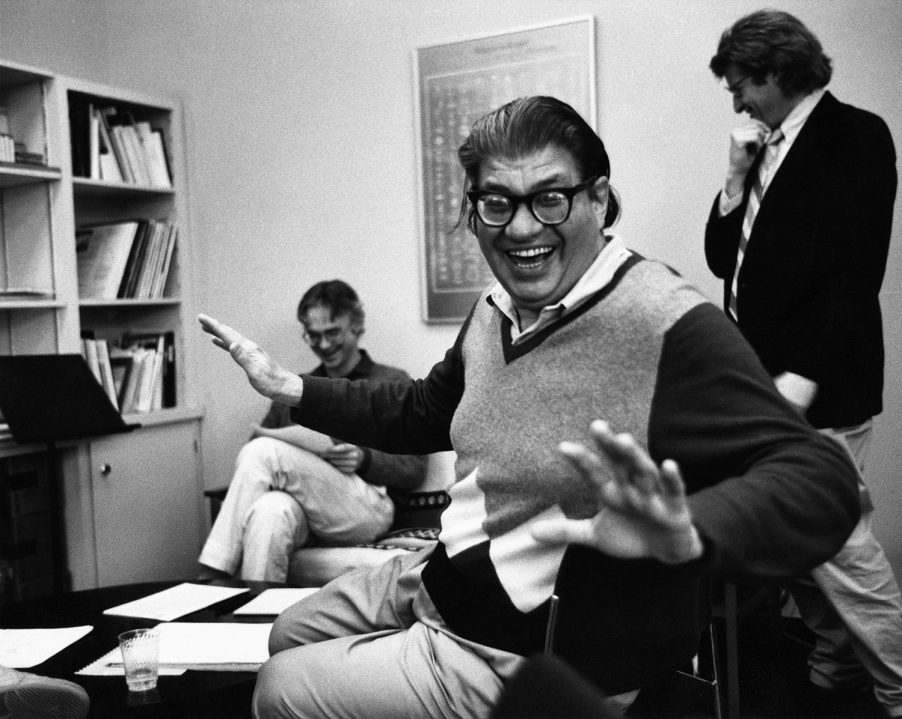
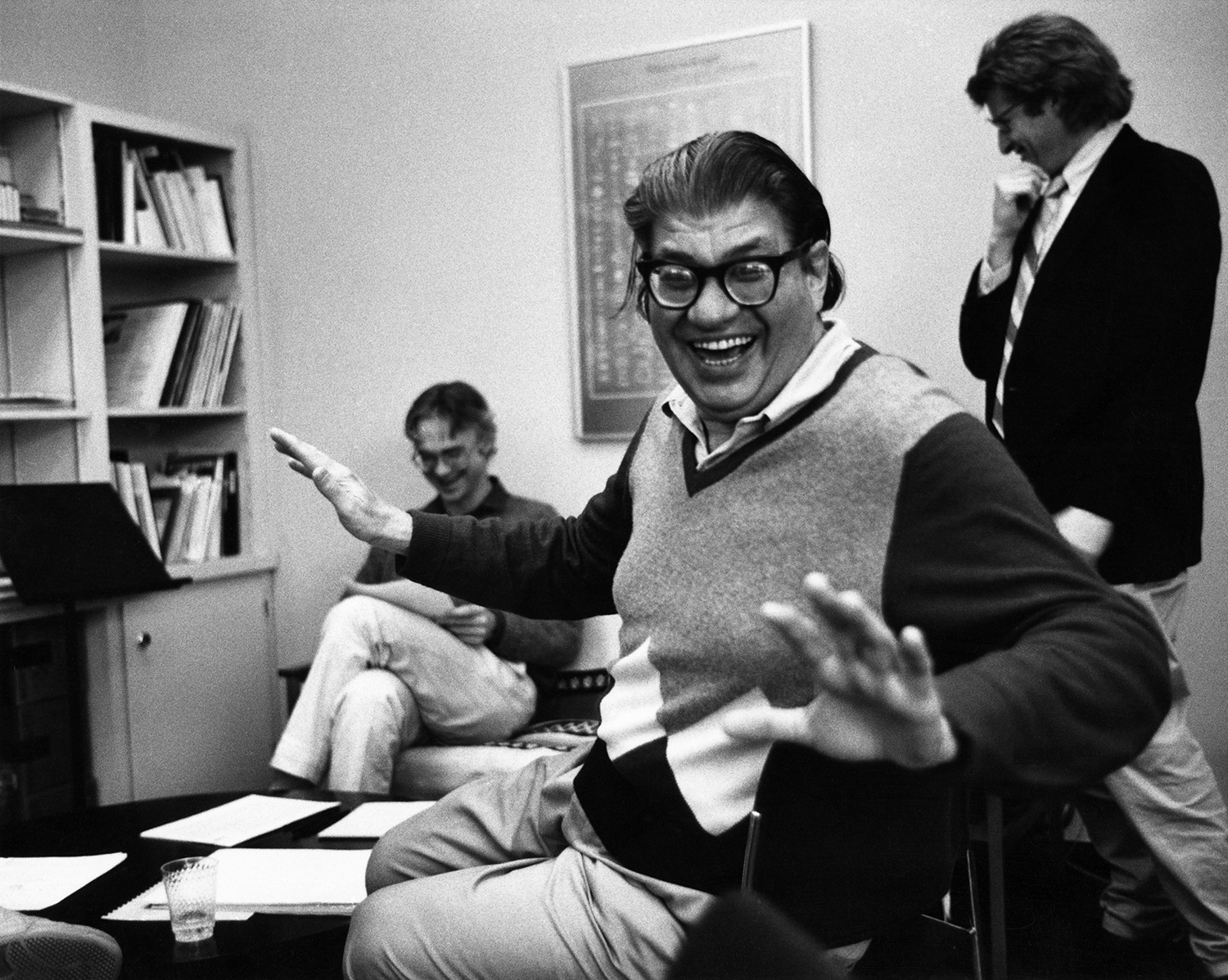
Feldman the man, with his greasy barnet, thick-rimmed black glasses and taste for hideous Alan Partridge jumpers, was perhaps an odd purveyor of sounds that expressed such sensual delicacy. His preference was for noisy, nasty jazz clubs and heart-attack-just-waiting-to-happen burger joints. The hectic pace of New York life that filled him with such joy was in striking contrast to the serene surface and gentle to-and-fro of his hushed harmonies. New York could allow Feldman the peace of an art gallery and the sensory overload of the Village Vanguard. He also found it a good place to indulge his love of buying Turkish and Persian rugs which, you sense, he heard as much as saw. The problem with Western music, he proffered, was that each piece required a reinvention of form from scratch, depending on narrative content or technical obsession. But the weave of a Middle Eastern rug, intricate patterns gradually transforming over a stretch of fabric to reveal micro-differences of colour and contour, he saw, and indeed heard, as a model for his music.
Most composers suffer a decline in reputation following their death, but Feldman’s has continued to rise
Another of Feldman’s favourite compositional strategy was Proustian. His knack of implanting a tiny melodic or harmonic kink into the early stages of a piece – only for it to finally blossom only three hours later – was a reminder that for all his expert manipulation of patterns, he worked ultimately by intuition.
The gradual transformation of small melodic modules over long durations from a composer based in New York might suggest a kinship with the systems-derived early scores of card-carrying minimalists like Steve Reich, Philip Glass or Terry Riley. But where an early Reich piece such as Piano Phase or Four Organs followed a clearly defined process, Feldman’s music always hovered above systems. Once he’d completed a page of a score, he would turn it facedown and not look at it again. Composing was about listening into his emerging structures and feeling in his gut where the music should head next, keeping sound in a constant state of unpredictable regeneration. The delicate balance he struck between intuition and structure cloaks Feldman’s work in an enduring air of mystery – music that explains itself by resisting explanation.
GBSR Duo: For Philip Guston is at Kings Place on 18 January.


Comments