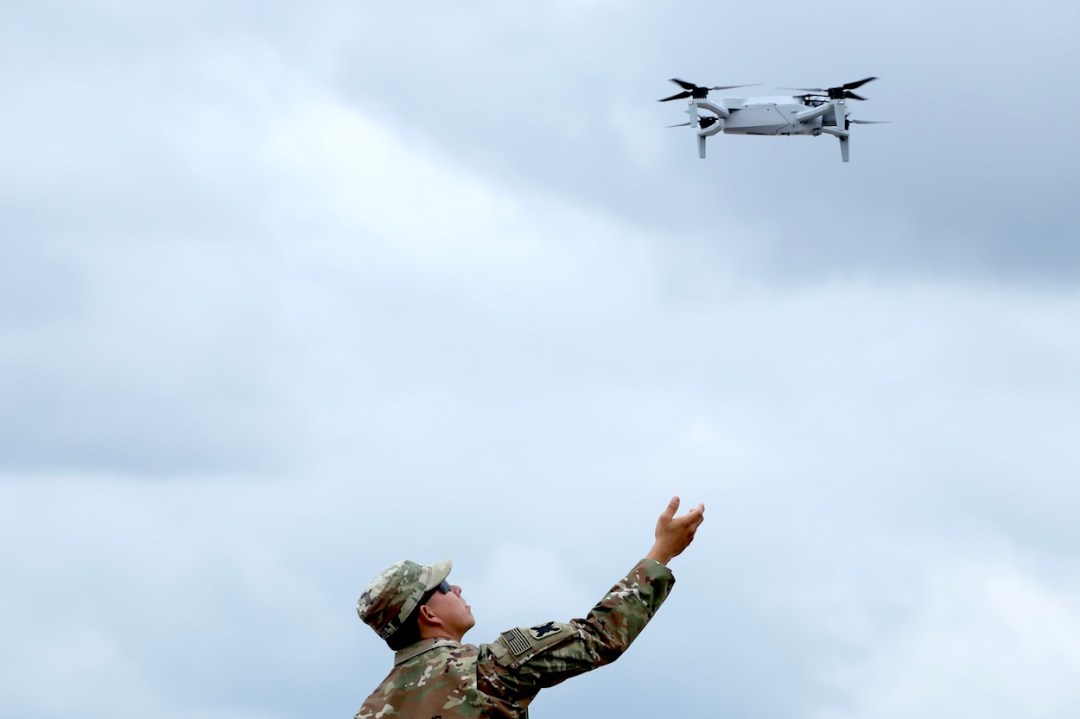
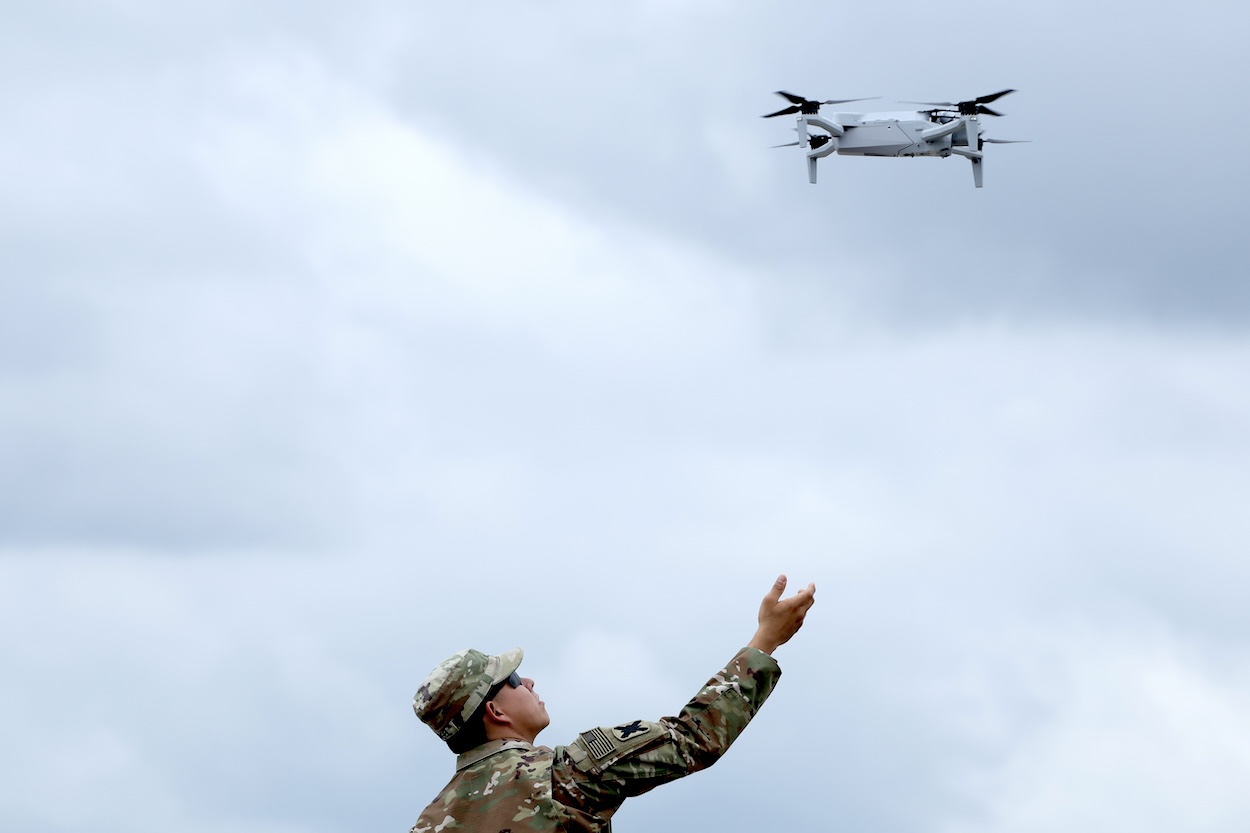
In March, Russia suffered 35,000 casualties in the war in Ukraine. It’s estimated 33,600 of those, an extraordinary 96 percent, were caused by drones. Attacks by drones equipped with bombs, machine guns and even flamethrowers are now responsible for most of the casualties on both sides of the conflict. Therein lies a potential trap for militaries across the globe. It would be a catastrophic mistake to believe that victory can be bought cheaply and quickly with a single technology.
The great lesson of Ukraine is that armies are punished for relying too heavily on one strategy. President Putin made precisely that mistake. He believed Russian vast tank regiments and precision artillery would bring Ukraine to its knees. Instead, Russia’s army was left wanting by poor leadership, corruption, low morale and a failure to adapt to the rapidly changing battlefield. The West risks making the same mistake if it believes drones are the new wonder weapon of the future.
Drones are unable to do the most important part of war: they cannot physically hold ground
“The danger is an over-correction,” Phil Ingram, a former colonel in British Army Intelligence, told me. “The danger is we over-learn the lessons of the Ukraine war and we treat drones as a convenient solution to more expensive problems. It would be very easy to look at Ukraine and say ‘this is the future of warfare’ and run the risk of putting all of our eggs in one basket. It would only take a breakthrough in counter-drone technology – and then what?”
It’s clear that Western militaries, including the US, believe drone technology is the future. Pentagon officials have requested almost $75 billion in funding to rapidly expand drone capabilities. Secretary of War Pete Hegseth has told the Army that every division should have drone capabilities by the end of the year. This is perfectly reasonable, given the changing realities of war. The problem comes in taking this logic to its dangerous conclusion.
The Center for Strategic and International Studies, a DC thinktank, has gone so far as to suggest substituting US troops for drones. “Imagine that instead of a 1,000-person battalion, there was a 250-person rotational battalion that had a mix of 500 [first-person view] drones and octocopters,” Benjamin Jensen, a director at the thinktank, told Defense News. Jensen suggests that the United States could free up thousands of troops stationed in Europe by replacing them with unmanned aerial vehicles. Such a strategy would be a mistake.
Drones are unable to do the most important part of war: they cannot physically hold ground. Yes, they can hover over a position, but that’s not the same as holding territory. Munitions and batteries can run out while reserve vehicles can fail to arrive. Drones require almost continuous datalinks, specialist operators and spare parts. While they can, temporarily, deny the enemy the ability to take a position, they cannot dig in like a human, they struggle to capture prisoners and are unable to search people at checkpoints. Drones cannot administer control. There is no technology that can beat the brutal simplicity of a soldier using his own intelligence.

Despite every technological leap in warfare, the fundamentals have not changed. Machine guns, tanks, attack helicopters and now FPV drones have transformed the battlefield, but none has removed the need for infantry to close with the enemy, take ground and hold it. Nor have they made obsolete the hard-won lessons of infantry tactics and combined arms warfare, which remain as vital as ever. Technology may alter the methods, tempo and risks of combat, but it does not remove the brutal human requirement to impose control on the ground. Wars are ultimately decided, not by machines, but by soldiers prepared to advance, fight, endure hardship and occupy the terrain on which political and military outcomes depend.
Even with the enormous range of advanced technology now being deployed by the Americans in the Gulf, the threat posed by the Islamic Revolutionary Guard Corps remains extremely difficult to neutralize. That should be a warning against believing that any single weapon system, however innovative, can transform war on its own.
Drones have undoubtedly changed the way armies fight, and their influence will only grow, particularly in reconnaissance, targeting and precision attack. But the real lesson is not that drones replace everything else. It is that militaries must strike the right balance, combining new technology with proven capabilities. They also need procurement systems that are fast, flexible and closely linked to industry, so useful equipment reaches soldiers in time for the next battlefield surprise.
The armies that succeed in the future will be those that can combine drones with artillery, electronic warfare, air defence, armor, infantry, logistics and rapid industrial adaptation. Not those that replace these capabilities with a single fragile technology.
Ukraine has not shown that drones can replace armies. It has shown that armies that fail to adapt to drones will be punished. That is a very different lesson. The worst response to Ukraine would be to learn nothing. The second worst would be to learn one thing too enthusiastically.




Comments