
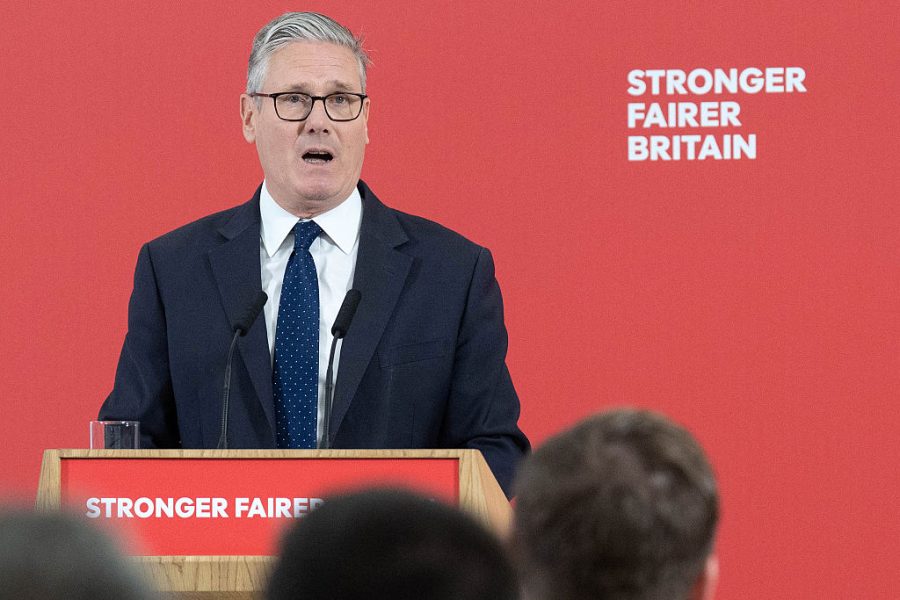
With just a few weeks until he is expected to step down as prime minister, Keir Starmer chose a drone factory in Berkshire as the location from which to deliver his swansong: the Defence Investment Plan (DIP). Starmer was joined at the venue by Defence Secretary Dan Jarvis – in the job for less than three weeks – and, unexpectedly, Chancellor Rachel Reeves to present the headlines of the DIP, published today after a delay of more than seven months.
Reeves confirmed that the Treasury is handing the Ministry of Defence (MoD) £15 billion over the next four years as part of the DIP. She went on to repeat the line frequently peddled during Starmer’s tenure that Labour has overseen the ‘biggest uplift in defence spending since the end of the Cold War’ – which jars somewhat with the fact the MoD claims to need approximately £28 billion over the next four years to fulfil existing commitments and build on them. Praising Starmer personally, she said that his ‘absolute moral clarity’ on defence ‘would go down as part of his legacy’.
Starmer presented the DIP as a spending plan built on tough choices. There will be a £5 billion investment in drone production over the next four years, which will provide a variety of ‘uncrewed’ drones for all three branches of the armed forces. Investment in Britain’s nuclear deterrent is being lifted to £64 billion over the same time frame, to be spent on building a new sovereign warhead and nuclear submarines and buying 12 F-35 fighter jets.
The elephant in the room, of course, is that Starmer is expected to cede power to Burnham
Starmer also renewed Britain’s commitment to building the Tempest fighter jet alongside Italy and Japan under the GCAP programme, allocating £8.6 billion to the project over the coming four years. The funding provided by the DIP would, he stated, create nearly 60,000 jobs in Britain by the end of the decade.
Starmer announced that, along with the 1.5 per cent of GDP Britain is expected to spend on defence-adjacent security projects, the DIP would raise the country’s core defence spending to just under 2.7 per cent of GDP spending by 2030. With notable relief in his voice, he declared this would put British defence spending on 4.2 per cent of GDP by that year, adding that he would be ‘very pleased to report this back to Nato colleagues’ at the alliance’s summit in Ankara.
Today’s DIP does, indeed, bring good news on a few minor points. Japan and Italy will, for example, be reassured by Starmer’s commitment to GCAP – after he failed to put any numbers on the page during his recent meeting with the Japanese prime minister Sanae Takaichi in Downing Street. Similarly, Nato chief Mark Rutte, who Starmer confirmed he had shown the defence spending blueprint to during a tete-a-tete yesterday, put out a statement welcoming the plan and calling it a ‘a good step’ towards meeting Nato’s defence spending commitments. Next week’s Nato summit – and Starmer’s wish not to attend humiliatingly empty-handed – was reportedly the driving impetus behind his insistence of publishing the DIP before leaving office.
Nevertheless, Starmer’s DIP does little more than paper over some substantial cracks. He failed to mention that of the £5 billion allocated to drone development, just £1 billion will be new money. He also failed to map out a route to spending 3 per cent of GDP on defence, saying only that this would happen in the next parliament. Passing the buck to his expected successor, Andy Burnham, he declared that meeting the 3 per cent target ‘must be the number one priority of the next spending review’, due next year.
The irony of the Defence Investment Plan (DIP) is that had it been published last year as intended, it probably wouldn’t have received nearly as much scrutiny as it is now getting. It was notable that, in their speeches, both Starmer and Reeves rather pointedly thanked Jarvis for his efforts getting the DIP over the line. His predecessor John Healey resigned earlier this month over funding he said fell ‘well short of what is required for defence’.
The elephant in the room, of course, is that Starmer is expected to cede power to Burnham, the MP for Makerfield, in as little as three weeks. Burnham was reportedly angered by Starmer’s insistence at pushing the DIP through before leaving Downing Street. Burnham recently suggested that he would be willing to boost defence spending – perhaps by cutting welfare or introducing other means of financing such as defence bonds. There is no indication so far, however, of whether he would go further than the £15 billion of the DIP or leave the spending allocation as it now stands.
In what could be read as a pointed jibe to Burnham – and also Healey – Starmer once again shut down the idea of raising funds for defence through the issuing of so-called ‘defence bonds’. ‘Defence bonds are just borrowing by another name,’ Starmer said, arguing that they would simply push interest rates higher. Burnham’s economic advisors have pushed him to reconsider introducing such bonds – first proposed by the Liberal Democrats at the start of the year, with the claim they could raise as much as £20 billion in the first few months.
The DIP is expected to be published in full imminently, with a debate in the House of Commons. There have been some suggestions that Healey may stand to speak as part of it. The prevailing mood in the defence industry – and among Britain’s Nato allies – is that the DIP will do for now, as long as more will eventually come from Burnham, something far from guaranteed. If the DIP is Starmer’s legacy, then it is a fragile, meagre one, at risk of being either squashed or overshadowed by the whims of his successor.





Comments