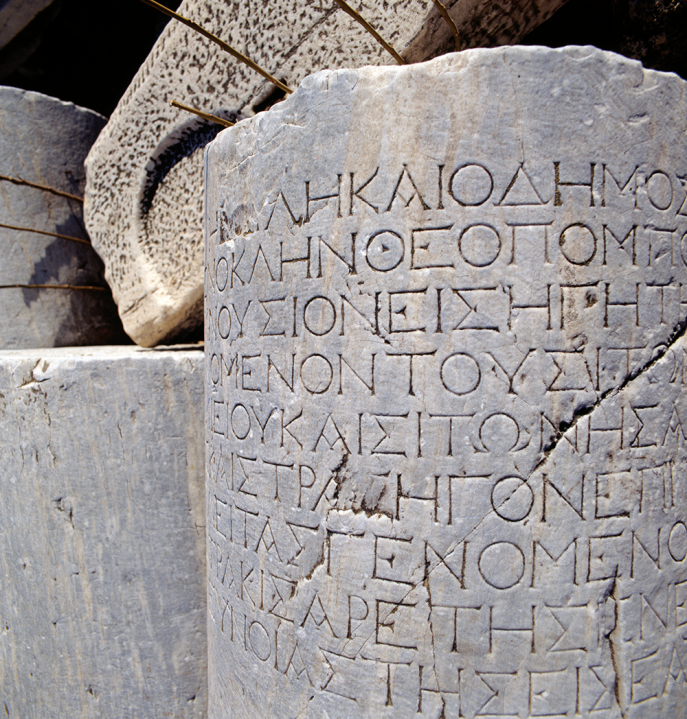
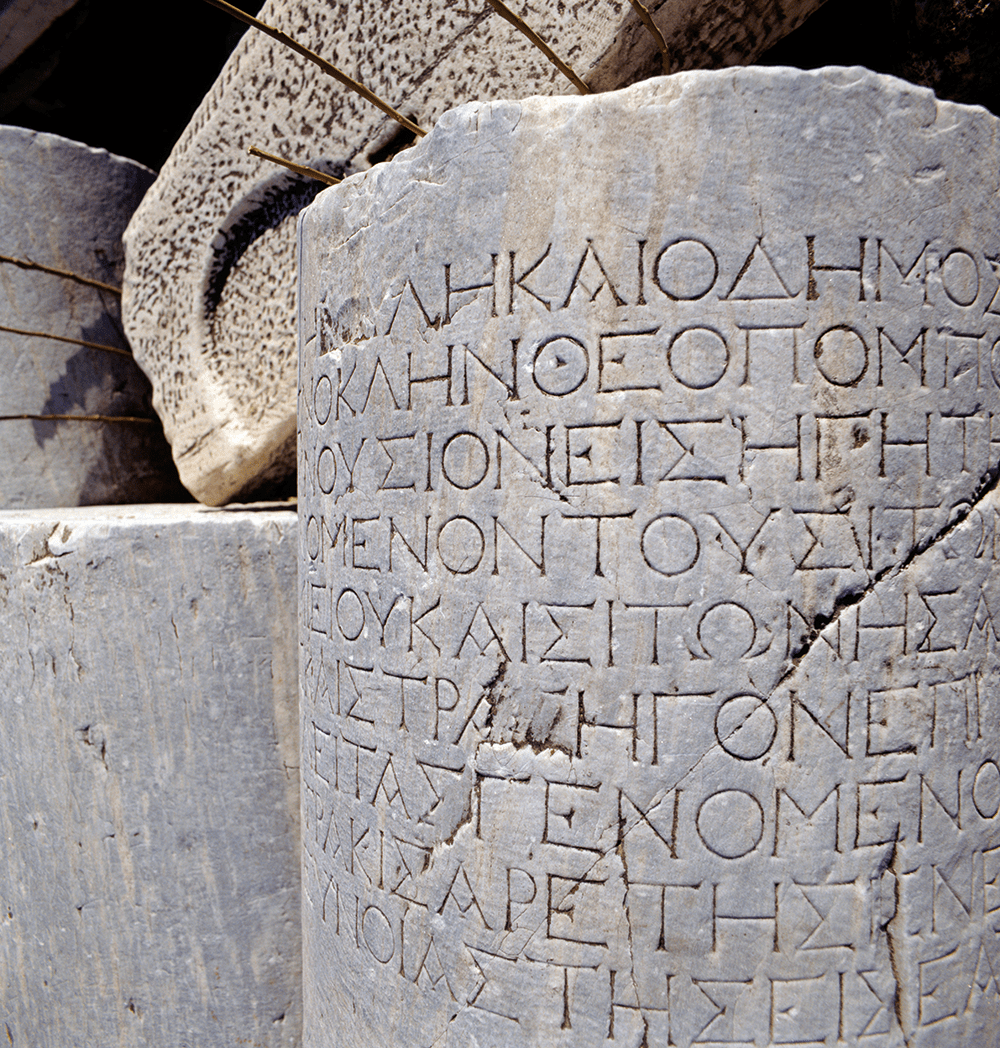
Ancient Greek, once central to a western European education, is on life support. Last summer, 206 pupils sat an A-level in ancient Greek. Of those, only a handful were state-educated.
So it’s farewell to the language taught in our schools since the 16th century. Farewell to the language of the New Testament; the language Roman nobles revered and the emperors spoke. Julius Caesar’s last words weren’t ‘Et tu, Brute?’ They were ‘Kai su, teknon?’ – ‘You too, my child?’
As A.N. Wilson recently wrote: ‘Someone once said that all western philosophy is just footnotes to Plato. All western literature is just footnotes to Aeschylus, Sophocles, Euripides and Homer.’
You end up with a diluted Greek GCSE that insults the intelligence of the handful of pupils who sit it
With the death of Greek in schools, so too it is dying in universities, with reading in the original language replaced by English translations. As one retired Oxbridge don put it to me: ‘The subject is becoming more like classical studies every day – an ancient equivalent of English literature.’
Of the 13 state schools that teach A-level Greek, most are grammar schools. Less than half are comprehensives. So the rigorous study of ancient Greek is almost entirely confined to selective schools – and the soft bigotry of low expectations strikes again. If you aren’t lucky enough to have rich parents, able to send you to private school, or if you don’t get into a grammar school, it’s almost impossible for you to study classical languages at the highest level at university.
Yes, Oxford and Cambridge admirably try to narrow the gap by teaching Latin and Greek to undergraduates who haven’t studied the languages at school. But how can they ever hope to close it? When I started classics at Oxford in 1989, I’d already done eight years, with long terms and long daily hours, of Latin and seven years of Greek at North Bridge House prep school and Westminster School. No one is going to catch up in the three or four years of a classics degree, for just 24 weeks a year, with only two hour-long tutorials a week.
Greek is hard to learn. You have to deal with a new script and alien terms, like the optative and the dual. So you need intensely rigorous Greek lessons early on at school to get anywhere with it. Instead, there has been a real decline in linguistic teaching in schools for 40 years.
That retired Oxbridge don says: ‘The Cambridge Latin Course – essentially teaching Latin like a modern language – was the start of the rot in schools, as far as rigour and solid learning of language go.
‘As for Greek in schools, Maurice Balme did his best with his course, Athenaze, which tried to provide a good reader, underpinned by solid learning of language. But far too much water has been poured into the wine in the past 40 years and dons are (privately) tearing their hair out. Oxford – and every other university – now admits candidates they would have dismissed a generation ago.

‘Pupils who haven’t done Greek can’t catch up with the private school students, despite the evidence that these privileged few are only too ready to slide down to the general level and happily treat their experience as classical studies rather than classics.’
I’m all for classical civilisation – it’s a wonderful subject. But it is a very different subject to classics and a full understanding of the languages. Well, it used to be. Now full-fat classics is morphing into classical civilisation, and few teachers and dons are prepared to acknowledge what schools are losing.
Along the way, Greek GCSE has been tragically dumbed down, with increasingly banal questions. That’s part of a failed bid to make the subject more accessible. So you end up with a diluted exam that insults the intelligence of the handful of pupils who sit it.
As a part-time Latin and Greek tutor, I’ve witnessed the catastrophic decline. One of my pupils – bright, yes, but with only two years’ Latin – got 97 per cent in his GCSE. The Emperor Augustus wouldn’t have got 97 per cent in the old Latin O-levels.
In the early 1950s, translation from English to Greek – the gold standard – was compulsory. Now you don’t have to do it at all. Most teachers and dons have been quietly accepting all this. Desperate for pupils to study any form of classics, they’re prepared to sacrifice the full-fat version on the altar
of classics-lite.
In 2015, Camden School for Girls, one of the last comprehensives offering Greek A-level, was on the verge of dropping it because its brilliant Greek teacher was retiring.
I wrote an article for the Telegraph about this, mourning what would indeed soon come to pass: the high-minded, mind-expanding beauties of Greek would be confined to public and grammar schools. The gap between comprehensive and selective education would yawn wider and wider, and difficulty would continue to be replaced by easiness.
Still, the classicists kept on drinking the Kool-Aid. One undergraduate at King’s College London called me an ‘antediluvian ape’. A teacher at Durham Sixth Form Centre predicted my next book would be ‘bowel-achingly derivative’.
My old tutor, Professor Edith Hall, blasted me for being a ‘classical Luddite… bedded down deep in the British Classics Establishment… I thought I had taught Mr Mount to ratiocinate in Homer classes I ran long ago at Magdalen College, Oxford.’ She attacked me again in the Guardian, saying I was insulting ‘the entire community of state-sector classicists and anyone who ever reads an ancient author in translation’.
No, I wasn’t. I was just mourning the demise of the greatest language of all in comprehensives. Thank God, Greek at Camden survived and lives on to this day – no thanks to the classics-lite brigade.
The dons fiddled while Rome – and Athens – burned. Meanwhile, thousands of bright, state-educated children, who could have lapped up the joys – and brain-crunching complexities – of Greek and Latin, are being deprived of the pleasure.
One of my Latin pupils – a nine-year-old girl at a north London state school – was brilliant at absorbing some of those delicious complexities, such as the passive, the participle and the deponent. She went on to excel at Camden School for Girls.
But she was lucky enough to have a mother who could pay for private tuition – and to live near one of the last few comprehensives in the country that taught Latin and Greek A-level. Without those two rare strokes of luck, she would never have been able to study classics at its highest level.
And so the death spiral of ancient Greek continues. As the proper study of classics at university is increasingly restricted to private schools and grammar schools, so the subject will inevitably be attacked for being ‘exclusive’. It will be increasingly marginalised.
In 1925, Virginia Woolf wrote a lovely essay, ‘On Not Knowing Greek’. Of course, the clever old Bloomsbury bluestocking did know Greek. Her essay was really about not knowing the Greeks – and how to appreciate their brilliance through their language:
‘Every ounce of fat has been pared off [Greek], leaving the flesh firm. Then, spare and bare as it is, no language can move more quickly, dancing, shaking, all alive, but controlled. So clear, so hard, so intense, that to speak plainly yet fittingly without blurring the outline or clouding the depths, Greek is the only expression. It is useless, then, to read Greek in translations.’
How horrified Woolf would be to discover that, 101 years after her essay, Britain has become a country that really does not know Greek any more.
Harry Mount’s Odyssey – Ancient Greece in the Footsteps of Odysseus is out now.




Comments