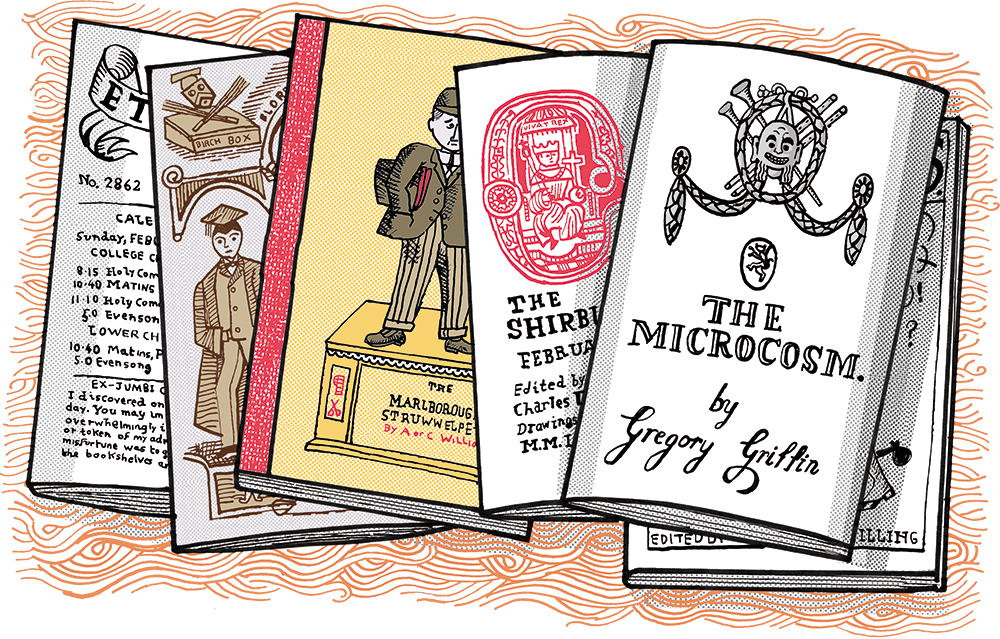
In my mind, there was always a sense of hubris in the air of our tucked-away offices at the Chronicle, Eton’s main student magazine. As in many other domains of our school’s life, we idly assumed ours was the first, as well as the only really consequential, example of a public-school magazine.
The early 2000s, when I was a boy there, were a particularly suitable time in which to indulge in such a view; we were all acutely aware of the rise of Boris Johnson.
If you were devoid of athletic, dramatic or musical talent, editing the Chronicle was the obvious crown
The record for first school magazine does belong to Eton, but it is in fact for a much earlier and odder production, puckishly called the Microcosm, which ran for 40 issues in 1786-7, published as a book the next year. It claimed to be the work of a single hand: ‘Gregory Griffin’. Behind this avatar lurked one future political titan, George Canning; a couple of notable literary eccentrics, John Hookham Frere and Capel Lofft; and a squadron of those gentlemanly, poetic Latinists whose grip upon the public’s imagination appears quite sadly to have faltered. A microcosm both does and does not sum up how Eton sees itself: the world at its most worldly in miniature; but also more entire, whole and perfect, and really a great deal more important.
When the Chronicle eventually appeared in 1863, Eton did not lead but follow. By that time there was a professionalising fashion for magazines in schools across the country, extending from Sherborne’s the Shirburnian (1859), devised as an ‘outlet for the school’s wit’, to Charterhouse’s Greyhound. Could girls and Scots be far behind? The Edinburgh Ladies’ College, later Mary Erskine, struck a blow for both with Our Magazine in 1877. Journalism, derided by Anthony Trollope in 1868 as ‘the lowest business by which an educated man and a gentleman could earn his bread’, was becoming an almost respectable vocation.

By my own teenagehood, if you knew yourself to be fond of writing, while also devoid of athletic, dramatic or musical talent, editing the Chronicle was the obvious crown to pursue. You started in an approved and official fashion on the Junior Chronicle, strictly overseen by a variety of interested schoolmasters. The spiking of, say, an implied criticism of a worthy school play or of a sub-Borisian attempt at political commentary was a fate to be feared.
I recall garnering most approval for a sincere but hardly substantial puff-piece about the Edinburgh Book Festival, which, as the son of a Scottish novelist, I attended every summer, and whose kind, child-humouring organisers were very willing to supply me with profuse inside information. I would have learned the lesson that contacts counted above all, had I, then or later, been willing to do so.
For the would-be wild at heart there was another outlet called the Ephemeral, which had evolved out of a custom of ‘ephemerals’, fleeting single-issue magazines at Eton, gently mocked by J.M. Barrie. Barrie makes James, later Captain, Hook editor of the Chronicle ‘for a brief period (resigning over some item obscurely connected with half a crown)’, then contributing to an ephemeral piece entitled ‘A Dissertation upon Roast Pig’. It is a master’s unjust suppression of this article, Barrie suggests, that in part drives young Hook to terrorise the seas. Throughout the years of piracy, Hook remained a faithful subscriber to the Chronicle and after his death in the jaws of the crocodile, hundreds of copies of it, ‘much thumb-marked’, were found littering his bunk.
By my time at school, the Ephemeral was just another magazine, the closest we had to an edgy, underground answer to the Chronicle. It was as such not really my scene, and I remember it largely as a display of pretty clever boys trying their hardest to seem silly; though its description of the ancient Scottish universities, in advice to school-leavers, as ‘love palaces’ has unaccountably stayed with me.
The spiking of a sub-Borisian attempt at political commentary was a fate to be feared
Marlborough’s equivalent to ephemerals plural or singular is the Heretick, started in 1924 by John Betjeman (motto: ‘Upon Philistia will I triumph’) and patchily revived since. My most talented friend actually deserted Radley for Marlborough largely in order to write for it. Its famed former editors include the comedian Jack Whitehall (who also drew cartoons for it) and The Spectator’s own Lara Prendergast.
I always had my eye on another Eton magazine called the Arts Review. It was a sort of intermediate stage, edited by boys grown beyond the Junior Chronicle but not yet eligible for the Chron itself. Its identity was protean but civilised. Jokes were involved, but they did not dominate as at the Ephemeral. The master in charge had the role of a hands-off proprietor rather than the Junior Chronicle’s de facto Paul Dacre-style editor (another piquant aspect of Eton in the early Noughties was that the school was full of actual Dacres, though they wisely preferred acting to journalism).
You could make of the Arts Review what you would, it seemed, and my Junior Chronicle colleagues had a very clear idea – they would take it over and essentially turn it into an Etonian Guardian. I was relaxed about this; I just wanted to write a lot and build up a profile that would enable my climb to the Chron. I liked editing work but regarded layout as ICT drone stuff far below the salt. I was astonished and wounded – in a way that I have both in jest and reality never let go – when my bright clique secretly replaced me. It was another obvious lesson to refuse to learn.


Comments