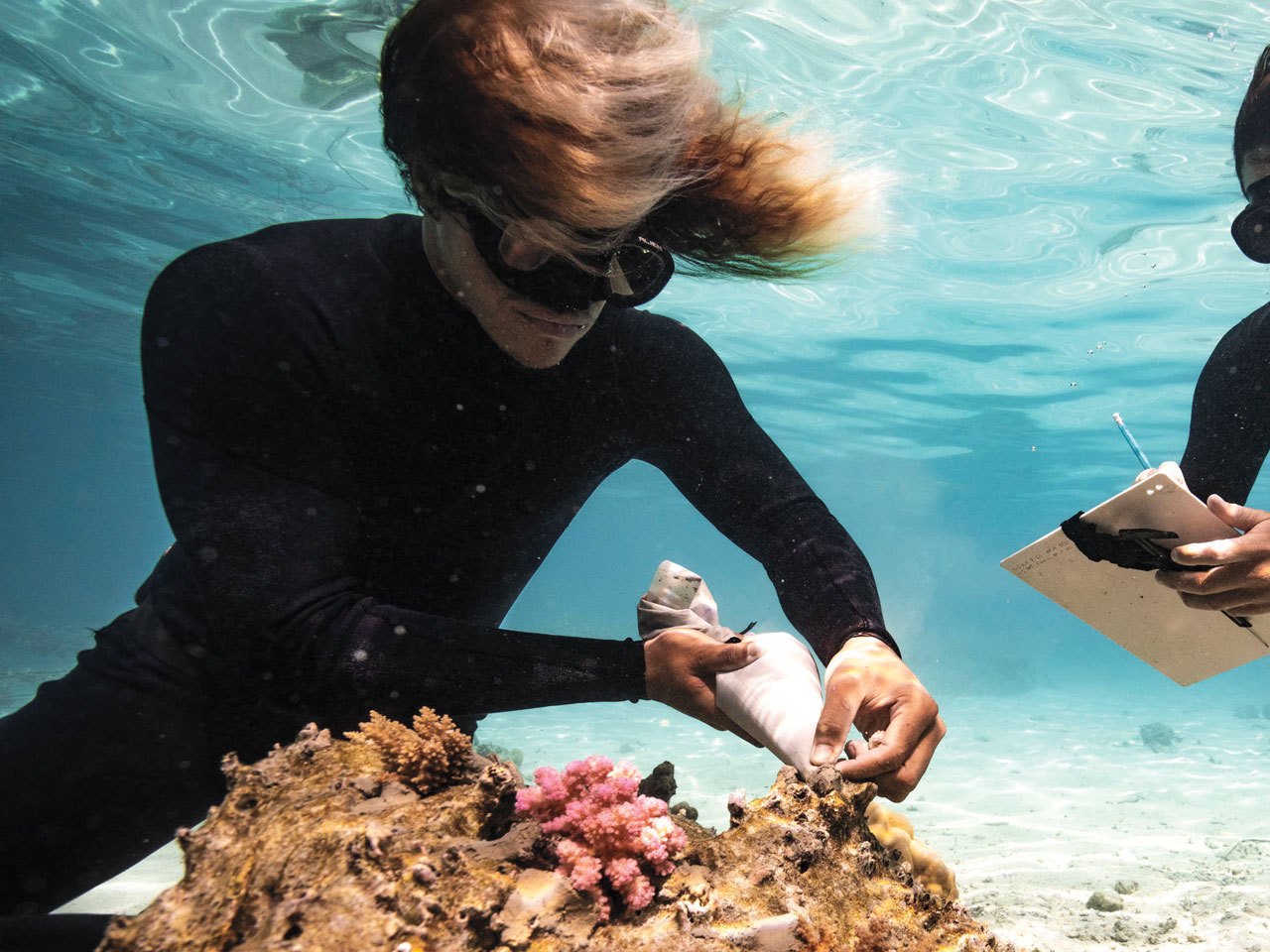
“What is a coral?” If you can answer that question, you are smarter than I am. My interlocutor is a 27-year-old Tahitian called Titouan Bernicot, and you should note that name, because this young man is doing remarkable things.
We are in Thailand at the HQ of Coral Gardeners on the small island of Koh Mak in the Gulf of Thailand, in the South China Sea. This is where Bernicot and his team are innovating techniques of coral rewilding, a mission he has been on since he was 16 years old.
“I grew up in French Polynesia in a little house built on coral. There was no school, no supermarket, no anything, just the sea. It was my playground,” he explains. He describes playing with his friends in the waters, while his family collected pearls to sell for a living. Then one day, while out surfi ng, he found that the usually brightly colored coral that he’d taken for granted his entire childhood had suffered what is known as a bleaching. “I came back from that surf session and typed in ‘white coral’ to Google and discovered what was happening,” he says.
Coral is the ideal way to get people – particularly young people – involved in conservation
Coral is not a plant, as many believe, but an animal. Bleaching occurs when it suffers stress as a result of warming waters, and turns white. Often it does not survive. Before I leave Koh Mak, I will witness one of Bernicot’s colleagues feeding bits of shrimp to coral that the Gardeners are growing in tanks, and see the extraordinary phenomenon of little mouths opening up among thousands of tentacles, pulling the food in, like something out of the Alien franchise.
“When I discovered this amazing thing, I thought this is way cooler than surfing,” says Bernicot, who hung up his board the day he discovered the answer to the question he’d just asked me: what is a coral?
“Corals have been on our planet since 480 million years before the dinosaur,” he says. “When I saw there were no more colors in my home reef, I realized that we were losing one of the most biodiverse ecosystems on the planet. We call the coral reef the rain forest of the sea.”
Determined to act quickly, the young Tahitian approached scientists and academics to discuss what he could do to begin saving the reefs. Their advice entailed years of marine biology; a PhD – “that maybe after studying for a decade, I could start to work in the fi eld,” he explains. This was not soon enough for someone impatient to start having an impact. “I went home, and with my little brother and friends we started to learn about how to grow new coral.”
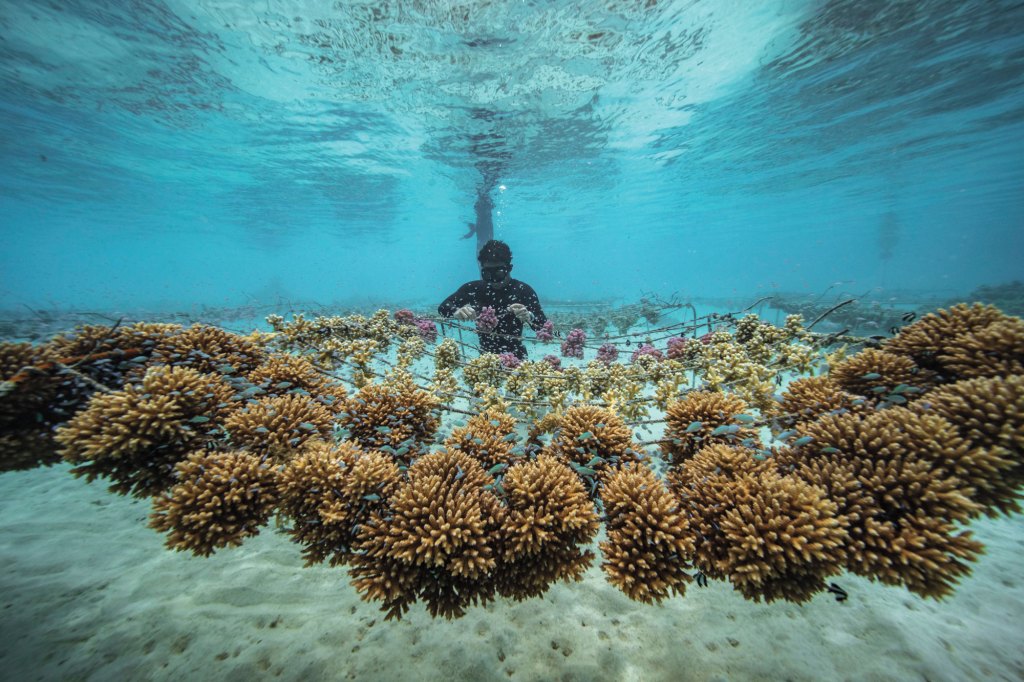
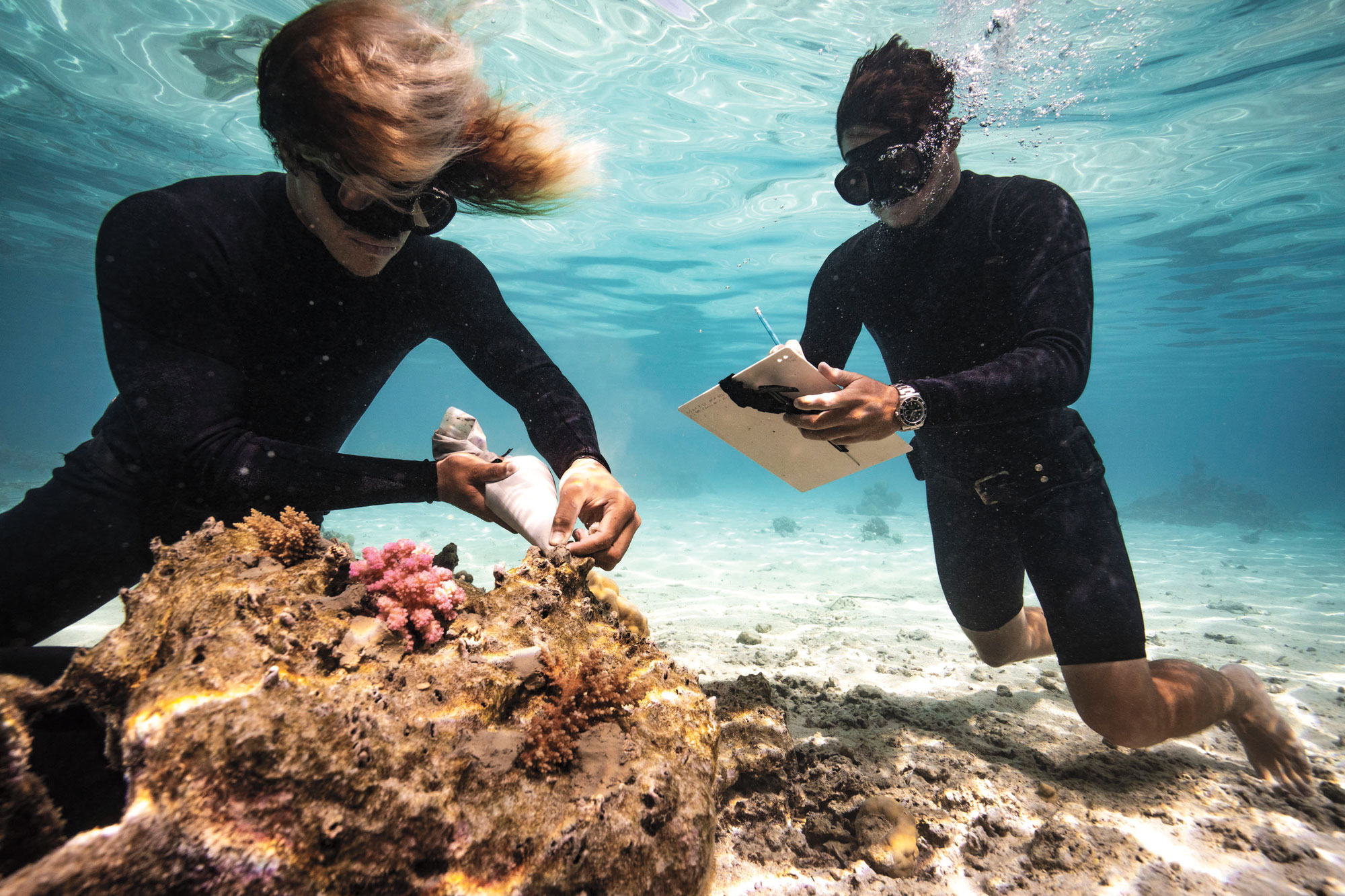
Through years of trial and error, Bernicot and his team have developed an efficient way of nurturing new robust coral from off cuts of healthy reefs. What began as a few tiny underwater nurseries has now grown to three large laboratories – in French Polynesia, Fiji, and the one I’m visiting, in Thailand. All are staffed by locals, many volunteers, and have outreach programs to engage the surrounding communities. Since 2017 Bernicot’s teams have planted some 120,000 corals and restored around 25,000 square meters of coral reefs. They’ve also educated over 10,000 local people and raised more than $10 million for reef conservation.
Here at the latest installation on Koh Mak there are on-land tanks of water in which cor al is grown and then transferred to underwater nurseries where it is attached to metal seabed racks or spiky metal “trees” that look like punk clothes horses. When they have reached a good size, they are integrated into the coral reef off shore to repair damaged parts.
I dive with Bernicot’s team to observe the underwater nurseries, which sit mistily a few feet down. The corals are of varying sizes and colors. The impression is one of a thriving submerged world, exciting and wondrous. Perhaps this is why Bernicot has been so successful in attracting attention. Coral is mysterious, beautiful – just the sort of thing people want to save. The fact that we’ve lost more than half our coral reefs in just a half-century, predominantly due to ocean warming, is cause for alarm.
However, Bernicot is a realist. He admits that his work won’t save the oceans as a whole, or even all the reefs. But his philosophy is one of trying to inspire. “Conservation needs to be talked about in a way that enthuses young people,” he says. “I studied Nike for inspiration.” The result is a highly active marketing program.
“We reach a lot of people online, and we’re building a global movement,” he explains. Over one million people follow Coral Gardeners across its digital platforms, while Matt Damon, Chris Hems worth and Jason Momoa have visited the Mo’orea, French Polynesia site. People are adopting coral via its website for $30 a piece, and watching their colorful babies grow. The tech Bernicot has developed (with a former Tesla engineer) is state of the art, allowing them to monitor the nurseries’ health and also opening the underwater world up to everyone online.
“What if we could make someone in New York, in Times Square, care about coral?” says Bernicot. They can of course come and visit – eco tourism is a great way of helping, he says; but what if they’re not able to, and still care? His goal is to motivate people to act. If he, at 16, could start making a diff erence, then why can’t others do the same? Coral is the ideal way to get people – particularly young people – involved in conservation.
At 27, Bernicot is certainly savvy. A clue to just how savvy sits on his wrist. He wears a Rolex Submariner diving watch, a token of the relationship between the famous Swiss watch company and the Coral Gardeners. Rolex supports many conservation programs through its Perpetual Planet Initiative, which aims to study and devise solutions to help preserve the natural world. It’s the logical conclusion of the firm’s use of the planet as what founder Hans Wilsdorf described as a “living laboratory.” Watches were dispatched from the 1930s onwards to be tested in extreme conditions. Famously, Rolex supplied the attempt on Everest in 1933 and the successful 1953 ascent.
Today, the Rolex Perpetual Planet Initiative focuses on science as a way to understand the threats to our world and promote its protection. And on Koh Mak, in a little corner of Thailand, the Coral Gardeners are benefi ting from the Initiative’s support as they try to have a positive impact on the ocean ecosystem. Having seen their work up close, I for one, will be handing over my $30 to adopt a burgeoning coral.


Comments