On July 30 and 31 around 80,000 migrants entered Ceuta from Morocco, according to the Spanish government’s latest estimate. Roughly 90 percent have since gone back. But, according to the government’s estimate, somewhere between 7,000 and 9,000 remain in the Spanish city whose normal population is 83,000. Ceuta’s authorities believe the figure may be as high as 11,000.
At least 83 bodies connected with the crossing have been recovered on the Spanish side of the border. Morocco officially acknowledges another 14 deaths but humanitarian organizations have estimated that in total more than 140 people have died since the border was breached.
Among Ceutans, the response has ranged from remarkable generosity to fear and outright hostility
In Ceuta itself, there are now fewer migrants wandering through the city center. The outskirts, however, are another matter. Soldiers have been discouraging young migrants from approaching houses, while military personnel have guarded the entrances to some supermarkets.
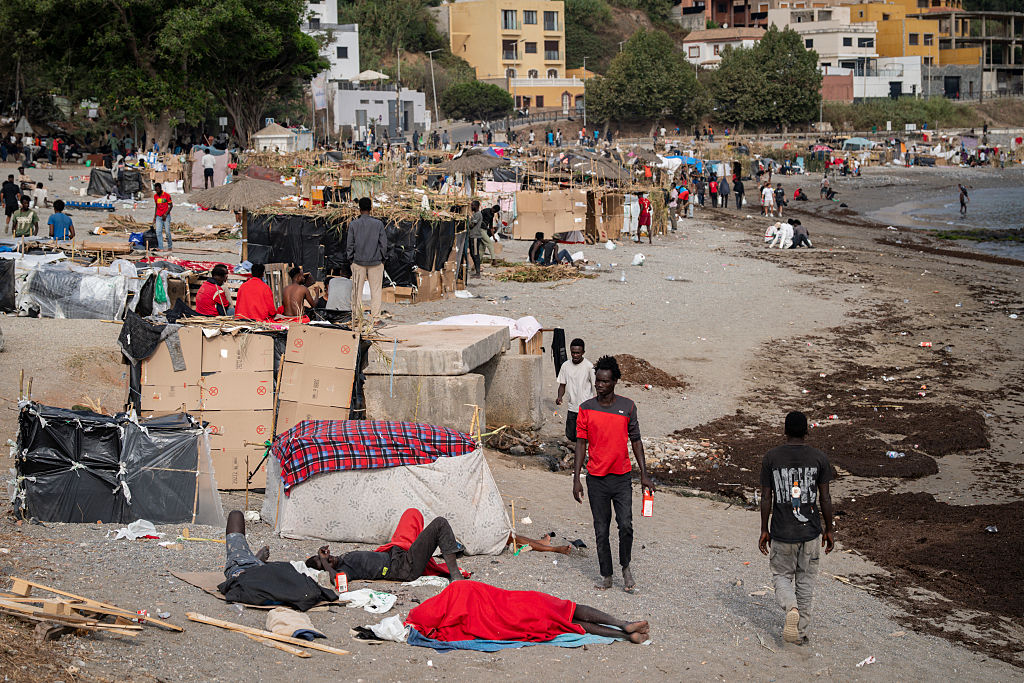
At El Trampolín, a little beach which at this time of year would normally be occupied by holidaymakers, hundreds of mainly sub-Saharan migrants have created an improvised settlement. Small huts have appeared, constructed from reeds, branches and pieces of wood. Mattresses lie on the sand and washing hangs from makeshift structures. By day they fish, wrestle, bathe and play soccer. At night they light fires.
Food arrives once a day. Earlier this month, Ceuta Actualidad reported that more than a thousand migrants spent over four hours waiting in the heat for their daily ration. The bag contained water, juice, bread, pastries, a piece of fruit and two portions of processed cheese. Tuna is sometimes included. For those without food obtained elsewhere, that bag has to last 24 hours.

Things are nevertheless better than during the first days of the crisis, when migrants complained of going several days without food or access to drinking water. Lavatories and showers have now been installed at El Trampolín. Yet people still wash themselves in the sea and hundreds do not have any proper roof over their heads.
Conditions elsewhere are worse. The abandoned commercial premises of El Tarajal industrial estate have become another enormous improvised dormitory. There have been infected wounds, fungal infections and cases of scabies. Recent visitors describe the smell of excrement and urine. Food supplied by the charity Luna Blanca arrives once a day; arguments, fights and thefts are reported to be frequent.
Among those living there, reports El País, Spain’s center-left newspaper of record, is Mohamed, a 26-year-old electrical-engineering graduate who says that in Morocco he worked 12 hours a day, six days a week in a factory for around €300 a month. On his first night in Ceuta he slept in the hills. The next morning he washed himself and his clothes in a stream without soap and, having nothing to drink, drank the water and developed stomach trouble. His diet has frequently consisted of bread and mortadella or the day’s charitable food distribution. On one day, he told El País, all he ate was a small container of macaroni with tomato sauce.
The government estimates that around 2,500 minors remain in Ceuta; neighborhood organizations believe the number could be higher. Some have been sleeping in industrial buildings or on the ground. Girls have been moved into specially adapted accommodation because of fears for their safety. Interior ministry sources say there have been at least six complaints of sexual assault involving migrant girls.
Nor of course has the influx been trouble-free for Ceuta’s residents. There have been robberies, fights and other assaults. El Faro de Ceuta reported last week that an elderly man was approached by a migrant asking for food. When the resident offered him a loaf of bread, the man allegedly seized him around the neck and attempted to rob him. A passing police patrol arrested the suspect.
There are also alleged sexual assaults, fights and theft within the camps. Genuine videos of incidents circulate alongside old or entirely unrelated footage presented as evidence of migrant crime. The Guardia Civil had to deny claims that viral videos showed a recent homicide committed by migrants in Ceuta.
Among Ceutans, the response has ranged from remarkable generosity to fear and outright hostility. Residents have brought food, clothing, medicines and mattresses. In Sidi Embarek local people have created and staffed their own refuge for women and children, relying heavily on donations. After ten days the volunteers told Ceuta Actualidad that they were exhausted but could not simply put the women back on the street.
Other residents have reacted differently. Neighborhoods have erected barriers and organized round-the-clock watches. Some Ceutans say they have been frightened to leave their homes; one man told El País that he had spent two weeks at home with the shutters down, while other residents say they have sent their children to stay with relatives on the Spanish mainland.
WhatsApp groups uncovered by El País were used to coordinate nocturnal patrols looking for migrants hiding in the hills and along the shoreline, with some encounters allegedly ending in violence.
Ceuta’s health service is under extraordinary pressure too. In 15 days it treated 5,800 migrants. Doctors have encountered gastroenteritis, infected wounds, heat-related illnesses and isolated cases of tuberculosis and scabies. The health minister, Mónica García, insists that the service is strained rather than “collapsed”: ordinary operations and consultations have continued and hospital bed occupancy remains at about 50 percent.
This morning, the Spanish government was still trying to find sites for temporary camps to take more than 1,500 of the most vulnerable migrants. Eighteen days after one of the largest mass border crossings Europe has seen, thousands of people in Ceuta are still waiting to discover where, if anywhere, they are going next.





Comments