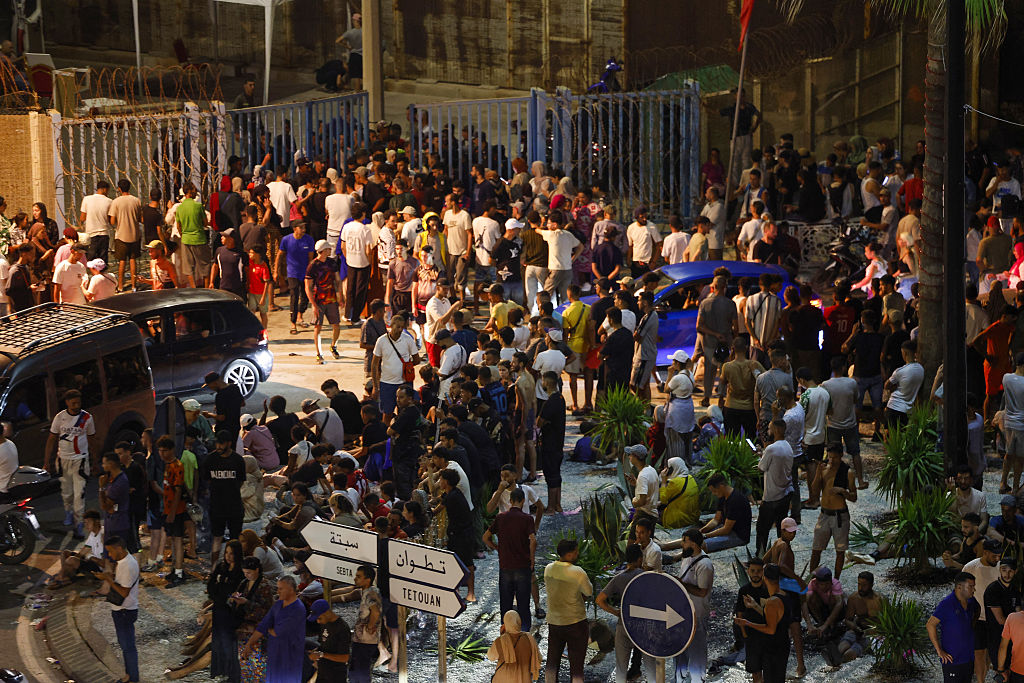
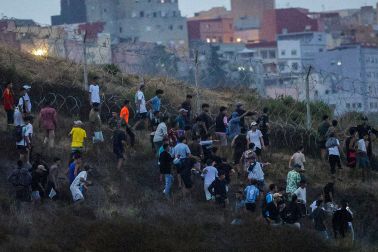
Yesterday, thousands of young Moroccan men – as well as women, children and non-Moroccans – entered Ceuta, one of Spain’s tiny North African enclaves, swimming around a breakwater or breaching border fences. Police sources estimate that so far more than 40,000 – some reports are suggesting 50,000 – people have already entered Spanish territory during this wave. Today the influx continues and the situation is critical.
One resident is reported as saying, ‘We are frightened tonight. We have lowered the shutters and turned off the lights. We are afraid that they may try to enter the houses.’
The temporary stay centre for immigrants, and other emergency reception and health facilities are overwhelmed. This morning El País, Spain’s centre-left newspaper of record, reports ‘hundreds of young migrants huddled on the damp grass in the parks, sleeping with hardly any clothes on’. The city, with a population of approximately 84,000, ‘has become a makeshift dormitory’. The civil guard has so far recovered the bodies of 27 migrants who died whilst attempting to swim into the enclave.
Spanish army units with armoured vehicles have been deployed alongside the civil guards and national police. For the time being, they are said to be simply monitoring the situation, keeping order and directing the flow of people. Shops and businesses have closed. One resident told television cameras, ‘We’re scared shitless. I’m frightened, my family is frightened – everyone is.’ Another is reported as saying, ‘We are frightened tonight. We have lowered the shutters and turned off the lights. We are afraid that they may try to enter the houses.’
Mauricio Valiente, the director-general of the Spanish Commission for Refugee Aid (CEAR), said, ‘We have no way of verifying this, but it is clear that historically Morocco has exerted very heavy pressure along the border. It is hard to imagine that an exodus of this kind would not have been detected in advance.’ Valiente urged the central government to execute a rapid transfer of the migrants to the mainland, suggesting that the state-wide humanitarian network has available beds to absorb arrivals from Ceuta.
Meanwhile, Spanish Prime Minister Pedro Sánchez and interior minister Fernando Grande-Marlaska are travelling to Ceuta to meet with the city’s president, Juan Jesús Vivas, and its security forces. President Vivas has publicly called on Madrid to declare a national emergency.
French interior minister Laurent Nuñez has announced an immediate tightening of security along the French-Spanish border. And following a meeting with her interior minister, Matteo Piantedosi, Italian Prime Minister Giorgia Meloni has announced that Rome is considering extraordinary measures, including the temporary suspension of the Schengen agreement with Spain. Finland’s interior minister agrees: ‘Spain has completely failed to protect the Schengen Area’s external border from infiltration. This cannot continue. Countries that do not fulfil their obligation to protect the external border cannot be members of Schengen.’
Italian foreign minister Antonio Tajani has criticised Spanish Prime Minister Pedro Sánchez’s government, suggesting that Spain’s recent massive migration regularisations have created a ‘pull effect’ that incentivises human trafficking and threatens EU border security. Others point to the publicity surrounding a Supreme Court ruling, announced on 8 July, that migrants intercepted at sea while attempting to swim into Ceuta cannot be summarily returned.
As the diplomatic row escalated, Spain’s minister of foreign affairs, José Manuel Albares, formally summoned the Italian ambassador in Madrid. He described Tajani’s comments as ‘improper for the foreign minister of a partner and friendly country from whom we expect European solidarity and not partisan demagoguery’.
Meanwhile, Alberto Núñez Feijóo, leader of the right-wing opposition Partido Popular has criticised the government: ‘People have continued to arrive in Ceuta throughout the night, and those on the ground describe a city under siege, with nothing sufficient being done to prevent it.’
Santiago Abascal of Vox, a party further to the right, has blamed the mass regularisation of migrants for the ‘invasion’ of Ceuta, and has said he holds Pedro Sánchez responsible for any future stabbings and rapes – linking migrants to crime. He added the ‘national emergency’ in which Spain finds itself ‘can only be resolved by ousting the traitor and mafioso [Sánchez] and putting him in the dock.’
Ahead of the next general election (due by August 2027), polls already suggested that a right-wing coalition of the Partido Popular and Vox will govern Spain. This latest crisis looks as if it will make that even more likely.



Comments