The World Cup starts in just four days’ time, but England games apart, I shan’t be watching. Instead, at the same time that the games are on, I’ll be heading back forty years to rewatch the 1986 Mexico World Cup, courtesy of my old VHS videos.
There are plenty of good reasons for diehard football fans to give this year’s tournament a red card. Ignoring the principle that more is less, the tournament has been ludicrously expanded to 48 teams – meaning it’ll drag on for six long weeks. Do we really want to spend three hours of our lives watching Jordan v Austria and Uzbekistan v Colombia in the group stages?
What we have this year is an over-bloated greed-fest. Admission to the 1982 World Cup final in Spain cost just £4.15, the top-priced tickets for this one are £24,500. As if that wasn’t bad enough, there’s also a Super Bowl-type concert at this year’s final, meaning that the half-time break will be a sacrilegious 45 minutes long. The stars headlining include Madonna, Shakira and BTS. (No, I haven’t heard of BTS either.) So instead, I’m going back to the simpler days when half time meant the reassuring presence of Jimmy Hill and Des Lynam and not a gyrating American pop singer in sight.
You can’t watch England versus Argentina again without wondering, ‘what if?’
There’s also a personal reason why I want to be a time traveller. My dear father died in 2024 (he was nearly 98), and this will be my first World Cup without him. World Cups without dads – debating who should or shouldn’t be in the England starting line-up and sharing the inevitable disappointment when England go out either on penalties or to a highly disputed or illegal goal – are, let’s face it, not the same. I watched the whole of the 1986 event with my dad (we both went to sleep at around 7 p.m. and got up for the night games at about 11 p.m.), and rewatching the matches this year will bring the memories of that summer back.

The 1986 World Cup has a strong claim to be regarded as the greatest football tournament ever held. It had everything – yet was only four weeks long. For England, things got off to a dreadful start. A 1-0 defeat to Portugal in the opening game was followed by a nightmare match played in 37 degrees heat against Morocco. In the first half, the Three Lions lost both their captain Bryan Robson (with a dislocated shoulder), and the usually mild-mannered Ray Wilkins, who was sent off for throwing the ball at the foot of the referee.
I remember my dad and I going back to bed that night totally dejected, believing that after two matches with only one point and no goals, England could be facing an inglorious early exit. The press called for manager Bobby Robson’s head. Actually, losing Bryan Robson and Wilkins turned to our advantage. The formation changed from 4-3-3- to 4-4-2 with Glenn Hoddle and Peter Reid coming into midfield and Peter Beardsley brought in to partner Gary Lineker up front.
The improvement was immediate: in the final ‘must win’ group game against Poland, England were 3-0 up at half-time courtesy of a Lineker hat-trick. The Three Lions had gone from flops to potential tournament winners in just 36 glorious minutes.
The first knockout round saw some wonderful matches. Denmark and the Soviet Union had played some of the most scintillating football of the tournament so far, but both surprisingly went out. The Danes were crushed 5-1 by Spain, while the Soviet Union exited – rather unluckily – in a late-night 4-3 thriller against Belgium. England were impressive again as they dispatched Paraguay 3-0.
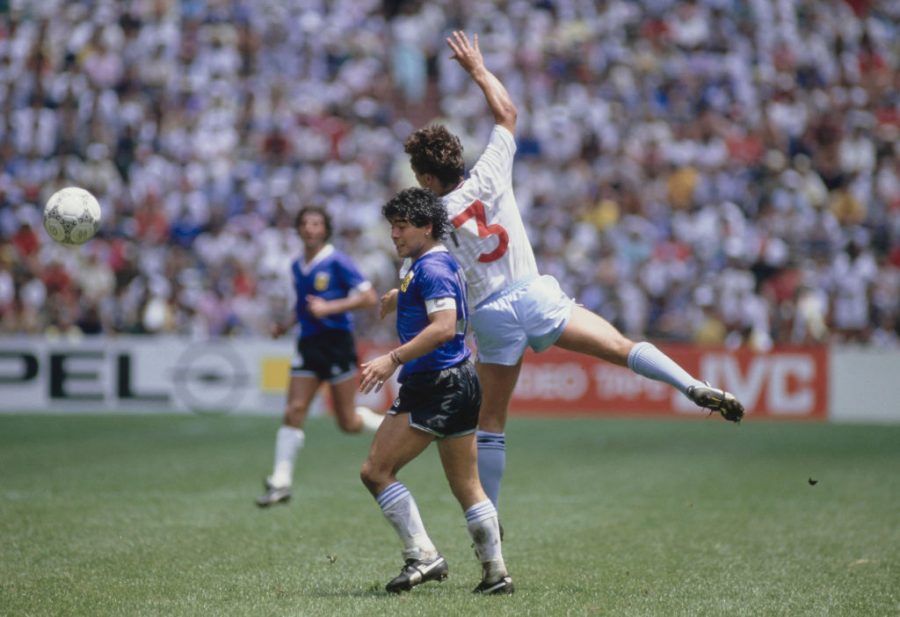
Then, on the afternoon of Sunday 22 June came England’s quarter-final showdown with Argentina, just four years after the Falklands War. ‘Classic’ just doesn’t do it justice. It was bigger than that. The game saw the most infamous ‘goal’ in World Cup history, followed four minutes later by the greatest goal in World Cup history.
Neither would probably have occurred today. VAR would have disqualified Maradona’s ‘Hand of God’, and in the game as it is played nowadays you simply don’t get players attempting to dribble past five other players from the half-way line before dummying the goalkeeper to slot the ball home. Instead, they’d just pass the ball sideways or back.
You can’t watch England versus Argentina again without wondering, ‘what if?’ What if one of the England players Maradona had beaten for his second goal had hacked him down, as any Italian or German defender would? The little Argentinian genius himself paid tribute to the England players for not fouling him, calling them the ‘noblest’ he had ever faced. And ‘what if’ – as commentator Barry Davies said recently – John Barnes had been brought on a bit earlier than the 74th minute (and Chris Waddle too for that matter)?
What if Lineker had managed to connect with Barnes’s late cross and levelled the match at 2-2? Had that gone in and England prevailed in extra time against a tiring opposition, a semi-final with Belgium would have awaited. Get past them (no easy task but certainly doable, bearing in mind that England did beat them 1-0 in the knockout stages four years later), and we would have had another England versus West Germany World Cup final, 20 years on from 1966. What an occasion that would have been.
But it didn’t happen. After Argentina beat West Germany 3-2 in a final that did happen, we waved goodbye to the World Cup. Forty years on, even though I know the eventual outcome, rewatching the 1986 tournament will still be more interesting, I believe, than watching 104, mostly turgid passy-passy games in this year’s one. Football is just not as good today as it was then. Maradona, for all his faults, still trumps Trump and Madonna.





Comments