

Is the page finally beginning to turn on children and screens? It certainly looks like it. For the first time since the advent of social media, we are seeing a burgeoning alliance across all political divides to protect children from digital harm. In 2024 Jonathan Haidt delivered an urgent manifesto for change in The Anxious Generation, and at the beginning of this year Australia responded with a ban on social media for under-16s. Now even Britain, which is usually drawn to inquiries over decisions, seems like it might act. Good. Liberalism doesn’t work in the arena of addictive substances.
However, the war on classroom screentime has yet to be properly waged, let alone won. Schools have embraced online learning with an almost evangelical fervour, urged on by billion-dollar businesses and bedazzled education secretaries.

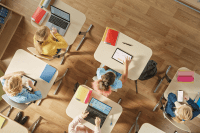
Overwhelmingly the lure of ‘one-to-one devices’ has gripped schools and, in a blitz of blue light, children across the country are gazing distractedly at screens instead of their teachers’ faces and their books.
Pupils often go unmonitored online as the teacher attempts to keep the class ‘on task’. Flitting ceaselessly between a proliferation of tabs – some educational, some not – a lot of swiping and scrolling take place. But learning? Not so much. Research has shown that students learning online spend as much as 39 minutes out of every hour off task.
The principal casualty of the digitalisation of education is the textbook. Leading publishers such as Pearson have moved online, ruthlessly killing off these reliable anchors of learning. Textbooks, damned by tech zealots as ‘analogue’, are slandered as boring compared with online resources, which offer video clips, audio, 3D modelling and other seductive 21st-century ‘essentials’.
We would beg to differ. For ‘boring’, substitute calming, reputable and blessedly undistracting. Pearson owns Edexcel, one of the biggest examination boards and currently spearheading the transition to online GCSEs and A-levels. Pearson should take a long hard look at its own educational principles.
Of course moving everything online makes things much cheaper, but schools have a duty to hold such powerful businesses to account. Pearson et al have a moral duty to research the impact of transferring education online. So much is lost in the process.
John Jerrim, a UCL-based educational researcher, conducted an experiment where 3,000 pupils took PISA tests in maths, science and reading. Over three months, half the group did all their work on paper and half on a computer. At the end, the paper-based group scored 20 points higher than the one working on screens – the equivalent of half a year’s extra schooling.
Nearly 100 per cent of ten-year-olds in Singapore, Taiwan, South Korea and Japan are issued with standardised textbooks in core subjects, compared with 10 per cent here. These countries, unsurprisingly, all vastly outperform us in these subjects, according to the most recent Trends in International Mathematics and Science Study.
Sadly, British schools often have no choice but to buy digital resources because publishers like Pearson have killed off the textbooks they once printed. Such a policy is a sunk-cost fallacy. The real cost – to our children’s ability to concentrate and learn – is immeasurable. A healthy, thoughtful, productive society is not a realistic expectation if children are not learning properly.
In contrast to a screenful of apps, Power-Points and gamified platforms, a chunky textbook provides a stable source of information. A linear repository for knowledge, it offers a tactile sanctuary for prolonged study. Online alternatives, designed for bite-sized consumption, cannot compete with the textbook’s ability to serve as a distraction-free companion to a pupil’s intellectual growth.
Textbooks also beat screens in that they don’t damage eyesight, disrupt hormones, delay sleep, trigger headaches, affect spinal formation and exacerbate symptoms of ADHD and autism, as screens do. That’s quite a long list of harms for a medium which is less effective for learning than its forerunner.
The tools given to children should be as simple and clear as possible so that they uncover the beauty of a subject
Textbooks are deliberately condemned by many in the ed tech industry as ‘inert’, ‘primitive’, and ‘outdated’, but the reality is very different. Leaving aside that they are less prone to crashing or running out of battery, they are far easier to navigate than multiple apps, enable longer and calmer periods of focus, help develop essential skills (such as notetaking) and, because pupils read from a physical page, are far more conducive to delivering knowledge that sticks.
If you talk to many teenage pupils, whether they are studying Latin or chemistry, psychology or economics, those who have an excellent, well-edited textbook prefer it to endless handouts, links and websites. They fully acknowledge that the latter methodology fragments their learning, and impairs how they access and decipher knowledge.
In education, the tools given to children should be as simple and clear as possible so that they uncover the beauty of a subject without unwanted distractions.
Sadly, the medium has become the subject. Screens have their (limited) place in this process of discovery, but too often they are a barrier; a backlit, noisy, crowded space designed for distraction, not absorption. In comparison, a textbook offers a quiet, authoritative voice that promotes sequential, linear learning.
If we wish for children to master the complexities of a subject, we must first grant them the simplicity of a medium that knows when to be silent. Ultimately, the textbook provides the one crucial thing the digital world cannot: a finite horizon, within which a child can find the peace to think.
Technology education? Of course! Education technology? An oxymoron that needs to be exposed. Bring back the textbook.


Comments