
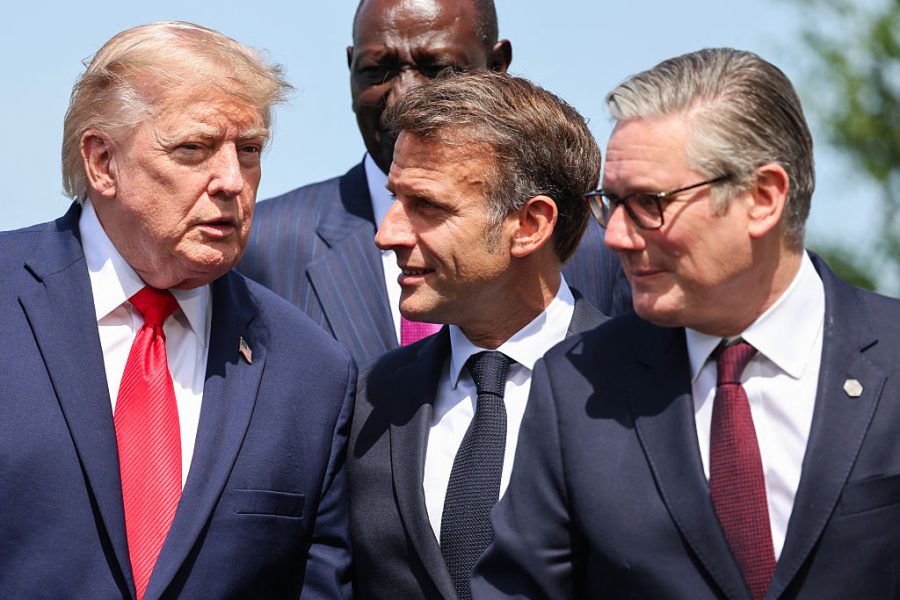
Foreign diplomacy is usually a refuge for Keir Starmer. But as the Prime Minister touched down in Evian-les-Bains, France for this week’s G7 summit, the warm greetings and firm handshakes couldn’t hide the tension that has bubbled up between Starmer and the summit’s other attendees over the past week or so.
With Thursday’s Makerfield by-election hanging over him like an impending political death sentence, Starmer had been hoping to sweep into Evian and talk up Britain’s support for Ukraine, show willing on keeping the peace in the Strait of Hormuz and, generally, demonstrate that he is the right prime minister – and, crucially, ally to Europe – to face the defence and security threats on the continent’s horizon.
Yet former defence secretary John Healey’s resignation on Thursday has turned Starmer’s diplomatic happy place into an extension of his domestic nightmare. Healey’s revelation in his resignation letter that Starmer and the Chancellor Rachel Reeves are planning to raise defence spending to just 2.68 per cent of GDP by 2030, as well as the government’s subsequent failure to publish the Defence Investment Plan (DIP), set the scene for an awkward reunion between Starmer and the other group leaders gathering in France this week.
Britain’s reputation has suffered internationally as a result of Starmer’s failure to publish the DIP
Alongside Starmer, French president Emmanuel Macron is hosting his German, Canadian, Japanese, American and EU counterparts for three days of talks. Providing more support for Ukraine is top of the agenda, with the country’s president Volodymyr Zelensky a guest at the summit today. Earlier today, European leaders at the summit urged Donald Trump to once again attempt to bring Putin into face-to-face negotiations with Zelensky over ending the war.
The leaders are also expected to quiz Trump on his newly announced peace deal with Iran, with discussions on AI and the issue of ‘correcting global economic imbalances’ planned too. In an effort to keep Trump from flouncing out of the summit early, Macron has invited him for dinner at Versailles tomorrow night to mark the 250th anniversary of US independence.

Starmer likes to emphasise the importance of Britain’s standing with its European and transatlantic allies on questions of defence and security. Speaking earlier today, the Prime Minister insisted that, on how to further support Ukraine, ‘there was great unity and very, very good conversations in the G7, including with President Trump’. Yesterday, Starmer promised to ‘choke off’ Russian revenue with fresh sanctions on vessels forming part of the Kremlin’s so-called ‘shadow fleet’.
Starmer and Trump, however, have no bilateral meeting scheduled for the course of the summit – perhaps a small mercy in the Prime Minister’s eyes, given the expectation that the President would berate him over the DIP and the government’s heel-dragging on defence spending. Nevertheless, it was a warning sign that Trump thinks there is little value in meeting with Starmer. Somewhat embarrassingly, the Prime Minister was caught on a hot mic asking, ‘Are they having a meeting?’ when Zelensky, Trump and Macron were absent.
It is possible to say with certainty that Britain’s reputation has suffered internationally as a result of Starmer’s failure to publish the DIP. There were already questions among European allies over how seriously to take the commitments the Prime Minister was making on defence at the Munich Security Conference in February. With Starmer embroiled then in the Peter Mandelson scandal, there was speculation about how long he would remain in office. The events of the last week have reinforced the view abroad that the Prime Minister is toast.
One diplomatic source I have spoken with described Starmer’s paltry ambition to raise defence spending to 2.68 per cent of GDP – by which time Germany’s will be at 3.7 per cent and that of even the Netherlands will be at 2.8 per cent – as ‘painful’. With it seeming like Andy Burnham will win the Makerfield by-election and challenge Starmer to the Labour leadership, London’s diplomatic community is turning, with curiosity, to the question of what Burnham’s diplomatic and defence priorities might look like.
Britain will be ‘bypassed’ in the coming months by Europe, this source said, if it can’t demonstrate that it is serious about its defence commitments, including taking on a greater share of security responsibilities on the continent as America recalibrates away from Europe. Chief of the defence staff Sir Richard Knighton’s assessment today that the British armed forces would have to ‘dial back our activities, our exercise, operational activity, if the level of resource funding that is available to us does not increase,’ will only reinforce this view on the continent.
Not helping Starmer’s insistence that Britain remains a credible defence partner was Healey, who stood up in the House of Commons to deliver his resignation statement this afternoon. The former defence secretary referenced Nato’s warning that the alliance must prepare for war with Russia in the next five years, continuing, ‘At this dangerous time. I see the current defence investment plans falling well short of what is required, a rise of 0.08 per cent from next year to 2030.’ In a stinging rebuke to Reeves, Healey added: ‘Our adversaries don’t follow timetables set by the Treasury.’
Neither, it seems, will Britain’s European allies. Reluctantly, they are coming to the realisation that not only is America no longer a predictable defence and security partner, but Britain may not be either.

Comments