

Picture yourself lying in bed in a restored vintage railroad car parked on a bridge overlooking the Lower Sabie River in South Africa’s Kruger National Park. Outside your window, there’s a gigantic herd of elephants, ranging in size from pint-sized babies to Brobdingnagian behemoths marching purposefully by as though auditioning for a National Geographic documentary. The first herd has perhaps a dozen members, but more of them, attracted by the riparian setting, will stomp by until you can see perhaps 50 of them from the comfort of your bed – or, if you prefer, the bathtub.
It’s almost time for afternoon tea and cakes. Later, during your drive, a leopard will amble so close to your vehicle that you could grab his tail. Then it’ll be time for a happy-hour sundowner in the bush and, afterward, an epic braai (South African BBQ) with bonfires and African dancers and local wines and grilled meats.
Driving south into northern Lesotho felt like arriving on a different planet
That was the sweet life I experienced for two memorable nights at Kruger Shalati, the so-called “train on a bridge” safari lodge. I have spent thousands of nights in hotels in 85 countries around the world but have never experienced anything quite like it.
“South Africa is dangerous, isn’t it?” is something I heard many times prior to our departure, including from my wife. The country’s crime statistics are daunting, as even its President, Cyril Ramaphosa, admitted in an Oval Office meeting with President Trump last year. When we hear about South Africa in the media, it is rarely good news.
Consider our good fortunes traveling around South Africa and the two small countries inside it – Lesotho and Eswatini – over a period of 22 days. On a day trip to the Cape of Good Hope, my son, James, lost his AirPods. The Find My app brought us to a lovely home in the Cape Town suburb of Fish Hoek where a kind gentleman named Humphrey invited us inside. His son, Nick, had found James’s headphones and refused to accept any reward. Days later, on a desolate country road in the middle of nowhere, I hit a pothole in our rental car and got a flat tire shortly before sunset.

The first car that passed us – a pickup truck carrying a pair of young, gun-toting Afrikaners and their girlfriends – stopped and quickly put our spare on for us. “We stopped because you’re white,” explained one of the young men.
I didn’t play it safe. I visited four townships, two in Cape Town and two in Johannesburg, and a squalid white squatter camp in Pretoria. All the while I was carrying cash, credit cards and at least two expensive cameras. My plan for our three-week trip was to visit Cape Town, the nearby Winelands, the Drakensberg Mountains, to experience a safari in Kruger National Park and to travel to Lesotho and Eswatini. Cape Town is as beautiful as advertised – the stunning coastline, the mountains, the wineries, the lovely suburbs – I couldn’t get enough of the place. The city’s markets and food halls were the best I’ve ever experienced.
One day, I took a break from sightseeing to meet Pastor Craven Engel, the charismatic leader of Ceasefire, an organization working to curb gang violence in the Cape Flats, a notorious area east of Cape Town that has one of the highest murder rates in South Africa. I was nervous about driving a new BMW rental car into the Flats, but I felt at ease once we walked the streets of Pastor Engel’s Hanover Park neighborhood. Everyone knew him and several people said he had helped them turn their lives around.
While I was there, the pastor’s charity’s truck arrived, bursting with crates of free oranges. I watched as children came sprinting to get one from all corners of the neighborhood. “Maybe 2 or 3 percent of these kids will grow up and be successful,” said DelCarmie, a female ex-gang member who works for the pastor.
Engel and most of the residents of the Cape Flats are mixed race – “colored” – people, a term that is verboten in the US but still in use in South Africa. He said that South Africa’s black economic empowerment (BEE) laws make it difficult for the brown-skinned community in Cape Flats. “If you’re the wrong color or surname, you’re not going to get a job very easily,” he said.
We stayed at an Airbnb in Hout Bay, a coastal suburb that borders Imizamo Yethu, a crowded, hillside shantytown of zinc-roofed shacks we drove by each time we returned from the city. On our last morning in town, the waiter at a café told me he lived in Imizamo Yethu and would be happy to take me on a tour after his shift. I was struck by the poverty, the garbage, the crowded shacks, which have no running water or toilets. But he was upbeat, highlighting the positives of his community. “It’s a beautiful place, isn’t it?” he asked. It wasn’t beautiful to me, but it was interesting. When I commented that I felt welcomed, he said, “White people don’t usually come here. If you came here at night, you would be robbed as a white guy, you see.” Imizamo Yethu was ravaged by a fire in December, leaving almost 200 residents without anywhere to live.
After these rewarding but heavy experiences, I was ready for some R&R on the next leg of our trip. We spent a day lounging on a pristine golden sand beach in uMhlanga, a suburb of Durban, where we enjoyed the best hotel breakfast of our lives at the Teremok Lodge and Spa, an impeccable eight-room boutique hotel. By the time we reached our next stop, the Cavern, I realized we were on the best trip of our lives.
The Cavern is a family-run resort that’s been an institution in the Drakensberg mountains since 1941. I was blown away by what was included in our room rate: three gourmet meals per day where we could order as much as we wanted, guided hikes up into the mountains behind the hotel and a dizzying array of activities. Arguably best of all, the Cavern has a wine cellar with more than a dozen varieties of very drinkable South African wines priced at less than 75 rand ($4).
Driving south into northern Lesotho felt like arriving on a different planet. You may recall that Trump called Lesotho a country “nobody has ever heard of” in his State of the Union address, while panning an $8 million aid program to, as he put it, “promote LGBTQI+ in the African nation of Lesotho.”
Lesotho is known as the Switzerland of Africa. It is the only country in the world that is entirely above 1,000 meters elevation and is picturesque, mountainous and very poor, full of friendly, blanket-clad cattle-herders. Before we arrived, the government declared a national state of emergency due to Trump’s tariff threat. The proposed tariffs were eventually negotiated down from a world-leading 50 percent to 15 percent, but the damage was done. People were already losing their jobs at the country’s textile mills and those who depend on USAID for their HIV medications were going without.
On our way from Lesotho to Eswatini, we booked an Airbnb on a farm in Standerton owned by an Afrikaner family. In the Western Cape, where many affluent white people live, everyone we met thought Trump’s refugee offer for South African minorities and claims of white genocide were ludicrous. But this family said they greatly appreciated Trump championing white farmers, though they said they have no interest in leaving South Africa. They said they feel under threat and detailed the security measures they take to discourage potential invaders. “We are targeted as white farmers, there is no question,” said the father of the family.
Despite South Africa’s BEE laws, the unemployment rate for black people is higher than the country’s staggering 43 percent average, while for white people it is less than 10 percent. The farmers told me that they and their neighbors donate to Afrikaners living in a squatter camp in Pretoria and encouraged me to visit, which I did.
The white squatter camp, referred to locally as Plot 111, is in an industrial area on the outskirts of Pretoria. A small group of friendly Afrikaner women who live in the community were happy to show me around. “We are victims of BEE,” said Nadine Parker, a former police officer who said she plans to apply for refugee status in the US.
I met about a dozen people in the camp and all but one of them said they wanted to move to the US. But none had applied yet: they have no computers and can’t afford the $35 it costs to get a passport. I toured a few homes and they were as primitive and awful as anything I saw in the impoverished black townships, if not worse, because some of the homes had leaky roofs and sewage water on their floors. I asked Nadine why she wanted to move to the US. “Because I want to get a job and it’s hard to find one here if you are white,” she said.
We saved our safari experience for the end of the trip. Our guide at Kruger Shalati, Ayanda Godi, had a cherubic face and appeared to be about 20 years old. She was a fountain of knowledge, an expert birder and a master at spotting hidden animals. We spent two glorious days binge-eating delicious food and bouncing around the back roads of the national park seeing every wild animal we dreamed of, and it was magic. None of us wanted to leave Kruger Shalati, which felt like a little Shangri-La with its pools overlooking the river.
In our last stop, Johannesburg, we arrived with low expectations. JoBurg is often derided as a crime-ridden hellhole, but the suburbs of the city, with their LA-style mansions hidden behind sky-high security walls, are pleasant and full of great restaurants and bookstores. The many residents of the city we met could not have been friendlier.
Sandton, where we stayed, sits adjacent to Alexandra township, which has a reputation for being one of the poorest and most violent neighborhoods of the city. I wanted to visit “Alex,” as it’s called, to see the home where Nelson Mandela first lived when he moved to the city as a young man looking to escape an arranged marriage. Two young men I met, Jeff and Mel, showed me around Alex, where they live, and Soweto. Alex is clearly a tough place, but I was met with hospitality and curiosity. Soweto was a huge surprise. The neighborhood has been transformed since the country hosted the World Cup in 2010, and it now must be the most affluent township in Africa, full of interesting shops and restaurants.
Aside from the memorable meals, the weight I gained, the scenery, the dreamy safaris and awesome hikes, I’ll never forget some of the charming characters who played bit parts in our trip. Like the cleaning women in the men’s room at the Cape of Good Hope who sang a Christian gospel song so pretty I almost wanted to cry. I will also remember a lovely woman at a highway toll booth who, when I asked her why she was in such a good mood, said, “I love my job, sir, and I enjoy meeting people like you.” And a security guard at our hotel in JoBurg who approached our car, singing. “I feel the strength of the Holy Spirit,” he explained.
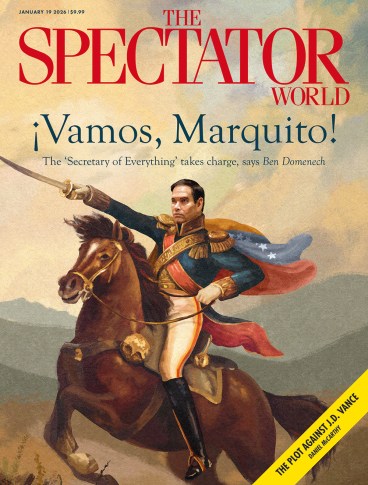
This article was originally published in The Spectator’s January 19, 2026 World edition.



Comments