
Postwar Britain can be defined by a bargain made with its middle class: pay for public services but benefit from them too.
Private education has always been the choice of a very small minority; private healthcare was reserved for the wealthiest and those whose employers paid for it. Middle England was content to send its children to the same schools as everyone else and use the same GPs, hospitals and dentists.
This is no longer true. State spending continues to grow, yet large parts of the population now pay privately to supplement what their taxes have already provided.
Eighty-four years ago, William Beveridge’s Social Insurance and Allied Services set out five “giants” standing in Britain’s way: want, disease, ignorance, squalor and idleness. His remedy was a national insurance floor with flat-rate contributions and flat-rate benefits with private provision on top.
Britons now pay a greater share of the nation’s health costs out of their own pockets than Americans do
The welfare state we ended up with went much further. Aneurin Bevan’s NHS was comprehensive and free for everyone at the point of use, while the Butler Act provided the same for education. The political strength of these institutions came from the fact that the middle classes were happy to use, defend and vote for them, paying for them through their taxes. That bargain is breaking.
NHS dentistry is increasingly hard to find. Private dental use has risen from 22 percent in 2023 to more than 32 percent by the end of last year. Almost a quarter of dentists no longer provide NHS care. The result is that an estimated 13 million adults have unmet dental needs.
The consequences for those who can’t or won’t go private are grim: according to the government’s Adult Oral Health Survey, 41 percent of adults have tooth decay, up from 28 percent in 2009. Emergency tooth extractions for children which have to be performed in hospitals are now so frequent that one happens every 15 minutes. This can hardly be unexpected when nearly 40 percent of children have not seen an NHS dentist in 12 months.
Dentistry is not the only area of healthcare where users increasingly feel they have no choice but to pay for private top-ups. For much of the NHS’s history, most people would not have even considered the use of a private general practitioner. Not so today. Thirteen percent of GP consultations are now private, up from 3 percent 20 years ago.
Some six-and-a-half million people are now covered by private medical insurance, with 953,000 private hospital admissions last year. Both of these figures are record highs. Even more astonishingly, Britons now pay a greater share of the nation’s health costs out of their own pockets than Americans do: about 14 percent against 11 percent, according to the World Health Organization. The US figure does not include insurance premiums, but that’s the point: once they pay their insurer, they are pretty much covered. Once we pay our taxes, we aren’t.
This trend isn’t confined to healthcare. While private school rolls have been dented by Labour’s introduction of VAT on fees, the use of private tuition is surging. Nearly half of schoolchildren in London have had private tutoring, and the national figure has risen from 18 percent in 2005 to 29 percent today. The recipients of this tutoring are not simply those whose parents can no longer afford private schooling. “I can say with confidence that 15 years ago, tutoring was for the very wealthy,” says tutor Sam Parsons. “After Covid, gaps in children’s learning soared and tutoring became less taboo and more widely accepted as part of the education system.” Now half her pupils are state educated.
Even policing needs topping up. In London’s West End, 600 businesses have clubbed together to spend £4 million a year for 20 uniformed private security officers and covert teams. With only 12 percent reporting weekly sightings of bobbies on the beat, it’s hardly surprising. One firm, “My Local Bobby,” runs street patrols across London and the southeast and has been hired by Essex County Council for town patrols at the cost of £118,000 for a three-month trial. Chelmsford’s Reform-led council leader has said regular police would be better, since the guards have no more powers than you or me, but the county council says it has been left with little choice. Other Reform-led councils plan to bring private prosecutions when security catches criminals in the act if the police won’t prosecute.
Driving tests are another example of state failure. Thanks to a pandemic-era backlog, a reselling industry was spawned, charging £500 for £62 test slots. The government has cracked down on this, but at one point a third of learner drivers felt they had no choice but to use this secondary market.
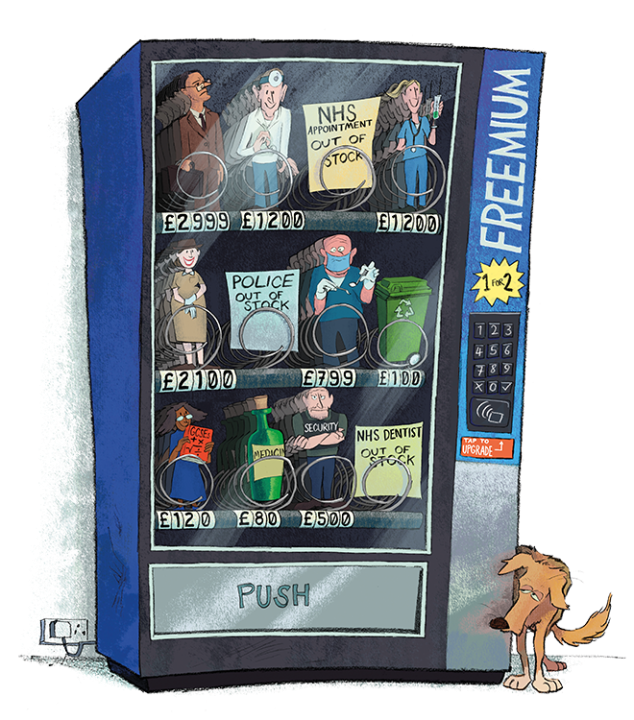
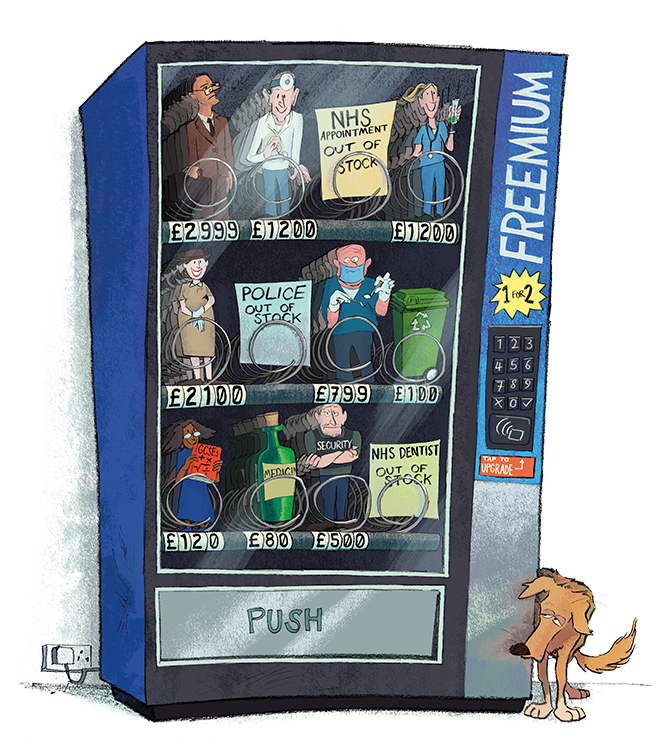
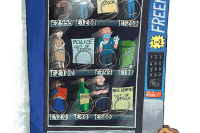
This is the “freemium state” we have come to accept. Your taxes are meant to pay for these services in full, but increasingly you need to hand over extra money just to access the basics.
That’s not to say there has been a total exodus from state provision, of course. Some 88 percent of hospital admissions are still in NHS hospitals, and private education has always been for the minority. But barriers to access, unbearable delays and unreliable service mean more and more of Middle England feel they have to pay twice.
That’s even after the public funding keeps growing. Fiscal drag has brought nearly three million more people into the 40p tax rate in the past five years. These people who are paying more for the state are the same people who can no longer rely on it.
The effect on public opinion is predictable. Many people used to consider it a badge of pride to reject private healthcare in favor of the NHS. I know someone who let a skin cancer remain untreated for 18 months until they got an NHS appointment rather than have a private doctor remove it. That attitude now seems old-fashioned. “The public’s aversion to private-sector involvement in the NHS appears to be shrinking,” says Matthew Lesh of Freshwater Strategy. A recent poll he conducted found that a majority of Britons agree that the NHS should make use of private providers when necessary. Another found that 55 percent of voters favor tax cuts even if that means less spending on public services.
“I think this suggests people are far more pragmatic than before – that is, much less sentimental about the NHS as a great public institution when their day-to-day experience of the service is mediocre,” says Lesh.
It makes little sense that we’ve ended up here. Contrary to the recent claims of a Green party councillor, we do not live in a country where there is “violence happening to the British people every day because of austerity.” The state is not shrinking. Public spending is at 45 percent of GDP – five percentage points higher than before the pandemic. That’s over £2,500 more being spent on every Briton, even allowing for inflation and immigration.
The problem is how that extra money has been spent. It hasn’t gone on education (which has had just a 0.1 percentage point boost of GDP spending). Instead, four-fifths of the spending splurge has been gobbled up by debt interest – which costs more than all schools and universities put together – the triple lock, and a health service that seems to have a negative return on investment. In fact, since 2010, per person health spending has risen 29 percent in real terms, while satisfaction with the health services has fallen from 70 to just 26 percent.
While Westminster spent last week poring over the Office for Budget Responsibility’s Budget scorecard, another OBR document offers a more revealing vision of our future. The Fiscal Risks and Sustainability Report finds that if we continue as we are going, even once you strip out debt interest, thanks to our aging population our “primary spending” will hit nearly 50 percent of GDP by 2075. Debt, having just passed £3 trillion, will eventually be worth 300 percent of the entire economy.
Officials talk in private of a ‘dependency pipeline’ that starts in early childhood
And the demands on the state begin earlier than ever. Take welfare and disability: Department for Work and Pensions officials now talk in private of a “dependency pipeline” that starts in early childhood. On current trends, a quarter of today’s six-year-olds will be on disability benefits by the age of 14 – and all the evidence suggests that most of those will continue down the pipeline toward worklessness and welfare reliance for life.
Our freemium economy is not the result of too little state spending, but because more and more of that spending is already spoken for. The top-up Britain we live in is far from the one Beveridge had in mind. His add-ons were for those who could comfortably afford more than the minimum. This is no longer the case. Private dental use among those who are struggling financially has nearly doubled and is increasing at a faster rate than among those further up the income scale. Of the 953,000 private hospital admissions last year, 283,000 were self-financed from savings or loans. Cataract surgery alone accounts for nearly half the increase in self-funded private treatment.
Top-ups, then, will become the norm. The choice is whether we get there by drift or design. Social care shows what drift looks like. It is the least loved service in the country, with self-funders paying thousands a week for a service that’s getting worse. Pensions, by contrast, show sensible design. Everyone tops up their savings privately through the auto-enrollment workplace pension and pensioner poverty is mostly a thing of the past.
Historically, our public services worked because the middle and working classes had a shared interest in making them work. Everyone paid according to their means for services everyone had access to. But as the middle classes are charged twice – through tax and top-up – that 80-year bargain no longer holds. It’s time we were honest about it.




Comments