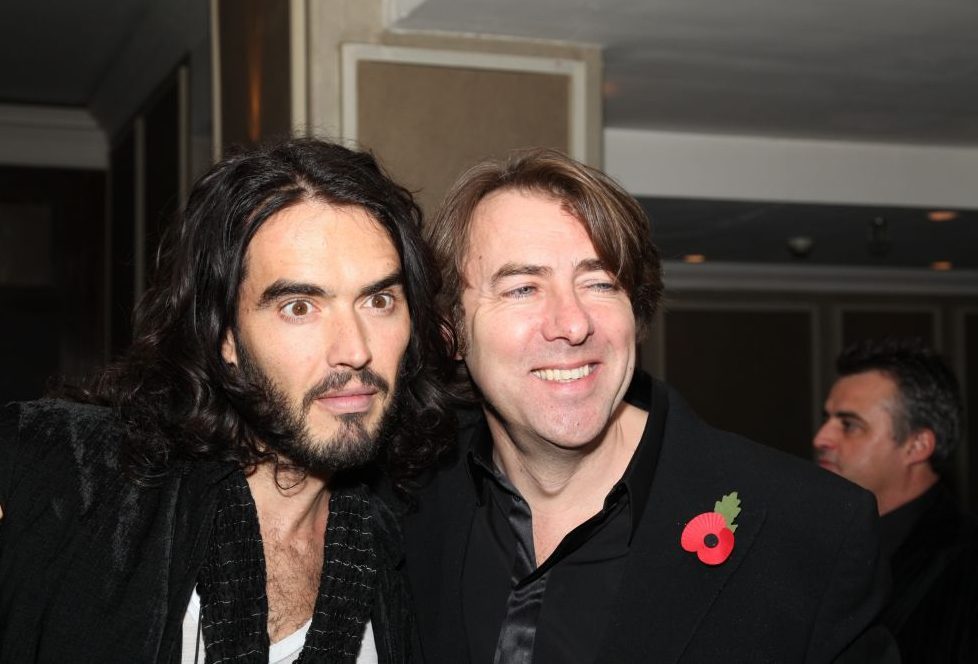
When the inevitable Jonathan Ross statement on Brand and Walliams arrived, it bore all the hallmarks of something that had been very carefully worked over by lawyers. Ross expressed his horror at the ‘revelations about David Walliams’ – Walliams denies the claims against him – and ‘the crimes of Russell Brand’, before going on to say that ‘There was a time in my life when I was on friendly terms with both men, and during that period I was genuinely unaware of their conduct. My thoughts are with the many, many women who have bravely come forward.’
It would not be unreasonable to expect further mealy-mouthed, carefully worded statements
Yet this by itself left many unsatisfied, and so he has addressed a particularly grim incident that occurred at the British Comedy Awards in 2004. To flash back 22 years is to revisit another age in the celebrity firmament, when the most egregiously tasteless of jokes would be met with the sound of loud, braying laughter. And there was little more tasteless than Ross, as compere, declaring that ‘The comedy awards is 15 years old – 15 years old! And like most 15-year-olds, it’s drunk, it’s unpredictable and it’s probably going home with David Walliams.’
The strangest thing about the ‘joke’, which was greeted with applause and delight by the audience, is that Walliams was only relatively recently arrived in the celebrity firmament. The second series of Little Britain had recently aired on BBC Three, and had turned him and his co-star Matt Lucas into household names. Yet Ross’s namecheck of Walliams, as well as his allusion to his supposed proclivities for underage girls, suggested that the now disgraced comedian had lost no time in ingratiating himself amongst more established figures. Including, naturally, Ross.

His statement went on to address the comments he made in 2004 in detail. It is a masterpiece in buck-passing. He acknowledged that the joke was ‘deeply shocking’, but that ‘this joke was submitted to me by the Comedy Awards scriptwriting team and I believed that the punchline was a reference to the fact he had publicly dated younger women, exaggerated for comic effect.’ Even as Ross now decries it as ‘a tasteless joke that I would not dream of making today about anyone’, he high-handedly announced that ‘Had I had any reason to suspect that it might be referring to actual events, I would not only have refused to use it, but I would not have felt comfortable continuing a personal or professional relationship with him.’
There is, appropriately enough, a recurring Little Britain sketch in which Walliams, playing a disgraced politician named Sir Norman Fry, offers increasingly improbable reasons for whatever scandal he has found himself embroiled in. It is hard not to think of Sir Norman when considering Ross’s hapless attempts to extricate himself from association with these two notorious figures. Still, to misquote Wilde, to befriend one high-profile comedian accused of sex crimes may be regarded as misfortune; to befriend two of them, and who knows how many others who are yet to be exposed, can be seen simply as carelessness.
Ross himself has avoided any suggestion of personal scandal. He has been married to Jane Goldman for nearly three decades – they met when he was 26 and she was 16, and wed two years later – and has led, by all accounts, an uneventful private life, save when it comes to associating with the likes of Brand and Walliams. Yet something that is profoundly depressing about Ross is the way in which he has shamelessly toadied to bigger, nastier boys, keeping watch and laughing as they say outrageous things.
A typical, and egregious, example of this was the incident in 2008 when Brand telephoned the actor Andrew Sachs to brag about having sex with his granddaughter Georgina Baillie. That this was ever broadcast on Radio 2 – on which Brand was a shining star, apparently because its controller Lesley Douglas worshipped him – defies belief, but it’s Ross sniggering in the background and shouting ‘He fucked your granddaughter!’ that somehow makes the whole thing even worse. Ross has subsequently apologised.
Ross was the king of Noughties television, with a flagship chat show on BBC1, and revelled in the power and influence that this gave him. He also took the licence that he was given to say outrageous and offensive things. Sometimes, these were simply puerile, such as when he asked the then Leader of the Opposition David Cameron as to whether he had ever masturbated while thinking of Margaret Thatcher. On other occasions, they were chilling, as in the incident when he told Gwyneth Paltrow on his chat show that he ‘would fuck her’. Paltrow was a good enough sport to suggest that she found the incident amusing rather than tasteless, but the recurring problem with Ross was that his extraordinarily high salary and celebrity status had gone to his head.
When he made the asinine remark – ‘joke’ is too generous – at, naturally, the British Comedy Awards in 2007 that he was ‘apparently’ worth 1,000 BBC journalists, so enormous was his reported salary of £6 million per year, he caused both outrage and offence, and placed a target on his head. While he kept his job after Sachsgate, serving only a 12-week suspension without pay, his departure from the BBC in 2010, to be replaced on his flagship chat show by Graham Norton, brought an end to his reign of error.
Ross continues to have a high profile in the entertainment world, with an ongoing ITV chat show and appearances in shows such as The Celebrity Traitors and Gogglebox. He has occasionally dipped his toe into the culture wars, offering Graham Linehan an effusive blurb for his controversial memoir Tough Crowd and describing JK Rowling as ‘right and magnificent’ in 2020: a remark that he subsequently withdrew under pressure from his daughters. This seems typical of Ross, a man who has flirted with outrage and offence while making sure that he never imperils his career in the process.
I suspect that he will ride out the controversy as regards both Brand and Walliams. After all, if none other than the Prime Minister can send supportive tweets about both men, albeit over a decade ago, then it would be hypocritical to suggest that anyone who was once friendly with them should be punished for their poor judgement. Yet the suspicion remains that Ross should have heard, or even seen, more of Walliams and Brand’s activities and done something about it, based on his association with the two men and his standing within their shared industry. It would not be unreasonable to expect further mealy-mouthed, carefully worded statements as this sorry scenario plays out.






Comments