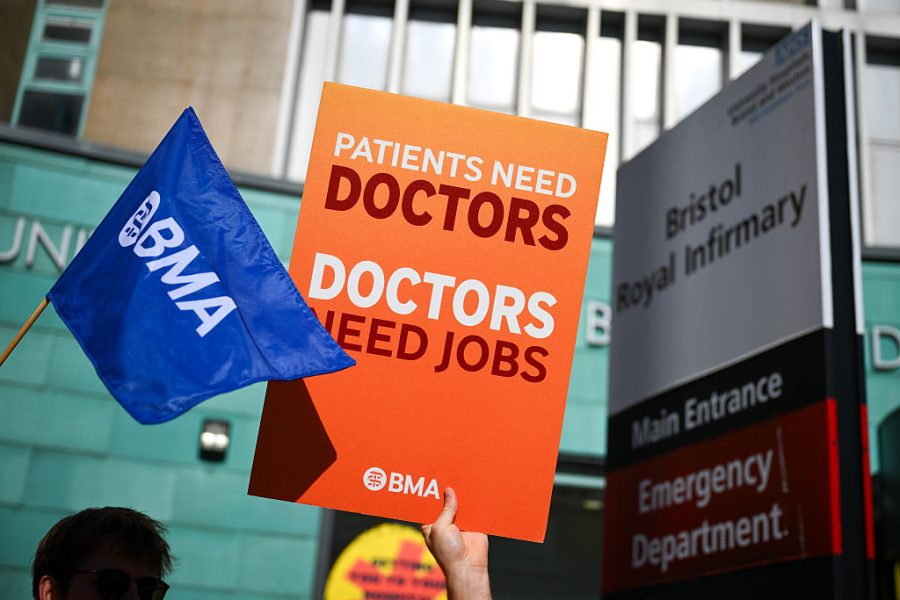
Kemi Badenoch has said she will ban doctors from striking. Yesterday, asked if he would do the same, Health Secretary Wes Streeting refused to rule it out. The police aren’t allowed to strike and nor is the military. Why should doctors be different?
The junior doctors are now on day four of their six-day strike; I have lost track of which number strike this is. Since I’m doing 13-hour days covering for them and have worked through Easter, I’ve also lost track of what day it is and fervently wish the legislation to ban the strikes was already in place. I’m being paid well above my normal rates, and my part of the hospital is running smoothly. I deal only with emergencies, so am one step removed from the costs of cancelled clinics and operations. A hospital where consultants are doing a greater share of the work runs at a distinct advantage – as you’d hope, given how much more we cost.
Streeting has been reasonable about pay; the juniors have not
Whether doctors should be allowed to strike depends largely on which side you distrust more. Historically, that’s been politicians, not medics. At the moment, the public is fed up with both. If you have a medical trade union that strikes only as a last desperate resort, when the situation is appalling, you would be wise to leave them room to act. If they strike at the drop of the hat, it is sensible to ban them. The BMA, once a modestly respectable union, has become a shoddy outfit enamoured of performative radicalism. Even its journal, which once combined lovely thoughtfulness with good science, now prefers to cultivate grievance. To say they have not covered themselves in glory is like saying Starmer has been a mild disappointment.
Doctors play an important role in society, even if there are those who heartily wish they didn’t. Their work cannot easily be mechanised, nor even properly measured. Much of what matters in medicine cannot be enforced by timesheets or checklist targets. Goodwill, whether we like it or not, matters.
Almost all countries ban their police and military from strikes; almost none ban doctors. Singapore does, where wages are triple our own, and Ethiopia, where they are not. Zimbabwe limits industrial action to a maximum period of three days, and in Israel areas with only a single hospital insist on medics signing a no-strike clause. This would be a strange area for Britain to make itself an outlier.
At the moment, most people wouldn’t mind if doctors were banned from striking. The left don’t like doctors because they’re so obviously not working class – they weren’t clapped in China’s Cultural Revolution, they were shot – and the right don’t like them because they’re besotted with the NHS. But the reason they’re striking is that the independent pay-review body, the DDRB, which was set up to mediate with the monopoly employer of the NHS, was undermined over decades. Nobody minded that either. At each step, the degradation of a useful system seemed too small a matter to count. The net result was that the DDRB became a façade and the mechanism by which a monopoly employer kept faith with its employees was destroyed. Nobody minded, but that didn’t make it the right thing to do.
Streeting has been reasonable about pay; the juniors have not. But Streeting has been grudging and half-hearted throughout the strikes about fixing the workforce planning issues that enrage junior doctors. They have seen their training posts go to foreign doctors, predominantly from India and Pakistan and Egypt. The Royal College of Physicians reported that in 2023, for example, more than two-thirds of doctors joining the NHS had qualified abroad. We have always relied on immigrants; never before have we displaced our own to make way for them.
Why did Streeting have to be forced to tackle a problem he should have been eager to solve simply because it was good for the nation and good for the NHS? Even the most charitable explanation leaves him weighing efficiency, fairness, patient experience and the careers of British doctors against the optics of diversity, then choosing the latter.
Much as I am tempted to agree with her, though, I think Badenoch is wrong. An essential profession should be legally prevented from striking only if they are far, far less trustworthy than their monopoly employer. Had Streeting been more reasonable, you could more readily argue that doctors had forfeited their right to strike. They are behaving badly, but our national incompetence gave them the excuse. If the state wants powers as strict as Singapore’s, it must earn them – and doctors, for all their many faults, retain more residual competence than the state that governs them.





Comments