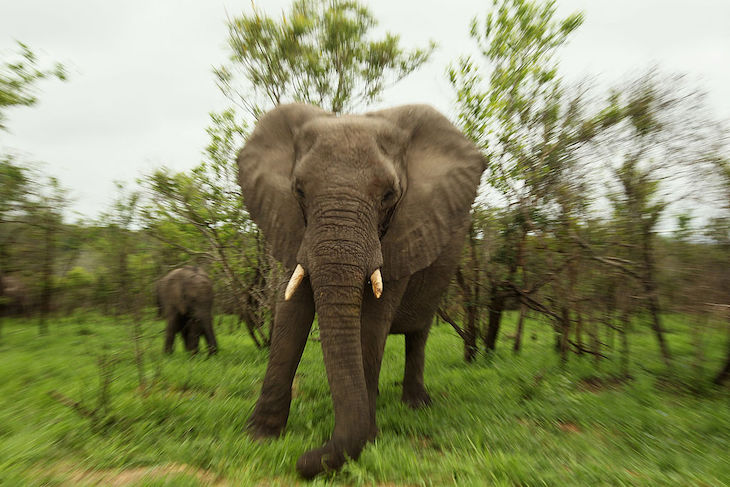
Africa’s elephants are out of control, and the continent’s people, and plants, are paying the price. Far too many elephants, with far too little territory – surrounded by ever more people and with culling hampered by Western animal rights groups and green activists – risk contributing to a wildlife-induced forest ecocide. Millions of mopane, baobab and other trees, are being pushed over, devoured or shredded into bushes. Great national parks are in danger of being transformed into desert-like scrubland.
Elephant numbers have exploded in Kruger over the past century
During a week hiking in what should be forest but now is a degraded bushland near the Olifants River on the edge of South Africa’s Kruger National Park, I saw elephants everywhere. On the first day, we ran into a herd of six elephants in less than an hour. Circling around them we encountered another larger herd tearing the tops off the already denuded trees. Trying to avoid this group, we blundered into three, young elephant bulls.
The largest of the trio caught wind of us and angrily flapped his ears forward. Trumpeting as he advanced in our direction, it was some comfort to be accompanied by two professional hunters armed with rifles. At about 70 meters, the bull broke off his shuffling canter in our direction and headed back to his pals. Wian Espach, one of the guides, laughed: ‘That was typical. It’s always the young bulls who cause the most trouble. A bit like with us people.’
Elephant numbers have exploded in Kruger over the past century. They now number over 31,000 up from ‘just a handful’ in the early 1900s, according to South Africa National Parks website. Kruger Park did not respond to three emails asking if there are plans to reduce elephant numbers.

‘We cannot cull elephants anymore because ‘the public wouldn’t like it’,’ says Ron Thomson, a retired game warden and field ecologist, and a founder of the NGO True Green Alliance. But something needs to be done – and urgently – to address the number of elephants in order to save Kruger’s biological diversity.
How many of the giant pachyderms are too many for the park’s almost five million acres? According to Thomson, the ‘carrying capacity’ for the park – the maximum number of an animal species a habitat can have without causing irreparable damage to the vegetation and eco-system – is just 3,500 (give or take 500) elephants. Some might dispute these exact numbers. But any visitors to Kruger will see for themselves the devastation elephants are causing.
‘Over 95 per cent of the trees here have been torn up and browsed by elephants and some parts of the park are even worse,’ Esbach said. ‘What do you notice? There are no birds or small animals. They need the big trees.’
Big trees are crucial nesting sites for countless African birds, including eagles, vultures and owls. No big trees; no big birds of prey. Giving limitless protection to elephants destroys the habitat for other wildlife.
There’s another ecological problem caused by elephants destroying the tree canopy: less trees mean less leaves and less leaf mass to rot and improve the soil. The whole nutrient cycle is ruined.
Centuries ago, elephants roamed across huge areas and were often kept moving by their only real enemies: human hunters who pursued the animals for meat, hides, ivory or in self-defense. Today, Africa’s human population is over 1.5 billion – up from an estimated 140 million in 1900 – and expected to rise to over three billion by 2070. This means even less space for mega-fauna and far more chance that human-elephant conflicts turn deadly.
Decades of global campaigns have simplistically claimed elephants are threatened across Africa. Not true. Elephants may be struggling in Kenya, which banned hunting in 1977, but their population is stabilising or rising across southern Africa, which tries to use hunting as a management tool.
Emotional campaigns by well-funded animal rights groups make all elephant culling – either by state game wardens or controlled trophy hunting – a political minefield. This has contributed to the current problems: Germany’s Greens have played a big role in European efforts to ban elephant and other trophy hunting. Unable to force African leaders to do their bidding, the Greens instead sought to destroy the economic basis of African big game hunting by Diktat from Berlin.
‘The import of hunting trophies must be completely banned,’ said the German Greens in a 2021 election manifesto. This is what Germans call ‘Wasser predigen und Wein trinken’ (preaching water but drinking wine). Back at home, the Greens are shrill in their demand for massive shooting of Germany’s roe and red deer to reduce populations to protect trees from browsing. The magnitude of woodland damage in Southern Africa would trigger an instant and deadly response if it happened in German forests.
‘No more than ten per cent tree damage is acceptable,’ said Harald Malek, a certified and state-appointed wildlife damage assessor in Saxony-Anhalt state’s Altmark. ‘But 95 per cent damage? That would lead to drastic orders to massively reduce deer numbers by hunting. And there would be huge compensation claims.’
Botswana, which has 130,000 elephants, was so angered over the German Greens’ attempted trophy ban that it suggested sending 20,000 elephants to Germany as a gift. Germans should try living with elephants that trample people to death and destroy crops and damage villages, Botswana’s then president, Mokgweetsi Masisi, told Bild newspaper. ‘This is no joke,’ he said. Botswana has since resumed elephant hunting which it had temporarily banned.
Left on their own, an elephant population can double every ten years
Kruger’s problem is similar to that of Yellowstone National Park in the United States, where wapiti (which the Americans also call elk) were devastating the vegetation. The release of wolves into the park in the 1990s led to a reduction in the elk population from about 20,000 to 8,000. Trees and woody vegetation have since recovered. But elephants are the apex animal in Southern Africa, and their only real historical enemy has been people. Left on their own, an elephant population can double every ten years.
On my last night at the Olifants River lodge, there was a tremendous racket outside at 3 a.m. Half asleep, I thought it was a helicopter. At breakfast, Wian showed a me a film on his mobile phone of an elephant herd rampaging through the grounds. They knocked down one of the last big trees still standing, just 50 meters from where I had been sleeping. ‘Some bull showing who’s the boss here,’ said Wian.
The metropolitan-green brigade and animal rights NGOs will hate it, but if you want to help save Southern Africa’s forests: book a safari and shoot an elephant.






Comments